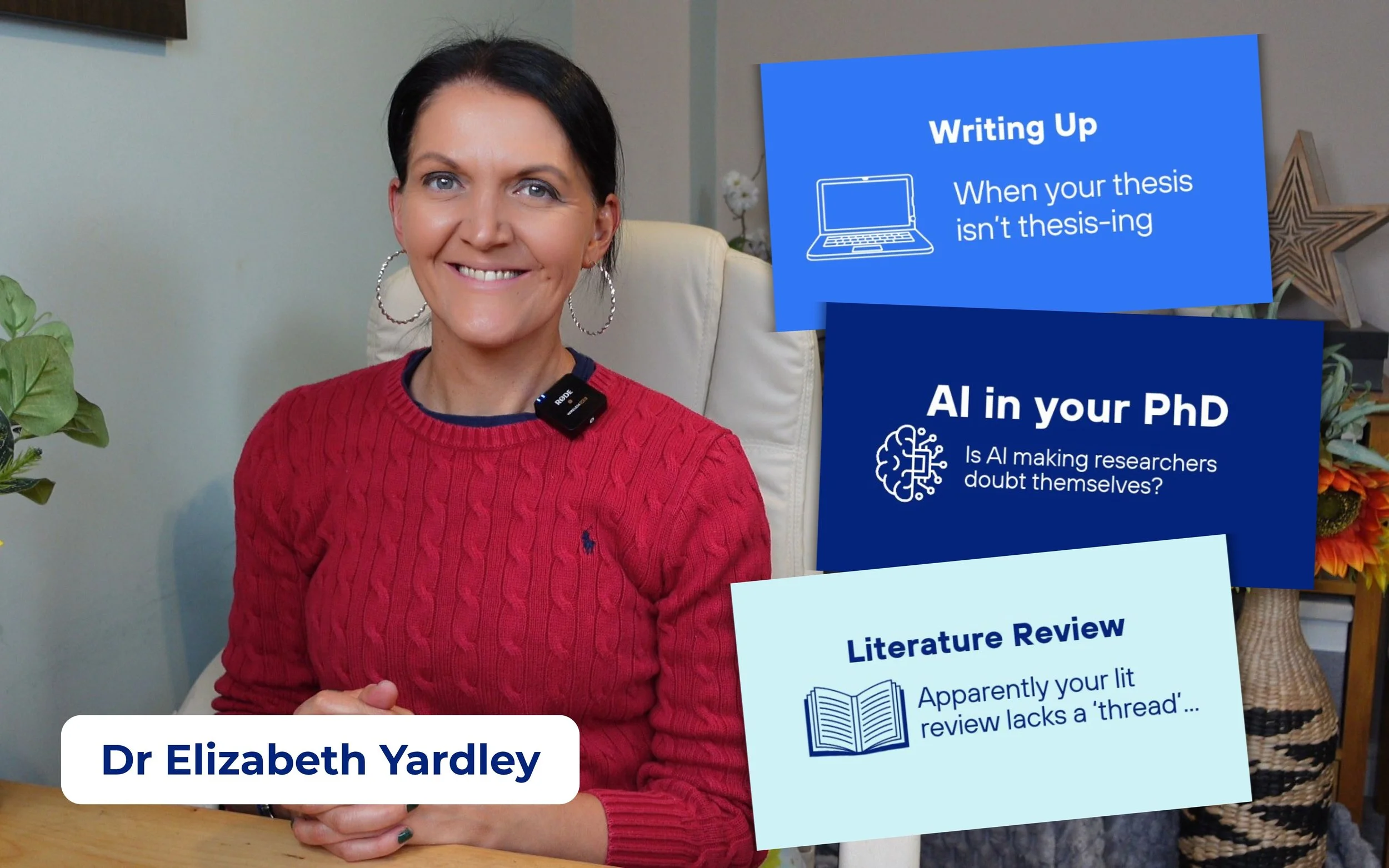
Welcome to my PhD blog
Worried you're doing your PhD all wrong and someone's about to find out? You're in the right place. 😂
In this blog, I cover all the stuff you might need help with. Like writing your literature review, doing your qualitative data analysis, developing your discussion chapter, and trying not to go completely bonkerpants in the process.
I'll help you work out HOW to do all those things everyone keeps telling you to do.
Expect practical PhD advice, based on the unspoken truth that nobody's PhD is nearly as neat as their finished thesis makes it look.
Have a nosey at the latest posts below, or browse by topic to find what you need.
Qualitative Methods | Literature Review | Methodology | Planning and Organisation | Writing Up | Supervision | PhD Mindset | Paradigms, Conceptual and Theoretical Frameworks |
AI and PhD Research | Paid PhD Resources
Featured Posts


Latest Posts

How to write a conference abstract for qualitative research
Writing a conference abstract for your qualitative PhD can feel daunting. This guide shows you how to structure your topic, theory, and contribution with clarity and confidence.

Critical Theory for Beginners: what it is, why it matters, and how to use it in your PhD
What is critical theory, and how can you use it coherently in your qualitative PhD? This guide explains its foundations, its focus on power and inequality, and how to apply it rigorously in your research design.

Semi-Structured Interviews: A beginner’s guide for qualitative PhD research
Clear, practical guide to semi-structured interviews for qualitative PhD research. Learn how to design your interview guide, avoid common mistakes, and build a coherent research method.

How to write up your Braun and Clarke Reflexive Thematic Analysis (without losing your mind)
It’s time to write up your reflexive thematic analysis. This is the sixth and final stage of the Braun and Clarke process, so this should be the easier part, right? All of the difficult things have been done - coding, developing themes, refining themes - now it’s just a case of writing it all up. The finish line is in sight, hurrah! Mmmm…

Conceptual frameworks in qualitative research
Confused about conceptual frameworks in qualitative research? Learn what they are, why they matter for PhDs, and how to build one clearly and confidently.

Postmodernism for beginners - a simple explanation
What is postmodernism? A clear, jargon-free explanation of postmodern theory for PhD students, with practical examples for qualitative research.

Ontology, epistemology, and paradigms - What are they, and how much should you write about them in your PhD thesis?
A clear, practical explanation of ontology, epistemology and paradigms for PhD students, plus exactly where they belong in your thesis and how much you actually need to write.

PhD research paradigms in the social sciences, made simple (for qualitative researchers)
Confused about paradigms in your qualitative PhD? Here’s a clear, practical guide to the main paradigms, how to spot your “leaning”, and how to contrast it with others in your methodology chapter.

Should you apply for an academic job before finishing your PhD?
Seeing academic job adverts before your PhD is finished can trigger a lot of questions. Should you apply now or wait? Here’s how to think through the decision carefully and strategically.

PhD annual review coming up? How to prepare (without the panic)
Worried about your upcoming PhD annual review? Learn how to prepare your progress report, handle panel questions confidently, and turn your review into a useful checkpoint for your research.

Interpretative Phenomenological Analysis in a Qualitative PhD: A beginner’s guide to IPA
Interpretative Phenomenological Analysis (IPA) can sound intimidating, but it’s fundamentally about exploring how people make sense of meaningful experiences. This beginner’s guide explains when to use IPA and how the analysis process works.

Mixed methods research designs for beginners (and when you actually need them)
What is mixed methods research and should you use it in your PhD? This guide explains common mixed methods designs and when combining qualitative and quantitative approaches actually makes sense.

Navigating PhD supervision as a qualitative researcher
Endless revisions are common in qualitative PhDs. Learn why supervisors keep suggesting changes and how to manage the qualitative thesis revision process.

How to write and structure a thematic literature review for your qualitative PhD research
Struggling with a messy literature review? Learn how to structure a qualitative literature review using thematic and narrative approaches.

Method vs methodology in qualitative research - a simple guide for PhD students
What’s the difference between method and methodology in qualitative research? Learn how to explain your research design clearly in your PhD thesis.

Research gaps in qualitative research: why it’s not really about “finding a gap”
Is your PhD supposed to “find a research gap”? In qualitative research the answer is more complicated. Learn how qualitative studies contribute to academic conversations.

Stuck in your qualitative PhD? Why progress often feels invisible (and what to do)
Feeling stuck in your qualitative PhD? Learn why progress in qualitative research often feels invisible and how to move forward.

How to code qualitative data using Braun & Clarke’s Reflexive Thematic Analysis (RTA)
Struggling with coding in Braun and Clarke’s reflexive thematic analysis? Learn how to code qualitative data step-by-step with practical examples.

How to plan your PhD research year without burning out
Learn how to plan your PhD research year with a clear structure that helps qualitative researchers make steady progress without burnout.

How to write an annotated bibliography for a PhD (and turn it into a literature review)
Learn how an annotated bibliography can help qualitative PhD researchers organise sources and transition into writing a thematic or narrative literature review.
I’m guessing you’re here because you’ve chosen to do a qualitative study for your PhD but things have started to feel a bit… slippery. You like how qualitative approaches value people’s lived experiences and you’re researching something you genuinely care about so that’s why you felt drawn to it. However, recently you seem to have unlocked a whole new level of confusing and it’s all gone a bit Alice in Wonderland.