Navigating PhD supervision as a qualitative researcher
If you're doing a qualitative PhD, there is a moment many researchers reach where the revision cycle starts to feel endless.
You send your supervisor a chapter.
They send it back covered in comments.
You make the changes, send it back again… and a new set of comments appears. Some of them are about things that were never mentioned before.
At this point it can feel like the finish line keeps moving.
You might start thinking:
“How am I supposed to finish my PhD if the revisions never stop?”
“Why didn’t they mention this the first time?”
“Will this chapter ever actually be finished?”
If this situation sounds familiar, you're not alone. Qualitative PhD researchers experience this all the time, particularly when working with interpretivist approaches where ideas and interpretations develop gradually.
Understanding why this happens can make the process feel far less chaotic.
Why revision cycles are common in qualitative PhD research
One thing many PhD students don't realise is that supervision is not a one-way process where your supervisor already knows everything about your topic.
In qualitative research, projects evolve as the analysis develops. Your interpretations deepen. The conceptual framing becomes clearer. The argument you are making gradually takes shape.
Your supervisor is learning about your specific research topic alongside you.
They may have deep expertise in qualitative methodology, theory, or your broader field, but your project itself is still unfolding.
As the analysis becomes clearer, new gaps or possibilities become visible. A concept that looked fine in an early draft might suddenly need more explanation once your findings chapter develops further.
This is one of the reasons revision cycles are particularly common in qualitative PhD work.
Interpretation evolves in qualitative analysis
Another reason the revision process can feel endless is that qualitative research is interpretive.
There is rarely a single definitive interpretation of qualitative data.
Instead, meaning develops through reflection, discussion, and revision. As your analysis deepens, your supervisor may suggest new ways of framing an idea or connecting your findings to theory.
This does not mean your earlier interpretation was wrong.
It means your thinking is evolving.
In interpretivist research, the goal is not to uncover one fixed answer hidden inside the data. The goal is to develop a well-reasoned interpretation grounded in your qualitative data, theory, and research question.
That process takes time.
Draft feedback and revision cycles are part of how qualitative research arguments become clearer.
Your qualitative PhD supervisor is not the final authority
Many doctoral researchers assume their supervisor has the definitive answer to every question about the thesis.
In reality, this is rarely the case.
Your supervisor brings experience, methodological expertise, and an external perspective. But they are not the only interpreter of your data.
You are the person who has spent months immersed in your interviews, fieldnotes, transcripts, or documents.
You know the dataset more intimately than anyone else.
In qualitative PhD research, supervision works best when it becomes a conversation between two scholars rather than a situation where one person simply corrects the other.
Over time, you develop independence as a researcher. Part of that involves explaining your interpretations clearly and occasionally discussing alternative perspectives.
That is not conflict. It is academic dialogue.
How to manage qualitative PhD revision cycles
Revision loops are normal in qualitative research, but there are ways to make them feel more manageable.
Clarify which revisions matter most
Not all feedback needs immediate attention.
Some comments address major conceptual issues. Others are stylistic or editorial changes that can wait until later drafts.
When you receive a large set of comments, it can help to ask your supervisor which revisions are the highest priority.
This allows you to focus on structural improvements rather than endlessly polishing sections that may change again.
Track revisions systematically
A simple revision tracker can make the process feel far more manageable.
Create a document listing:
• the feedback point
• the action you took
• where the change appears in the chapter
This helps you see how your qualitative analysis and argument are evolving.
It also prevents the same issues from resurfacing repeatedly.
Ask for clarification when needed
Sometimes feedback can feel vague or difficult to implement.
If you are unsure how to apply a suggestion, ask.
For example:
"Could we talk through what this revision might look like in practice?"
"I understand the point you're making here, but I'm not sure how best to integrate it into this section."
These conversations often save hours of unnecessary rewriting.
Recognise when interpretations differ
In qualitative research, it is possible for two scholars to interpret the same data slightly differently.
That is not necessarily a problem.
What matters is whether the interpretation is well supported by the qualitative data and clearly argued.
Discussing different interpretations can actually strengthen the final thesis.
The revision stage often feels endless in qualitative PhDs
One of the hardest parts of the qualitative PhD journey is that revision cycles rarely feel finished.
You may find yourself wondering:
"Will there ever be a point where my supervisor says this chapter is done?"
Academic writing rarely feels completely finished. Even published journal articles go through multiple rounds of revision.
The goal of a PhD thesis is not perfection.
The goal is a clear, coherent qualitative research project that contributes new understanding.
Revision is the process that gets you there.
If qualitative PhD writing feels stuck
Sometimes the real challenge is not the feedback itself but translating feedback into clear progress.
Many qualitative PhD students find themselves rewriting sections repeatedly because they are unsure how the pieces of the thesis fit together.
This is exactly the point where structure becomes incredibly helpful.
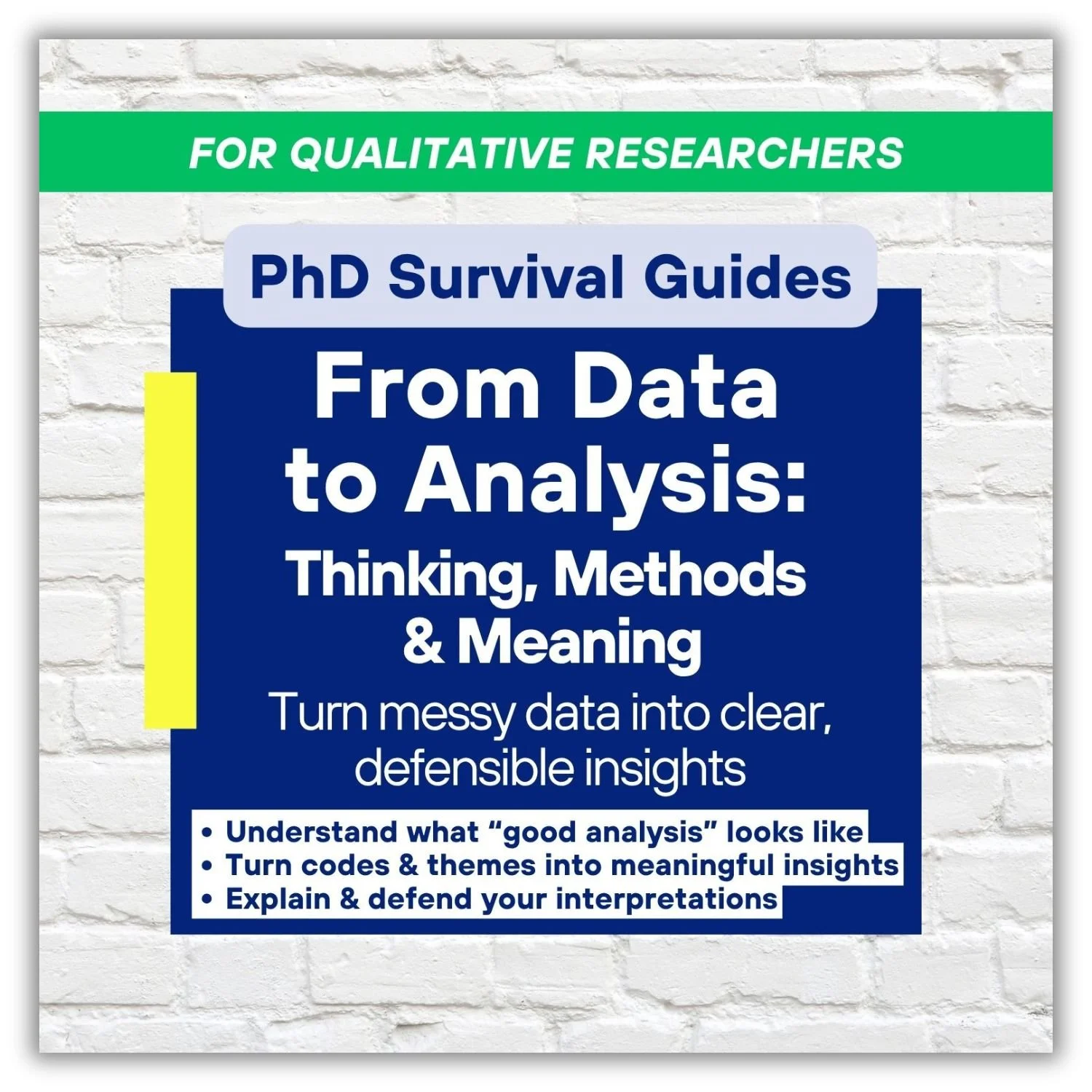
If you want a clearer way to think through qualitative methodology, data collection, and analysis decisions, my Data to Analysis PhD Survival Guide walks through the key decisions qualitative researchers need to make and how to explain them clearly in the thesis.