Postmodern theory. Postmodernism.
If you’re a PhD student in the social sciences or business and you’ve come across the term and thought, What on earth does this actually mean? - you are not alone.
Postmodernism has a reputation for being abstract, jargon-heavy, and slightly intimidating. But beneath the terminology is something far more practical: a way of questioning certainty, power, identity, and the stories we take for granted.
Before we go further, a quick clarification.
Postmodernism refers to a broader cultural and intellectual shift - a move away from confidence in universal truths and neat progress narratives.
Postmodern theory is how scholars make sense of that shift. It gives you conceptual tools to analyse identity, media, discourse, power, organisations, and consumer culture.
In this post, we’ll focus mainly on postmodern theory - because if you’re reading this, you probably want to know how it applies to your research.
What is postmodernism, really?
At its simplest, postmodernism challenges the idea that there is one single, stable truth.
Instead, it suggests that:
Knowledge is shaped by perspective
Reality is interpreted rather than discovered
Meaning is constructed through language, culture, and power
If modernism believed that careful reasoning and science would eventually produce certainty, postmodernism asks:
Who defines certainty?
Whose version of truth becomes dominant?
Who gets excluded from the story?
Think of modernism as believing the jigsaw puzzle has one correct picture.
Postmodernism wonders whether the box lid was ever accurate - and whether some pieces belong to entirely different puzzles.
Where did postmodernism come from?
Theoretical movements do not appear in isolation. They emerge from historical conditions.
Postmodernism gained prominence in the mid-to-late 20th century, shaped by:
The aftermath of World War II
The Cold War
Rapid technological change
The expansion of global capitalism
The rise of mass media
Grand promises - that science would fix everything, that progress was inevitable, that capitalism guaranteed freedom - began to feel unstable.
Postmodern thinkers responded by questioning what Jean-François Lyotard famously called “grand narratives.”
Core ideas of postmodern theory
Let’s unpack the key concepts you’re most likely to encounter.
1. Relativism: many truths, not one
Postmodernism suggests that truth is perspective-dependent.
If you interview five people about remote work, you may get five conflicting accounts. Postmodernism does not try to collapse those into one average truth. It treats multiplicity as meaningful.
For qualitative researchers, this is powerful.
It validates complexity.
2. The social construction of reality
Postmodern theory argues that what we treat as “natural” or “given” is often socially constructed.
Money, leadership, professionalism, gender roles, success - these are not neutral categories. They are shaped by shared meanings.
In research, this pushes you to ask:
How is this concept constructed?
Who benefits from this construction?
What alternative meanings exist?
3. Rejection of grand narratives
Postmodernism is sceptical of sweeping explanations like:
“Economic growth benefits everyone.”
“Meritocracy rewards hard work.”
“Science is neutral.”
Instead, it focuses on micro-narratives - local, situated stories.
This makes it particularly compatible with qualitative methodologies that privilege lived experience.
4. Hyperreality
Jean Baudrillard’s concept of hyperreality suggests that mediated representations can feel more real than lived experience.
Think of social media travel influencers. The curated feed becomes more vivid and persuasive than the actual trip.
In organisational research, marketing, and consumer culture, hyperreality helps analyse how image, performance, and identity blur.
5. Playfulness and irony
Postmodernism often disrupts seriousness.
Self-aware advertising. Irony. Parody. Blurred boundaries between authenticity and performance.
It invites you to question stability - even in the categories you are studying.
Why does postmodernism matter for your PhD?
You might be thinking: interesting… but how does this help my research?
Postmodern theory:
Encourages you to interrogate taken-for-granted assumptions
Equips you to analyse identity and power
Helps you work comfortably with contradiction
Validates complexity in qualitative data
Makes space for marginalised or silenced voices
If you are working with discourse, identity, media, organisational culture, or consumer narratives, postmodernism offers a strong interpretive lens.
It also often underpins methodological choices such as narrative analysis, discourse analysis, or certain forms of reflexive qualitative research.
What would a postmodern researcher actually ask?
Let’s make this concrete.
Consumer culture
Rather than asking, “Why do consumers prefer Brand X?” a postmodern researcher might ask:
What identity is Brand X selling?
How does it construct meaning?
How do consumers perform identity through consumption?
Organisational culture
If an organisation says “We are a family,” a postmodern lens asks:
Who defines this family?
Who feels excluded?
Does this language obscure power dynamics?
Social media influencers
Instead of asking whether influencers are authentic, postmodernism explores:
How authenticity is performed.
How image becomes more powerful than reality.
How followers co-construct identity.
Common criticisms (and how to think about them)
Postmodernism is often criticised for being vague or pessimistic.
“It’s too abstract.” It can be - unless you treat it as a lens for asking sharper questions.
“It leads to ‘anything goes.’” Recognising multiple truths does not eliminate evaluation. It shifts evaluation from certainty to critical reflection.
“It’s too negative.” Deconstructing dominant narratives can feel destabilising. But it also opens intellectual space.
How to use postmodernism in your research
If you are drawing on postmodern perspectives in your PhD:
Be explicit about your epistemology.
Explain how it shapes your research design.
Acknowledge your interpretive role as researcher.
Avoid claiming universal truth.
Highlight multiplicity rather than resolution.
If you are unsure how paradigms, theory, and conceptual positioning connect, that is often where doctoral confusion begins.
This is exactly why strengthening your conceptual foundations makes everything else easier - from literature review to methodology to analysis.
Embracing complexity (without losing rigour)
Postmodernism does not remove structure.
It changes what counts as rigour.
Rigour becomes:
Transparency about interpretation.
Critical engagement with power and discourse.
Clarity about epistemological positioning.
If you take one thing from this post, let it be this:
Postmodernism is not about chaos. It is about questioning certainty.
And for qualitative researchers especially, that is not a weakness - it is a strength.
Where to go next
If this post has clarified postmodernism for you, you might also want to explore:
Conceptual frameworks in qualitative research
The difference between conceptual and theoretical frameworks
Reflexivity in qualitative research
These are not separate conversations. They connect.
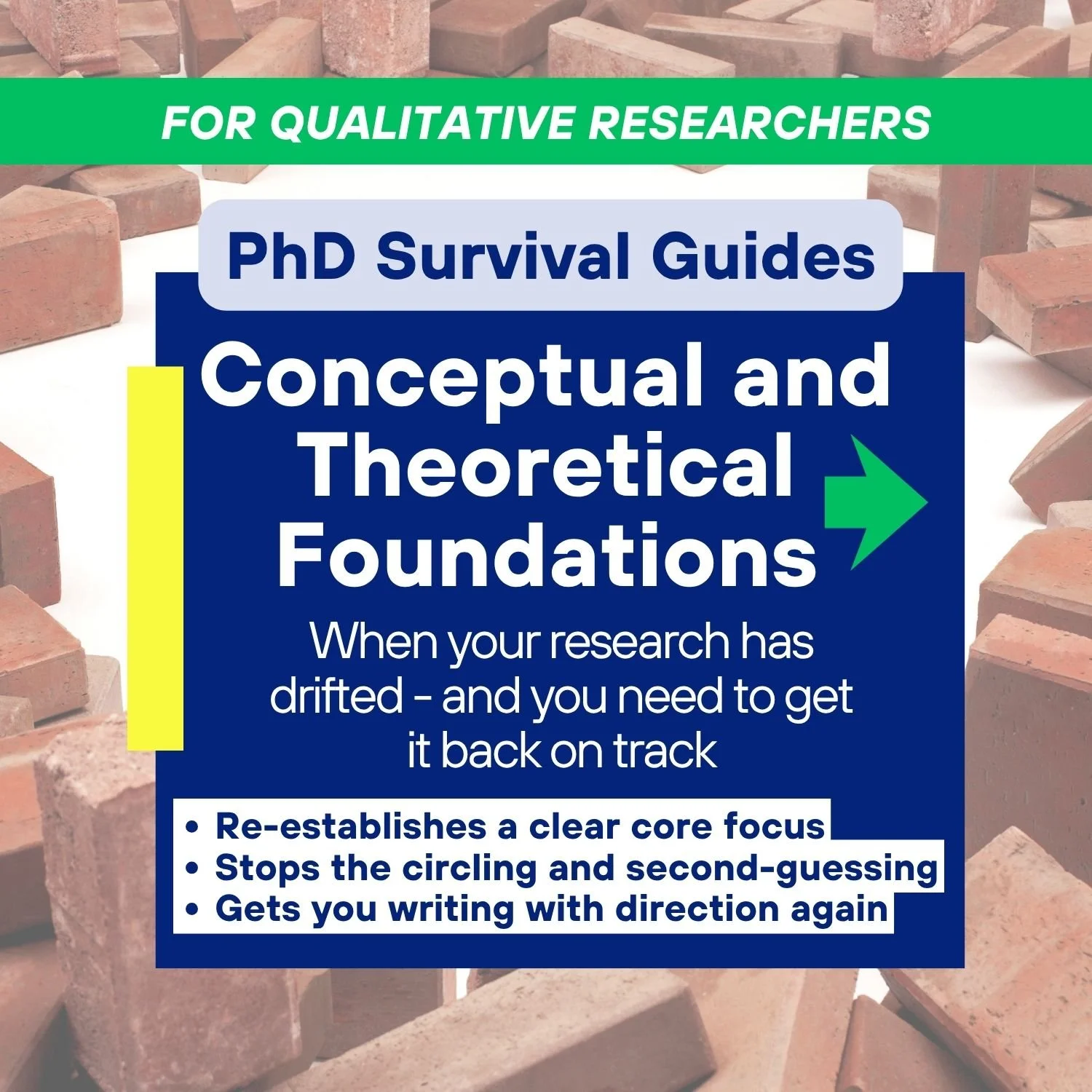
And if you would like structured guidance strengthening your paradigmatic and theoretical positioning - without drowning in jargon - my Conceptual and Theoretical Foundations PhD Survival Guide walks you through this step by step.
It is designed for researchers who want clarity, not buzzwords.
You can explore it here if you’re ready to deepen this properly.
Or, if you prefer thoughtful, grounded guidance in your inbox as you navigate doctoral theory, you are welcome to join my email community.
Theory does not have to feel intimidating.
It just needs unpacking carefully.
“My research feels slippery, I’m not sure what it is anymore.”
If your research is moving, but something underneath it doesn’t fully make sense yet, this guide will help you get it back on solid ground. If you’ve started to freeze when someone asks what your PhD is about, this guide will help you get clear on it.
Swipe through the images to see exactly what’s inside.
Get the full Survival Guide set here.
Got questions? Contact me using this form, I’ll be happy to help.
By purchasing this product, you agree to our Terms & Conditions.