A conceptual framework is the collection of ideas that shapes how you understand your research.
It helps explain what concepts matter, why they matter, how they connect, and how they guide your interpretation of your data.
Most qualitative researchers already have a conceptual framework. Yes, that includes you - there will be some semblance of one already there.
The thing you might be struggling with is explaining it.
If you've ever had someone ask, "So... what's your conceptual framework?", and immediately wondered whether you'd somehow forgotten an entire stage of the PhD, you’re in the right place.
Which reminds me...
I have a recurring dream - although nightmare is probably more accurate - where I’m back at college and everyone around me is walking into a maths exam.
I ask one of my friends what’s going on.
They look at me as if I’m being ridiculous and say, “The maths exam, obviously. It would have helped if you’d actually come to the classes.”
Then comes that horrible sinking feeling.
I realise I have somehow forgotten an entire course. Not missed one lecture or fallen slightly behind. Completely forgotten. Everyone else seems prepared, everyone else knows what is happening, and I am standing there with no idea what I’m supposed to know.
For a lot of qualitative PhD researchers, the phrase “conceptual framework” creates a similar feeling.
It often appears suddenly - in supervision, in an annual review, in feedback from someone outside your immediate project, in a passing comment that lands much more heavily than the person probably intended.
Wait… was I supposed to have one of those already?
So… do you need a conceptual framework?
In short: yes - but probably not in the way you’re imagining.
Qualitative research absolutely involves conceptual frameworks.
They are essential - because you are working with meaning, interpretation, and explanation, rather than measurement.
However - here’s the important part: You don’t start from nothing. You are already working with a conceptual framework.
The question isn’t: Do I have one? It’s: Can I explain it clearly?
In the twenty years I’ve spent supporting qualitative researchers, I’ve rarely met anyone who had no conceptual framework at all. What I see far more often is someone who is already thinking with concepts, already making choices about what matters, already drawing on ideas from the literature, but has not yet found a clear way to explain that thinking. The problem is usually about articulation.
You may already know that belonging, identity, emotional labour, stigma, power, trust, care, resilience, or professional culture matters in your study. What feels harder is explaining how those ideas fit together, why these concepts are the right ones, and how they shape the way you interpret your data.
That is the real work of a conceptual framework.
Psst… Do all the different parts of your PhD feel a bit disconnected?
You might have several separate pieces of the thesis jigsaw puzzle all sorted out, but slotting them all together without it sounding weird has got you in a write-delete-write-delete spiral. You might even have a sense of deja-vu because the same paragraph keeps appearing in different chapters of your thesis, and you’re like, “Hang on, haven't I already said this somewhere?”.
That's exactly what we tackle in Clarifying Your Research, my PhD Survival Guide about making sense of the foundations of your study - because when those foundations are clearer, the different parts of your thesis become easier to connect and explain.
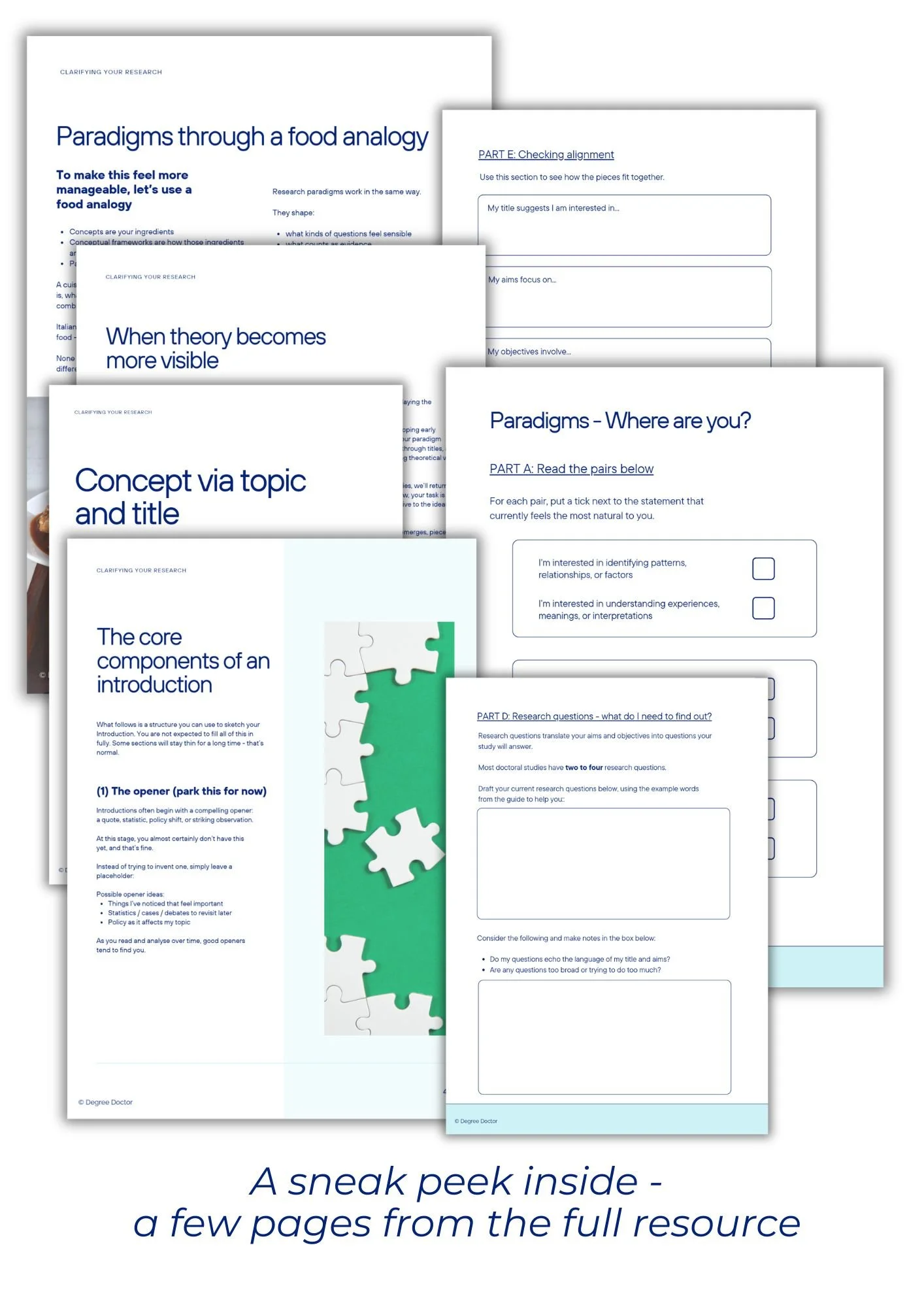
Take a look inside
A selection of some of the sections and worksheets from the guide.
There are seven main parts, worksheets and examples throughout to help you map out all of these elements of your own study, rather than just reading about them.
What is a conceptual framework in qualitative research?
A conceptual framework is the set of ideas that shapes how you understand your research.
Not just what you’re studying, but how you’re making sense of it.
It’s not just a diagram. It’s the thinking that sits underneath your decisions.
In qualitative research, this usually draws on these things:
your broader philosophical stance or paradigm
relevant ideas from the literature
key concepts that help explain your topic
your research questions
A useful way to think about it is this:
Your methodology explains how you generate knowledge.
Your conceptual framework helps explain how you make sense of it.
Isn’t qualitative research supposed to be open and flexible?
A conceptual framework doesn’t restrict your analysis, it stops it from drifting. Without it, you can end up with rich, interesting data and thoughtful insights - but difficulty explaining why your interpretations matter, or why you focused on certain patterns and not others, or how your findings connect to wider conversations in your field.
A conceptual framework gives you something to stand on while you do that work.
It brings alignment between your research questions and analysis, a firm grounding for your interpretations, and clarity about how your work contributes.
How do you actually build one?
1. Start with your research questions
Your framework begins with what you’re trying to understand.
For example:
How do international students experience belonging in UK universities?
How do early-career nurses navigate emotional labour?
How do remote workers interpret work–life boundaries?
These questions already point you towards certain concepts.
2. Look for ideas that actually help you think
This is about finding concepts that genuinely help you make sense of your topic.
For example, a study on belonging might draw on:
identity
group culture
rituals of belonging
initiation
3. Be selective (this is where people often overdo it)
A strong conceptual framework is not everything you’ve ever read or every idea you’ve ever had. It’s a small number of ideas doing real work.
This is often where I see PhD researchers hesitate. They worry about leaving things out, or not being “academic enough.” So they include more, and end up with something that’s harder to use, not easier.
Instead, ask:
Does this concept actually help me interpret my data?
Does it fit with how I’m thinking about my research?
Will it guide my analysis - or just sit there?
4. Show how things connect
Now it's time to show how your ideas work together.
For example:
This study draws on concepts of identity and group culture to explore how students come to see themselves as belonging within university spaces. Rituals of belonging and informal initiation practices are used to examine how inclusion is signalled, negotiated, and sometimes withheld in everyday interactions.
Now we can see the logic.
5. Explain why you’ve made these choices
This is the part that often gets rushed - or assumed.
But it matters - you’re not just showing what you’re using, you’re showing that you’ve thought about it.
For example:
Concepts of identity and group culture help explain how belonging is experienced and recognised within peer groups, while rituals and initiation practices draw attention to the often subtle, taken-for-granted ways inclusion is performed and reinforced.
This is where your framework becomes yours.
What does a conceptual framework actually look like?
There’s no single format. It might be a diagram, a table, a written explanation, or a combination of these.
What matters is not the format. It’s whether your reader can understand what concepts are shaping your study, how they relate, and why they’re there.
Why this matters more than it might seem
When the conceptual foundations of your study feel unclear, that uncertainty rarely stays contained in one place. It tends to ripple through the rest of the thesis.
Your literature review can become more descriptive than analytical because the ideas organising it are still a little hazy. Your methodology may feel disconnected from the wider project, as though it sits alongside the research rather than growing naturally from it. Your analysis might make perfect sense in your own mind, yet feel harder to justify clearly on the page. By the time you reach the discussion chapter, articulating your contribution can feel more difficult than it should.
As your conceptual framework becomes clearer, those difficulties often begin to ease. The different parts of the thesis start to relate to one another more naturally, and the overall argument becomes easier to explain and defend.
Want more help with conceptual and theoretical frameworks?
▶️ WATCH: See conceptual and theoretical frameworks in action
Still trying to get your head around the difference between conceptual and theoretical frameworks? Watch my YouTube video where I explain both - with examples to help you see what they can actually look like.
→ Watch the conceptual and theoretical frameworks video
📥 DOWNLOAD: Get ontology and epistemology straight
If words like ontology and epistemology are adding another layer of confusion, grab my free cheat sheet. It explains what they mean, without the jargon.
→ Get the free ontology and epistemology cheat sheet
🧑💻 GO DEEPER: Get the foundations of your PhD to click
If the bigger problem is working out how your research questions, concepts, theory, paradigm and methodology all fit together, Clarifying Your Research helps you with that - you’ll write your own concepts and ideas into the guide’s worksheets so you can actually get this work DONE rather than disappearing into another scroll hole and just reading about it. 😉