Many PhD students encounter the term mixed methods research and immediately wonder whether they should be combining qualitative and quantitative approaches in their study.
You might be asking questions like:
Should I collect interviews and surveys?
Should I analyse qualitative data before or after quantitative data?
Do I need both to produce a strong PhD?
These are very common questions.
Mixed methods research can be valuable in some projects, but it is also frequently misunderstood and sometimes unnecessarily complicated, particularly for doctoral researchers.
In this blogpost, we’ll walk through:
What mixed methods research actually is
The main mixed methods research designs
How qualitative and quantitative data can be integrated
When mixed methods is useful - and when a qualitative approach alone may be stronger
What is mixed methods research?
Mixed methods research combines quantitative and qualitative approaches within the same study.
In simple terms:
Quantitative research focuses on numbers, measurement, and statistical patterns.
Qualitative research focuses on experiences, meanings, and interpretations.
Mixed methods attempts to bring these two approaches together in order to produce a broader and deeper understanding of a research question.
For example, a researcher studying student satisfaction with online learning might:
Distribute a survey measuring satisfaction scores (quantitative data), and
Conduct interviews exploring students’ experiences (qualitative data).
The survey might show how many students feel satisfied, while interviews help explain why they feel that way.
This combination of numerical patterns and lived experience is often presented as the main strength of mixed methods research.
When can mixed methods research be useful?
Mixed methods research tends to work well when a research question requires both breadth and depth.
For example:
A public health study may measure how common a behaviour is using surveys, then explore people’s motivations through interviews.
An education study might analyse test results quantitatively while also examining students’ experiences qualitatively.
An organisational study might analyse employee survey data and then follow up with interviews to explore workplace culture.
In these situations, combining different types of evidence can help researchers develop a more complete understanding of the phenomenon they are studying.
But do you actually need mixed methods in a PhD?
This is where many doctoral researchers get stuck.
Mixed methods can sound appealing because it appears to offer the “best of both worlds.” However, it also introduces significant complexity.
A mixed methods PhD requires you to design, justify, and execute:
A quantitative research component
A qualitative research component
A clear strategy for integrating the two datasets
This means you effectively need methodological competence in two different research traditions.
For many doctoral projects - particularly in the social sciences - a well-designed qualitative study alone is more than sufficient to answer the research question.
Qualitative approaches such as Reflexive Thematic Analysis, Interpretative Phenomenological Analysis (IPA), narrative analysis, and ethnography are specifically designed to produce deep, conceptually rich insights without requiring quantitative data.
So before committing to mixed methods, it’s worth asking:
Does my research question genuinely require both types of data?
If the answer is no, a focused qualitative design is often the stronger and more manageable option.
Types of mixed methods research designs
If you do decide to use mixed methods, the next question becomes how to structure the study.
There are several common mixed methods designs. The most widely used are:
Convergent design
Explanatory sequential design
Exploratory sequential design
Each design differs in when and how the qualitative and quantitative phases occur.
Convergent design
In a convergent design, qualitative and quantitative data are collected at roughly the same time, analysed separately, and then brought together.
The aim is to compare or combine the findings to build a fuller picture.
For example, a researcher studying workplace wellbeing might:
Distribute a survey measuring stress levels across a workforce
Conduct interviews with employees about their experiences
After analysing each dataset separately, the researcher then examines how the numerical patterns and personal accounts relate to each other.
Do the interview findings explain the survey results?
Do the two datasets contradict each other?
Do they highlight different dimensions of the same issue?
The process of bringing the two strands together is called integration.
Explanatory sequential design
In an explanatory sequential design, the study begins with quantitative research.
After analysing the numerical data, the researcher then conducts qualitative research to explain or explore the results in more depth.
For example, imagine a survey finds that employees report high job satisfaction overall, but a particular department scores much lower.
The researcher might then conduct interviews with staff in that department to explore why those differences exist.
In this design, the quantitative results shape the qualitative phase.
Exploratory sequential design
In an exploratory sequential design, the order is reversed.
The study begins with qualitative research, which is used to explore a topic and generate insights.
Those insights are then used to develop a quantitative phase, often in the form of a survey or measurement tool.
For example:
A researcher might first interview participants to explore how people experience workplace burnout.
Based on those interviews, they might then develop a survey designed to measure burnout patterns across a larger population.
Here, the qualitative phase informs the quantitative phase.
The importance of integration
One of the defining features of mixed methods research is integration.
Simply collecting both qualitative and quantitative data does not automatically make a study mixed methods.
The researcher must demonstrate how the two datasets relate to each other.
Integration might involve:
Comparing findings across datasets
Using one dataset to explain another
Developing tools or measures based on qualitative insights
Bringing both strands together in the discussion
Without this integration, the study risks becoming two parallel projects rather than a coherent research design.
Mixed methods vs qualitative research
It’s important to recognise that mixed methods and qualitative research serve different purposes.
Mixed methods prioritises combining breadth and depth.
Qualitative research prioritises deep interpretation of meaning, experience, and context.
For many PhD projects - particularly those exploring identity, experience, sense-making, or social processes - qualitative research alone can sometimes be entirely appropriate.
In fact, adding a quantitative component can sometimes dilute the depth of the qualitative work, particularly when time and resources are limited.
Choosing the right approach for your research
Ultimately, the choice between qualitative, quantitative, or mixed methods research should be driven by your research aims.
Ask yourself:
What kind of knowledge am I trying to produce?
What type of data will help answer my research questions?
Do I genuinely need both numerical patterns and experiential insight?
If your project is primarily about understanding meaning, interpretation, and lived experience, qualitative methods are often the most suitable approach.
If you’re designing a qualitative methodology
Many PhD students struggle not with collecting data, but with explaining and justifying their methodological decisions clearly.
If you’re currently designing your methodology chapter, my Methodology, Data Collection & Analysis PhD Survival Guide provides structured guidance on:
Choosing appropriate qualitative methods
Explaining your methodological reasoning
Designing data collection strategies
Making your analysis process clear in your thesis
It’s designed specifically for qualitative PhD researchers who want to make their methodological reasoning visible without overcomplicating things.
You can explore the guide here.
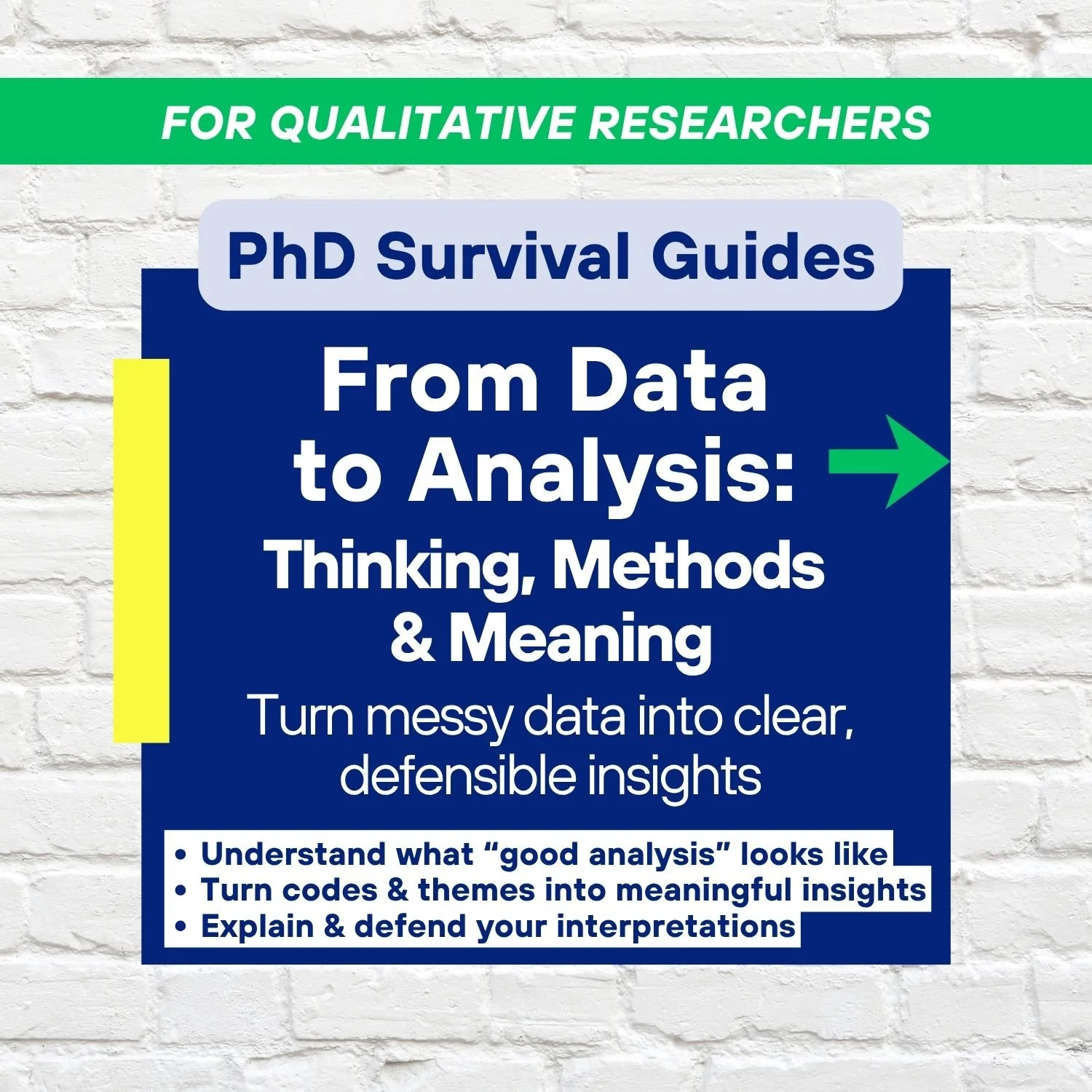
“I can describe what I did. I just don’t know if I trust my own judgement.”
This is the point in the PhD where your research starts demanding something different: interpretation, judgement, coherence, and confidence in your reasoning. This guide was written for that stage.
Swipe through the images above to see what’s inside.
Get the full Survival Guide set here.
If you have any questions, feel free to contact me. I’ll be happy to help.
By purchasing this product, you agree to our Terms & Conditions.