Interpretative Phenomenological Analysis (IPA) often intimidates PhD researchers the first time they encounter it.
The name is long, the explanations are often philosophical, and many students are left wondering: What does IPA actually involve in practice?
In practice, IPA is much simpler than it sounds. It’s a qualitative approach designed for one core job: exploring how people make sense of important experiences in their lives. If your PhD is concerned with meaning, identity, transition, disruption, or sense-making, IPA may be a good fit.
This post explains what IPA is, what kinds of research questions it suits, and what the analysis process is actually asking you to do.
What IPA is, in plain terms
At its heart, IPA is about experience and meaning.
You are trying to understand how a participant experiences something and how they interpret that experience. You are not only interested in what happened, but what it meant to them, how they understood it at the time, and how they make sense of it now.
IPA is usually rooted in two traditions:
Phenomenology: attention to lived experience.
Hermeneutics: interpretation and sense-making.
In a qualitative PhD, the practical takeaway is this: IPA assumes there is no “pure” access to experience without interpretation.
Participants interpret their world, and you interpret their account. That’s not a problem to solve - it’s the point.
A helpful way to think about it is: you are making sense of how someone else is making sense.
Why qualitative PhD researchers choose IPA
IPA tends to work best when your research focuses on an experience that is:
significant (not necessarily dramatic, but meaningful)
personally and socially situated
best understood through depth rather than breadth
It’s often used for topics like living with chronic illness, navigating identity shifts, adapting to major change, experiencing stigma, or making sense of a diagnosis. But it can also fit organisational, educational, and professional contexts, especially when the focus is on how people interpret and live through something.
The reason IPA fits many qualitative PhDs is that it supports careful, bounded claims. You are not trying to generalise statistically. You are trying to offer a deep understanding of how a particular group makes sense of a phenomenon, and what that reveals conceptually.
What makes IPA distinctive
IPA is idiographic (case-focused)
IPA is not primarily about collecting lots of accounts and immediately looking for common themes.
You begin with depth. You treat each participant as a case worth understanding in its own right before you look for patterns across participants.
This is why IPA samples are usually small. The work is intensive because the analysis is intensive.
IPA is interpretative (not just descriptive)
IPA is sometimes misrepresented as “capturing lived experience”. That can make it sound as if you are simply recording what people say.
In reality, IPA requires you to interpret meaning. You pay attention to language, metaphors, emotional tone, contradictions, hesitations, and the way a participant constructs the story of what happened.
If someone says, “Crossing that finish line felt like being reborn,” IPA invites you to ask: reborn from what? Into what? What kind of identity shift is being claimed here? What makes that metaphor necessary?
IPA stays close to experience, but recognises context
IPA is deeply interested in subjective experience, but it does not treat people as floating minds detached from the world.
Experiences are shaped by context: culture, institutions, relationships, history, and social expectations. In a qualitative PhD, that means you can interpret experience without pretending it is purely individual.
What an IPA research question looks like
IPA research questions tend to be open and meaning-focused. They are usually not “does X cause Y?” questions.
Instead, they ask what an experience is like, and how people make sense of it.
Examples:
How do first-generation PhD researchers make sense of belonging in academic spaces?
What is the experience of receiving a late diagnosis of ADHD in adulthood?
How do nurses make sense of moral distress in understaffed wards?
What is it like to return to work after bereavement?
If your question is fundamentally about sense-making, IPA is worth considering.
How to conduct an IPA study (a practical overview)
Step 1: Define a clear phenomenon of interest
IPA works best when you have a fairly focused phenomenon, rather than a very broad topic. “Anxiety” is broad. “Feedback anxiety during performance review supervision” is more focused.
Step 2: Recruit a small, fairly homogeneous sample
Homogeneous doesn’t mean identical. It means participants share a meaningful relation to the phenomenon. You want enough shared ground that you are exploring variations of a comparable experience.
Typical IPA studies might involve around 6–10 participants, sometimes fewer, depending on your project and depth.
Step 3: Collect rich, first-person accounts
Semi-structured interviews are common because they support depth and participant-led meaning. Diaries, written reflections, or other narrative materials can also work if they give you access to how someone makes sense of their experience.
Step 4: Analyse case by case, then look across cases
IPA analysis is iterative. It takes time because it relies on immersion and judgement, not quick coding.
A typical flow looks like this:
You read and re-read the transcript until you are genuinely familiar with it.
You make exploratory notes, noticing what stands out in content, language, and emotional tone.
You develop emergent themes for that single case, capturing something important about meaning.
You connect themes, noticing how they relate and what story they tell about that participant’s sense-making.
Only then do you move to the next case.
After you have analysed cases individually, you look across them for patterns and differences.
A key reminder: IPA is not just “what are the themes?” It is “what do these themes show about how people understand this experience?”
A brief example of IPA-style interpretation
Imagine a participant describing an ADHD diagnosis in adulthood:
“The diagnosis was the missing piece of the puzzle. Everything made sense afterwards.”
At the surface level, there’s relief and clarity. But IPA invites you to interpret what this reorganisation of meaning is doing.
“Missing piece” suggests a previous sense of incoherence, and a new narrative that makes earlier struggles intelligible. It may also signal an identity shift: the participant moves from self-blame to explanation, or from confusion to belonging. It raises questions about how diagnosis changes how the person reads their past, and how it affects their future expectations.
That’s the level IPA works at. It stays close to the participant’s words, but it asks what those words are achieving in the story they are telling.
Tips that make IPA more manageable
Be explicit about reflexivity. Your interpretations are shaped by your assumptions, training, and positioning. That doesn’t disqualify your work. It strengthens it when handled transparently.
Stay close to the data. Interpret, but don’t drift into abstract theorising that isn’t grounded in the account. Use quotes as anchors.
Expect it to take time. IPA is slow because it values depth. Build that into your planning.
If you want a more structured, step-by-step way to plan your qualitative methodology and analysis decisions (including how to explain them clearly in the thesis), the Methodology, Data Collection & Analysis Guide may be helpful . It’s designed to help you make your reasoning visible, without overcomplicating or forcing philosophical certainty.
“I can describe what I did. I just don’t know if I trust my own judgement.”
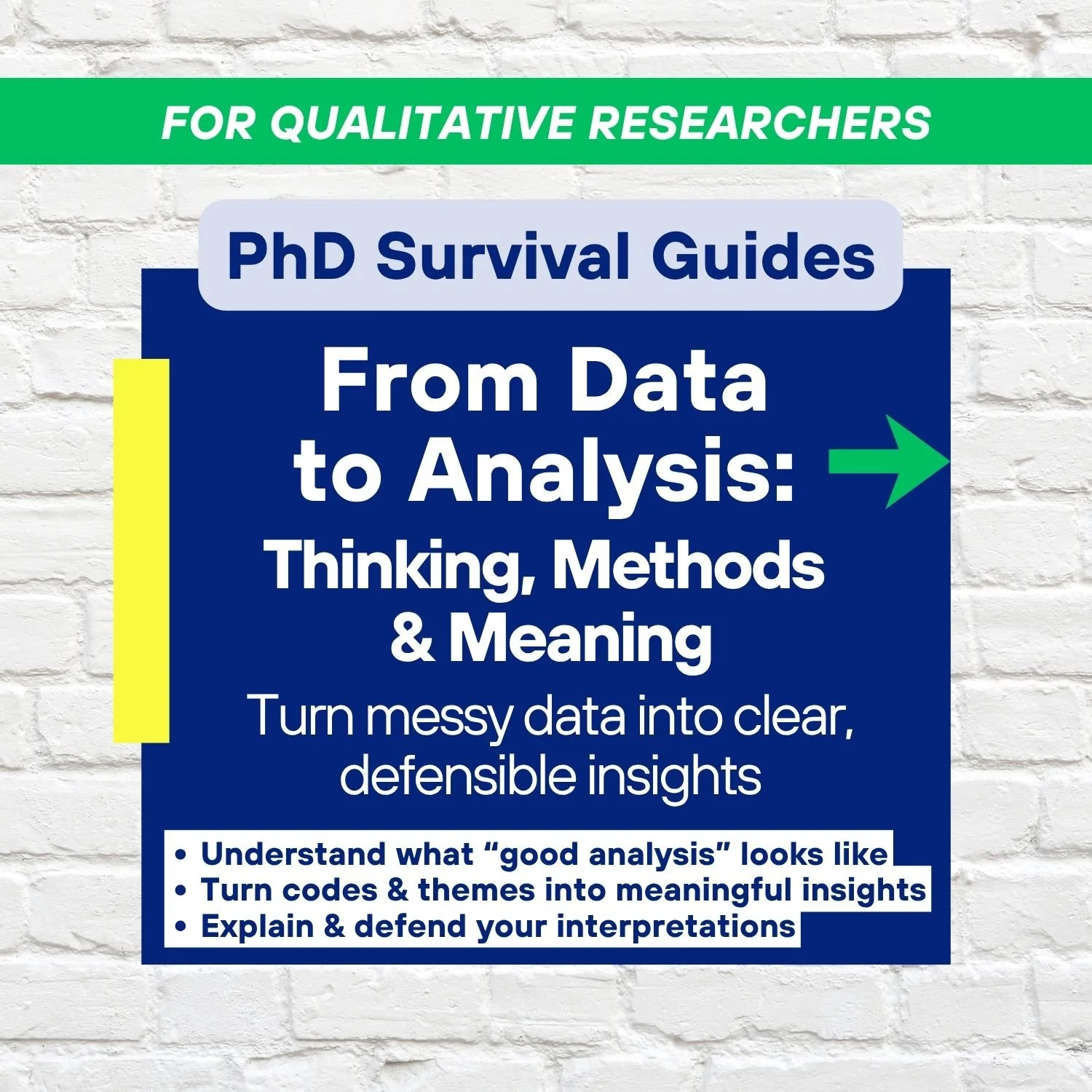
This is the point in the PhD where your research starts demanding something different: interpretation, judgement, coherence, and confidence in your reasoning. This guide was written for that stage.
Swipe through the images above to see what’s inside.
Get the full Survival Guide set here.
If you have any questions, feel free to contact me. I’ll be happy to help.
By purchasing this product, you agree to our Terms & Conditions.