Ontology, epistemology, and paradigms - What are they, and how much should you write about them in your PhD thesis?
If you are doing a PhD, you have probably encountered the words ontology, epistemology, and paradigm more times than you ever wanted to. They can feel like the kind of vocabulary that everybody else learned in a separate class you somehow missed.
The frustrating part is that people often tell you that you “need to write about your paradigm” without explaining what they actually want to see on the page. So you end up with a vague sense that it matters, but no clear sense of what to do with it.
This post will give you two things: a simple explanation of what these terms mean, and practical guidance on where they belong in your thesis and how much to write about them.
If we have not met before, I’m Dr Elizabeth Yardley. I help PhD students finish well, with structure and clarity, especially those working in qualitative and social science traditions.
A clear recap of the terms
Here is the simplest way to think about the three ideas.
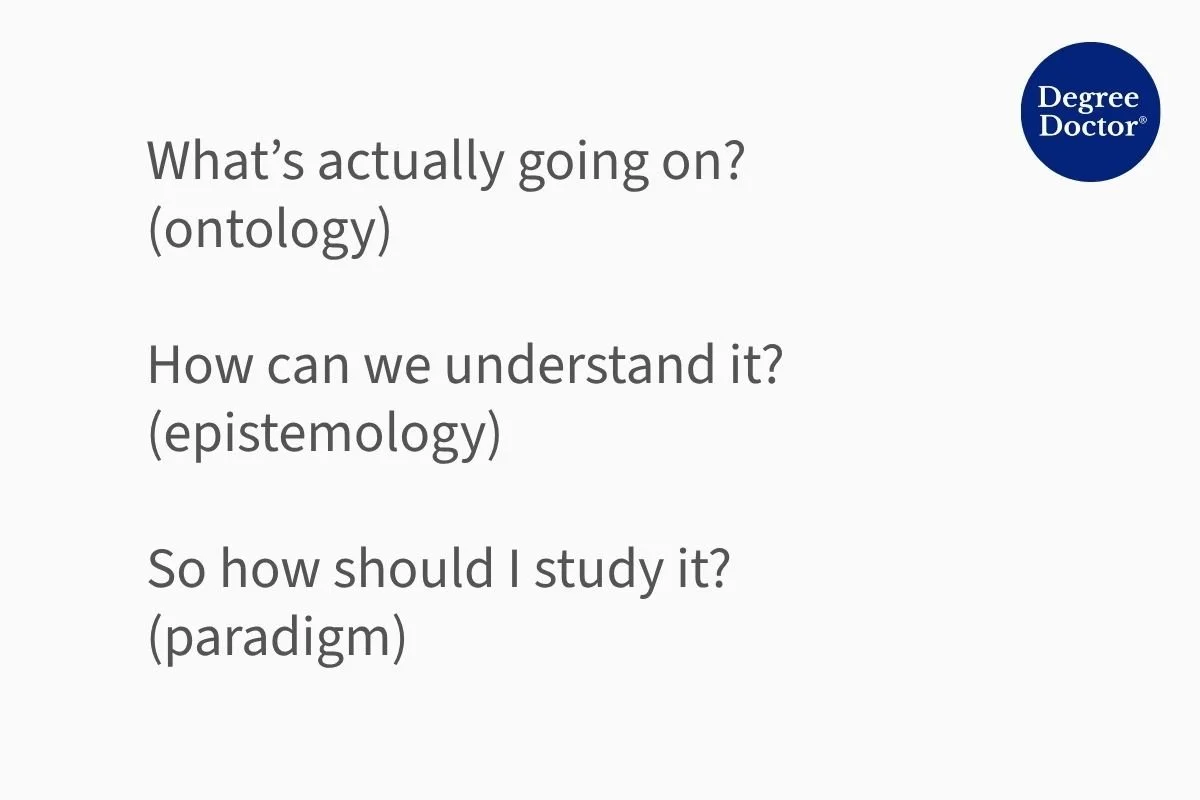
Ontology is about reality. It asks what you believe exists and what counts as “real” in the area you are studying. Some researchers assume there is one external reality that can be measured. Others assume reality is experienced differently depending on context, identity, history, and meaning.
Epistemology is about knowledge. It asks what you believe counts as knowledge and how knowledge can be produced. Some approaches aim for distance, measurement, and minimising researcher influence. Others assume knowledge is created through interpretation and relationship, and that the researcher’s position is part of the process.
A paradigm is your overall worldview. It is the set of assumptions that sit underneath your study and connect what you believe about reality with how you believe we can know it. Your paradigm shapes what you see as a good research question, what counts as evidence, what methods feel appropriate, and how you justify your choices.
If you are working in the social sciences, you will often hear about paradigms such as positivism, post-positivism, interpretivism, pragmatism, and critical realism. The names matter less than the coherence of your reasoning.
Why this matters more than definitions
Many PhD researchers reach a point where they can repeat the textbook definitions, but still feel stuck when they have to write their own position down. That is because what examiners want is not a glossary entry. They want to see that your stance makes sense for the kind of study you are actually doing.
In other words, it is not enough to say “I am an interpretivist.” You need to show how that connects to your research questions, your methods, and your approach to interpretation.
This is also the point where some people start to feel wobbly, because stating your position can feel strangely exposing. It makes your assumptions visible. It shows your judgement. That is not a problem. That is the work.
If you want a structured way to build this section so it feels coherent rather than vague, my Conceptual and Theoretical Foundations PhD Survival Guide walks you through aligning paradigm, ontology, epistemology, theory, and method. It is designed for the moment where you understand the terms, but still do not feel confident writing your own stance clearly.
The interpretivism confusion you are not imagining
You might have noticed something genuinely confusing: terms like interpretivism or positivism are sometimes used to describe both a paradigm and an epistemology.
That is not you misunderstanding anything. It is disciplinary shorthand.
Here is the cleanest way to understand it.
When people say “interpretivist paradigm”, they usually mean the whole package of assumptions, including a view of reality and a view of knowledge.
When people say “interpretivist epistemology”, they are emphasising the knowledge side: the idea that knowledge comes from understanding meaning and interpretation.
So you might see interpretivism used in both places because the word is doing double duty.
If you want to separate the pieces more explicitly, you might write something like this: a constructivist ontology (reality is socially constructed), an interpretivist epistemology (knowledge is produced through interpretation), within an interpretivist paradigm (the overall worldview that holds these assumptions together).
You do not need to perform this separation for its own sake. The goal is clarity, not technical perfection.
Where these belong in your thesis
You do not need to write about ontology, epistemology, and paradigms everywhere. They have a main home, and a couple of sensible supporting appearances.
In the introduction
A light mention is usually enough. You are signalling the general orientation of the study so the reader understands what kind of work they are about to read.
Often this is one or two sentences. It is not the place for a long philosophical discussion.
A typical example might sound like this:
This research adopts an interpretivist paradigm, recognising that participants construct meaning through their experiences and social contexts. It therefore uses qualitative methods to explore how those meanings are formed and negotiated.
That is usually sufficient in the introduction. The detailed explanation comes later.
In the methodology chapter
This is where ontology, epistemology, and paradigm do their main work.
In the methodology chapter, your reader is asking: why did you design this study in this way, and why does it make sense?
Your philosophical stance is part of your answer. It helps you justify why your research questions are framed the way they are, why you chose particular methods, and why your approach to interpretation is appropriate.
A good section here does three things. It states your stance, gives a brief rationale, and links it to your design choices.
You do not need to write a mini philosophy thesis. You need to write enough so that your examiner can see the logic connecting your foundations to your method.
In the analysis or discussion chapters
You usually do not re-explain your stance in depth here. Instead, you reference it when it is relevant to how you are interpreting your findings.
For example, you might briefly remind the reader that your analysis prioritises participants’ meaning-making rather than treating accounts as objective facts. Or, if you are working within critical realism, you might connect interpretation to underlying structures as well as lived experience.
This is less about repeating definitions and more about showing consistency.
How much should you write?
The honest answer is: enough to make your study defensible, and no more than that.
In many PhD theses, around 800 to 1,200 words in the methodology chapter is a reasonable range for a clear explanation of ontology, epistemology, and paradigm, plus a rationale and a link to method. Some disciplines do less. Some do more. Your university guidelines and examiner expectations matter.
A useful self-check is this: if the paragraph does not help your reader understand why your study was designed the way it was, it probably does not need to be there.
If you find yourself explaining the history of ontology in great detail, pause and ask, “Is this serving the study, or is this me trying to prove I understand the vocabulary?” Most of the time, examiners want to see clarity and coherence, not philosophical gymnastics.
Writing it clearly in your methodology chapter
A practical way to write this section is to use a simple progression: reality, knowledge, worldview, then method.
You might write something like:
This study assumes that social reality is shaped through interaction and interpretation, and that participants may experience the same phenomenon in different ways depending on context. It therefore adopts an interpretivist approach to knowledge, prioritising understanding meaning rather than measurement. This positions the research within an interpretivist paradigm, which aligns with the use of qualitative methods. Semi-structured interviews were selected to explore participants’ accounts in depth, and the analysis focused on patterns of meaning across the dataset.
That kind of paragraph is usually more useful than three separate blocks of definition. It shows the reasoning in motion. The goal is to make your logic visible, not to sound grand.
Coherence is the most important thing
Ontology, epistemology, and paradigms sound intimidating because they are often introduced as if they are abstract hurdles you must clear. In reality, they are a way of explaining the logic of your study.
You do not need to be a philosopher. You need to be coherent.
If your stance is clear, your methodology reads as intentional rather than accidental, and your analysis feels grounded rather than floaty. That is what examiners are looking for.
If you want a structured process for strengthening that foundation, my Conceptual and Theoretical Foundations PhD Survival Guide will help you connect paradigm, theory, and method in a way you can actually defend in writing. It is there for when you are ready to go deeper and make your foundations feel steady.