Analysing your interview data sounds fairly innocuous, right? Surely, you’ve done the hard part, which was getting the actual data in the first place.
Because that was NOT easy, was it? Finding participants, inviting participants, arranging the logistics of the interviews - which feels like a major military operation - then remembering to hit the ‘record’ button. Then not being able to properly relax until those interview files are saved very safely in one place. Or two. Or three. Just to be sure. 😂
But, then… the analysis stage begins.
You've got your transcripts. Now you're sitting there thinking, "What on earth am I supposed to do with all of this?"
Maybe you've got 10 interviews. Maybe 25. Maybe 50. Each transcript is 20, 30, perhaps 40 pages long. Jeez, Louise.
You start reading the first one, and everything seems fine. Then you read another. And another.
By about transcript number five, they've all started to blur into one enormous qualitative data SOUP, and you can't remember who said what.
So you start making notes. Highlighting things. Perhaps you start coding because you're worried you'll forget something important.
Before long, what started as a fairly innocent attempt to familiarise yourself with your data has turned into trying to analyse ALL OF IT. AT ONCE. You’re like: Ooh hello, Overwhelm! FML.
Please stop doing that to yourself. 😂
You're making this stage considerably harder than it needs to be.
What are you actually supposed to do when you first read your interview transcripts?
If you're using a method like Braun and Clarke's reflexive thematic analysis for example, you'll know that the first phase involves familiarising yourself with your data.
Sounds straightforward enough, doesn't it?
Until you open 400 pages of interview transcripts and realise that knowing what familiarisation is and knowing how to actually do it are two different things.
Here's what I want you to remember: Your job at this stage isn't to remember absolutely everything or know exactly what participant three said compared with participant seven or have your themes worked out. Goodness, no. That’s all a bit much. Oof.
You're getting a feel for the terrain.
Think about walking into a room full of people at an event. (Personally, my idea of hell. 😂)
Initially, you're just taking everything in.
Who's here? What's the atmosphere like? What seems to be happening?
You're not trying to have an in-depth conversation with every single person in the room simultaneously.
So stop trying to do that with your data!
How do you stop all your interview transcripts blurring together?
Here's a practical little exercise that can make familiarisation much more manageable.
Create a one-page summary for each interview.
Start by choosing one transcript and reading it from beginning to end. Don't try to code every line or highlight half the document - there’s oodles of time for that later, so steady, Eddie. Just read it.
When you've finished, create a short summary addressing four things.
Who is this participant? Not their entire life story. Just whatever is relevant for understanding their account.
What seemed particularly important to them? What did they keep returning to? What appeared to matter most
What emotions, tensions or dilemmas stood out? Perhaps they expressed contradictory feelings about something. Maybe they seemed particularly angry, anxious or enthusiastic.
What surprised you? Was there anything you weren't expecting? Anything that made you stop and think?
That's it.
You now have a short record of that interview that you can return to later.
This is where the magic happens. Well, not actual magic. That would be lovely, wouldn't it? 🪄
When you get to transcript number nine and think, "Hang on, somebody else talked about this. Who was that again?", you don't have to wade through hundreds of pages trying to find them because you've got your summaries.
They're there to support your memory, not replace your transcripts or become a substitute for analysis.
But what if I start noticing patterns? Am I analysing too soon?
This is something I see PhD researchers getting themselves into a right old pickle over.
They know familiarisation comes before coding and developing themes in the process they're following.
So they assume they're not supposed to be analysing yet. Then they notice something interesting and panic.
"Oh no! I'm analysing! STOP ANALYSING! STOP!!!"
But you're a qualitative researcher reading your own data. Of course you're going to have analytical thoughts! It would kind of WEIRD if you didn’t!
Familiarisation is an active engagement with the data. It's not a completely separate, analysis-free activity.
Perhaps participant two described something that participant six experienced very differently. Then participants eight and ten seemed to be talking about something similar, but for completely different reasons. Those observations are useful.
The trick is not to feel that you have to do something with them immediately. Write them down. "This is interesting." "This seems connected to something another participant mentioned." "I wonder why these two accounts are so different?"
Then carry on. You're giving your analytical thoughts somewhere to go without demanding that you develop them into fully formed interpretations or themes right there and then. You can return to them as your analysis develops.
Familiarisation is about beginning to understand the material you're working with, noticing things and developing your thinking. So please don't spend today creating some terrifying spreadsheet with 900 columns because you're worried you might forget something.
Choose one transcript. Read it. Write your summary. And then go and have a cup of tea.
What next?
📃 What they don’t tell you about qualitative data analysis. I created a free short guide, called Qualitative Data Analysis: What they don’t tell you. Download it here.
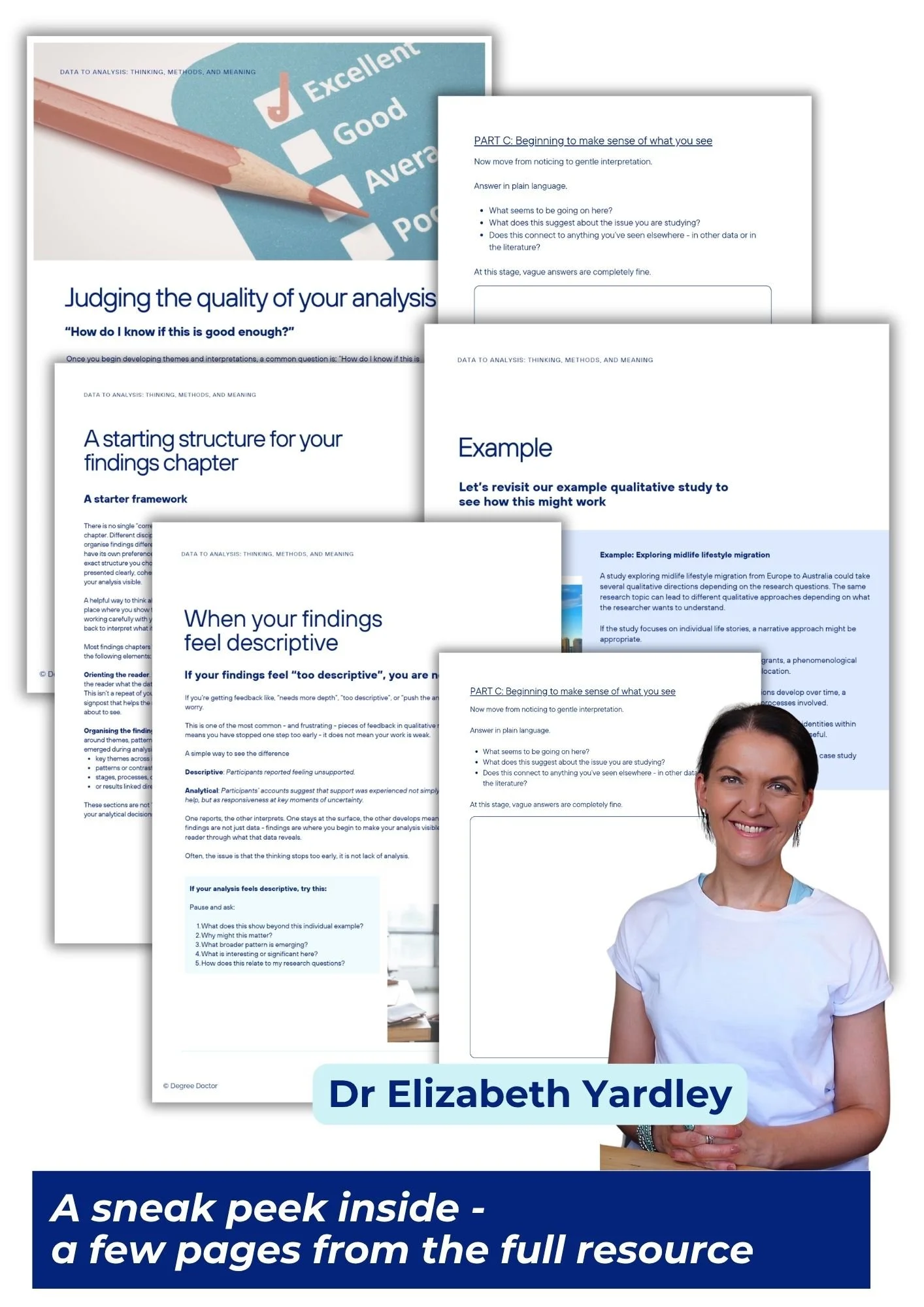
📗 “No, Elizabeth, I don’t have time for that. Just walk me through everything from designing my study to analysing my data, please. Oh - and show me the REAL way - not the polished version the textbooks tell you to do or what it looks like in a finished thesis - I can handle the truth.” Ooooo-kay then. You need this 👇