Connecting your literature review to your methodology chapter requires a bit more than just a fancy-pants connecting paragraph.
You need to demonstrate that both of these chapters are contributing to a coherent research project, there needs to be a thread. That’s my fancy-pants way of saying that all your chapters need to make sense when considered together.
No one should come away from reading your thesis thinking it's been stitched together like Frankenstein's Monster. That is what can happen if you’re not clear about what they’re each contributing to the whole. So, let’s get that sorted. Or, let’s get all our ducks in a row, as my grandmother used to say. 🦆🦆🦆
Your literature review and methodology chapter aren't two separate bits of your PhD
Now, let’s get clear on what each one is doing.
First up, the literature review. Your literature review essentially establishes three things:
What we know
What we don’t know
What needs further investigation
Then, your methodology explains the approach you’re going to take to your study. What will you be looking at and how will you be doing that? More importantly - WHY are you doing it that way? What have you learned from the literature that feeds into that?
There should be a clear intellectual connection between them, so if someone (like your examiner) says, “Tell me about how the literature informed your methodology…” you won’t be shuffling awkwardly and avoiding eye contact.
Now let’s look at each one in detail.
What does your literature review SAY about your research?
Here, you’re looking at the research other scholars have carried out and essentially saying, “Okay, I know you haven’t looked at exactly what I’m planning to explore, but you’ve looked at bits and pieces that are related to it. Let’s get those bits and pieces together and see what more that tells me, and what I still need to figure out on my own with my study”.
Your literature review should give you a good grasp of what research other folks have done, but also where they were coming at it from.
That involves the assumptions they might have about the topic, and about the kind of knowledge they think matters. As you’re doing this, you’ll probably find a little voice at the back of your mind going, “Yeah, that sounds sensible”, or, “But what about x, y and z? They haven’t written about that. Mmmm…”
So, for example, imagine you're researching how housing officers make decisions about supporting people experiencing homelessness.
You've been reading research about homelessness policy, professional discretion and frontline decision-making.
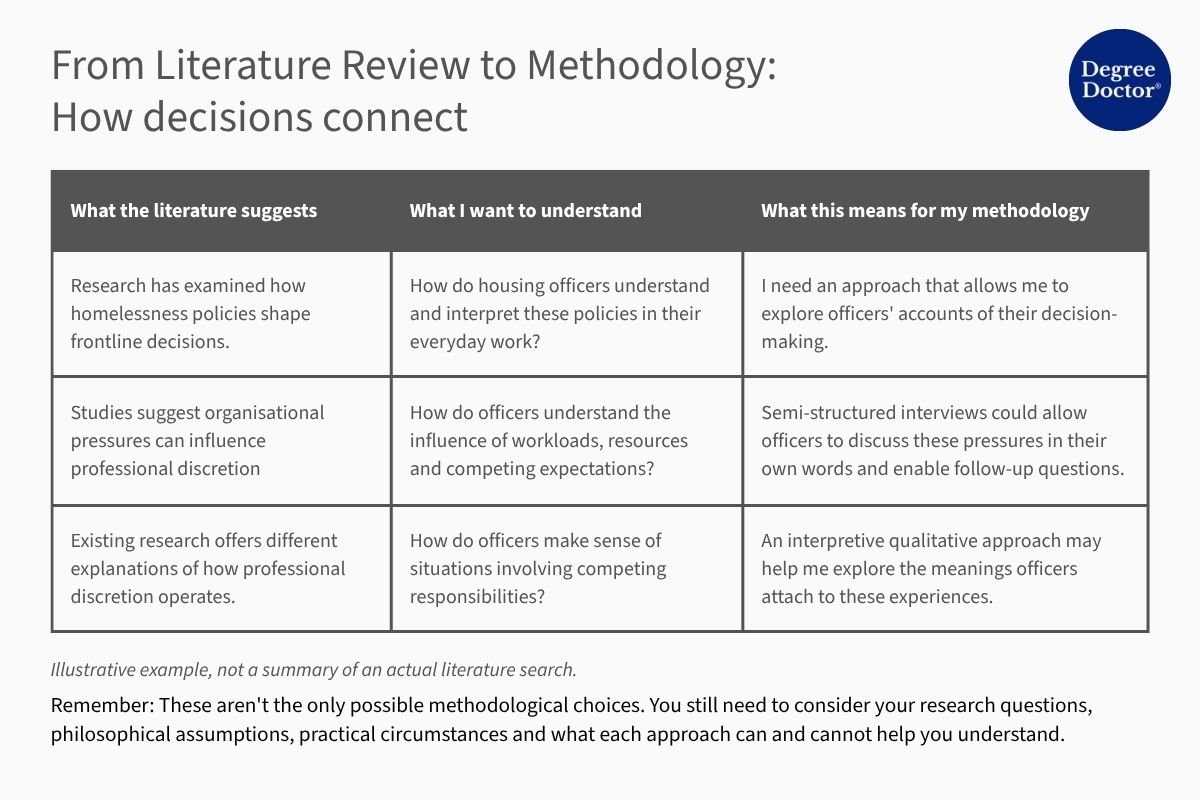
Some studies have examined how housing officers apply policies and procedures. Others have looked at the organisational pressures they're working under, including workloads, targets and available resources.
All useful stuff… obvs.
But as you're reading, you think, “Hang on a minute. We're learning quite a lot about the rules housing officers are supposed to follow and the conditions they're working in. But what about how THEY understand the decisions they're making? How do they make sense of situations where the policy says one thing, but the circumstances of the person sitting in front of them suggest something else?”
Ooh. Interesting.
Now, that doesn't automatically mean nobody has researched this before. You'd need to check that rather than declaring you've discovered a great big drafty gaping hole in the literature. But it does give you something to investigate, doesn’t it?
You're beginning to identify not just what previous research has established, but what YOU’D like to understand more fully. That is where the connection with your methodology starts to become interesting, because the next question is: what kind of research would actually help you understand that?
Explain WHY your methodological choices make sense
It's those thoughts you've been having as you've read the literature that can start informing not just WHAT you do, but HOW you do it.
You might have enthusiastically nodded and agreed with some researchers' assumptions about the topic, whilst raising an eyebrow at others. You might have noticed that certain research approaches have helped us understand particular aspects of the problem, whilst leaving other questions unanswered. You may have even done this out loud, prompting confused looks from the other people on the train.
That's all useful information when you're working out how to approach your own study.
It's not a case of pull-a-research-method-out-of-a-hat: “TA-DAAAAH! Semi-structured interviews!”
It's more a case of, “Okay, here's what I've learned from the literature. Here's what I want to understand more fully. Here are the assumptions I'm making about the topic and the kind of knowledge I'm trying to develop. So what research approach makes sense for THAT?”
Then you need to be able to explain and justify your answer.
Also - important to note that “Because the literature told me to” is not a reason for your methodological choices, sorry. It’s not like the kid in the medical room at school trying to explain to the first aider why they stuck their finger into something they shouldn’t have: “Because Martin told me to.” No, we’re not listening to Martin anymore.
Check out the examples below to see what I mean here.
Make the connection visible in your writing
Now, here's something I want you to remember.
Having a connection between your literature review and methodology is one thing. Making that connection clear to your reader is another.
It's a bit like explaining a joke. You know why it's funny, but everyone else is looking at you like you've just announced that your toaster is running for Prime Minister. This happened to me recently, when someone started their sentence with “This one time…” and then I said, “AT BAND CAMP!” and laughed out loud, and it was awkward because no one got it. Some of you will know exactly what I mean by that, whilst most of you are like, “What the fiddlesticks?” See? Exactly! It’s a reference to the 1999 movie, American Pie.
Essentially, what I’m trying to say here is that you need to give them enough information to follow your thinking.
Let's go back to our housing officers.
Imagine your literature review found existing research provides useful insights into homelessness policy and professional discretion, but you're particularly interested in how housing officers themselves understand and negotiate difficult decisions.
Then you get to your methodology chapter and write:
“This study uses semi-structured interviews to collect qualitative data.”
Okay. Fine.
But WHY?
What does that decision have to do with everything you've just spent an entire literature review discussing?
What about something like this instead?
“The literature reviewed in the previous chapter highlights the importance of professional discretion in housing officers' decision-making, whilst also identifying the organisational pressures that can shape its exercise. This study seeks to explore how housing officers themselves understand and negotiate these competing demands. Semi-structured interviews were therefore selected to provide opportunities for participants to discuss their experiences and interpretations in depth, whilst allowing the researcher to explore issues arising during the interviews.”
Boom. See what we've done there?
We've explained what the literature has established, what the study is trying to understand and why the chosen method could help.
Of course, that paragraph wouldn't be your entire methodological justification. It’s just for illustrative purposes here, obviously. You'd still need to discuss your philosophical position, research design, sampling, analysis, ethics and other relevant decisions.
But we've started making the reasoning visible and that's a LOT more useful than sticking a fancy connecting paragraph between two chapters and hoping nobody notices that they don't really speak to each other.
What next?
Get your ducks in a row 🦆🦆🦆
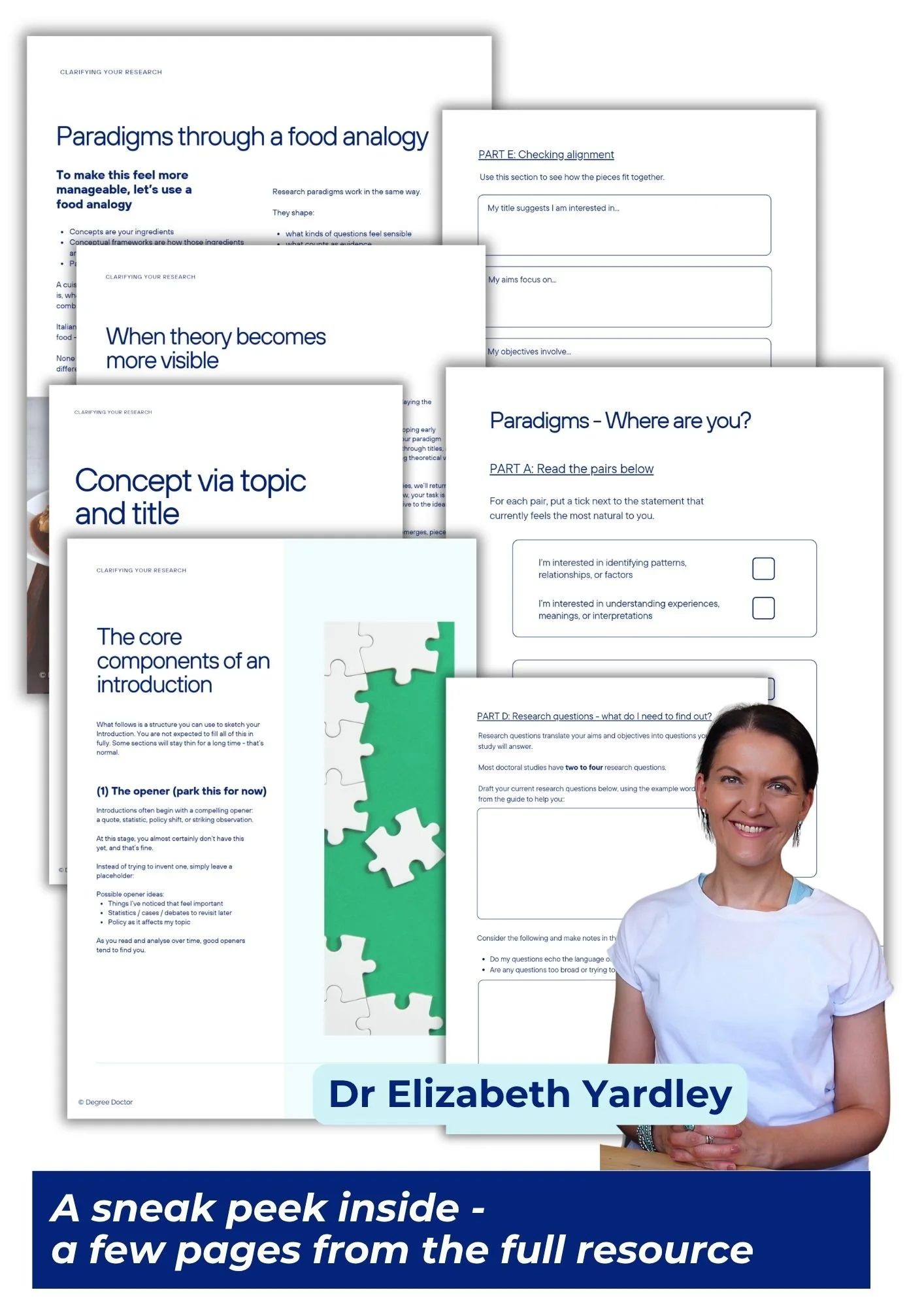
If you're finding it difficult to get your research questions, theoretical foundations and methodological decisions to make sense together, my Clarifying Your Research PhD Survival Guide includes practical exercises to help you work through those decisions in relation to YOUR study. Because reading about how research should fit together is one thing. Actually getting your own research to fit together is quite another!