What do you do when the ‘thread’ of your literature review needs work? If you’re wondering what on earth to do about it, let’s break it down.
Your supervisor: "I can't see the thread running through this."
You: “Okay…. (Internal narrative: What’s a thread? Is this linked to synthesis? Critical analysis? Will they think I’m stupid if I ask them these things? Mmm, I’ll look this all up later….)”
I’ve come across a lot of PhD researchers scratching their heads about this mysterious ‘thread’ in my 20-plus years of supporting doctoral dissertation students, it’s also a common topic in my Momentum Community Q&As. And - can we just get this out of the way now - it just sounds super mysterious, doesn’t it? Like something from myth and legend. Like you’re the brave knight off on a quest to find the ‘thread’. Maybe it’s just me?!
The good news is that you don’t need to gallop off on a horse to find it. You might not even need to start your literature review again or have do much more reading - because you’ve already got all those PDFs in your ‘To read’ folder, right?! 😉
What you probably need to do is work out what your literature review is actually saying and make that clearer to the person reading it.
Let's get into it.
What does it mean when your literature review has no clear thread?
When your supervisor says they can't see the thread, they're usually telling you that they can't follow the argument connecting the different parts of your literature review.
But a thread isn't just about putting your sections in the right order, like in the Fastest Finger First round on Who Wants to Be a Millionaire? “Okay, contestants! Put these things in the correct order: A, B, C, D…” Ooh, the pressure. No thanks.
It’s not about copy-pasting a few connecting sentences either.
What you need to do here is make sure that the arguments you're developing throughout your literature review build towards a clearer understanding of your research problem.
Now, if you have a tendency to catastrophise, I just want to make one thing clear here: this does not mean that your lit review is awful or badly written. You might have a perfectly good section on one topic, followed by another perfectly good section on something else.
The problem is likely that your reader doesn't understand one or more of three things:
Why those sections are there
Why they're in that particular order
What they're supposed to understand once they've read them
Okay, it’s example time!
Imagine you're researching how housing officers make decisions about supporting people who are experiencing homelessness.
Your literature review might have sections on:
- Homelessness policy
- Professional discretion
- Organisational pressures
- Frontline decision-making
- Relationships between housing officers and service users
All totally relevant topics - all very interesting too - but that’s not enough in a doctoral literature review.
Your reader needs to understand how those topics connect and what those connections tell us about your research problem.
Otherwise, your literature review can start to resemble five separate essays that happen to be sharing a chapter, they’re just random housemates.
Let’s look at how to get some synthesis between them:
Step 1: Work out what each section is actually doing
Open your literature review and write down all your main headings. Now, underneath each heading, complete this sentence:
"I'm including this section because..."
Here's the important bit: don't just tell me what the section is about. Tell me why your reader needs to understand it.
Let's return to our housing officers example, I’ve broken it all down in the table below.
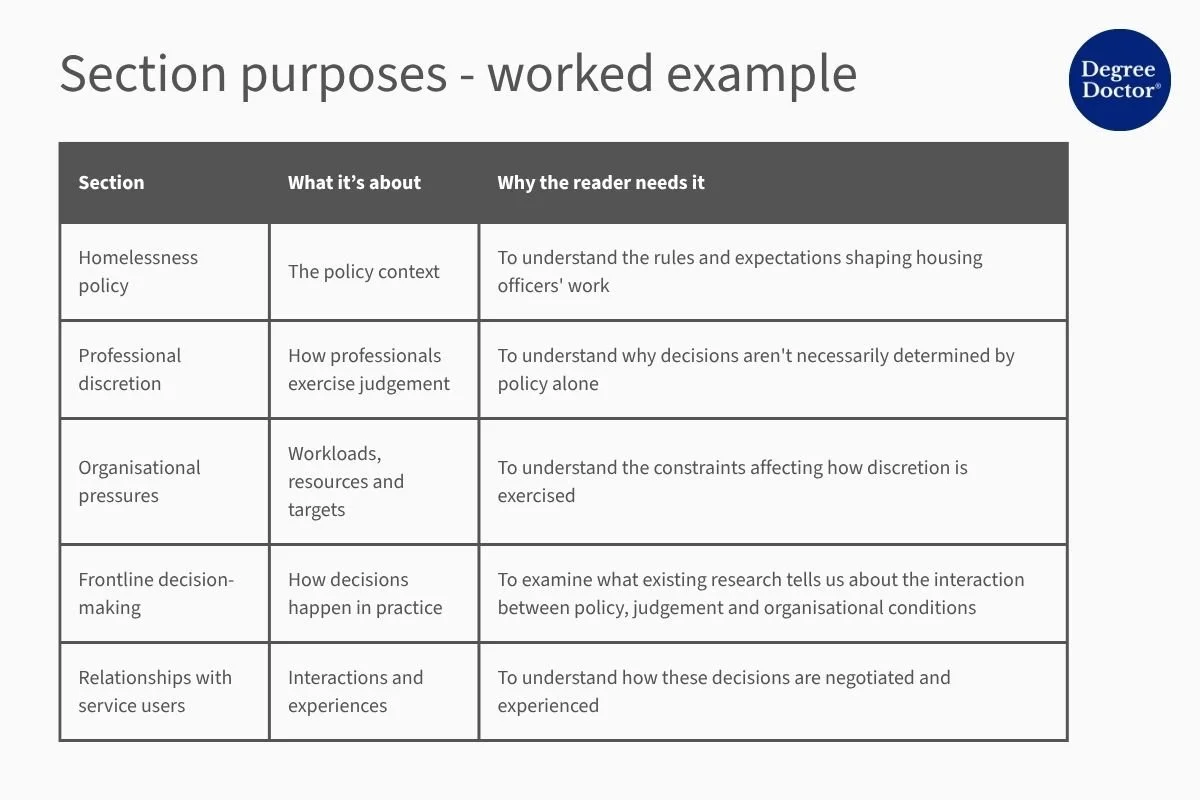
A worked example showing how to move beyond describing what each literature review section covers and explain why your reader needs it. This is the first step towards building a clear, connected argument.
See the difference? In the middle column, we've got five subjects. In the final column, we're starting to develop a reason for including each one. That gives us something to work with.
Step 2: Check whether your sections build on each other
Now look at your headings again.
Ask yourself:
"Why does my reader need to understand this section before they move on to the next one?"
There should be a logic you can explain.
In our housing officers example, we might decide to begin with homelessness policy because that establishes the formal expectations within which officers work.
Then we introduce professional discretion, because policy alone doesn't tell us exactly how individual decisions are made.
Next, we examine organisational pressures, because discretion doesn't happen in a vacuum.
Finally, we explore what existing research tells us about frontline decision-making and interactions with service users.
We're gradually developing a more complicated understanding. Each section gives the reader something they need to make sense of the next one.
Notice that we're not simply moving from one topic to another, pinball style!
Step 3: Find the arguments connecting your sections
This is where things get particularly interesting, because now we’re examining what the literature is telling you.
Let's imagine you've read several studies about professional discretion.
Some of them might suggest that discretion allows frontline workers to respond flexibly to individual circumstances, whilst others argue that discretion can lead to inconsistent decisions. Meanwhile, research on organisational pressures suggests that heavy workloads and limited resources can restrict the choices available to professionals.
You could write three separate summaries of those arguments. Or - if we’re going for the gold star (which we are, obvs!) you could begin connecting them.
For example:
Although professional discretion is often presented as a means of responding flexibly to individual circumstances, research on organisational pressures complicates this assumption. Housing officers may possess formal discretion while having relatively limited opportunities to exercise it in practice.
Now we're getting somewhere because we're examining the relationship between their arguments and developing an interpretation of what they mean when considered together.
That's synthesis. Boom! Synthesis is one of the things that helps create a clear thread through a literature review.
Step 4: Make the connections visible in your writing
Here's something I see quite often: PhD researchers who understand how everything fits together - but in their own heads.
The reader - i.e. your supervisor, your examiner - doesn't have access to the inside of their head. Good job, right? Because it can get a bit weird in there sometimes. 😉
Don’t assume the connections are obvious because they’re not. Yes your examiners and supervisors are smart, but they’re not psychic.
Making things clearer for them can be as straightforward as writing a few sentences that explain the relationship.
For example, imagine one section finishes with a discussion of professional discretion, then the next section begins: Organisational pressures have been widely examined in research on public services.
Your examiner is thinking, “Wait, what just happened? Did I miss something?! Had I drifted off? Let me go back and read that again… Nope, still not clear”.
This is better:
The literature discussed so far suggests that professional discretion plays an important role in frontline decision-making. However, understanding how that discretion operates also requires consideration of the organisational conditions in which decisions are made.
Boom, connected! Now the reader knows why we're changing direction. You don't need to announce every connection with a giant flashing neon sign - wouldn’t that be fun 😂, they’d make the weirdest neon signs ever - but you do need to make the logic visible.
Here are some examples of how you can do that.
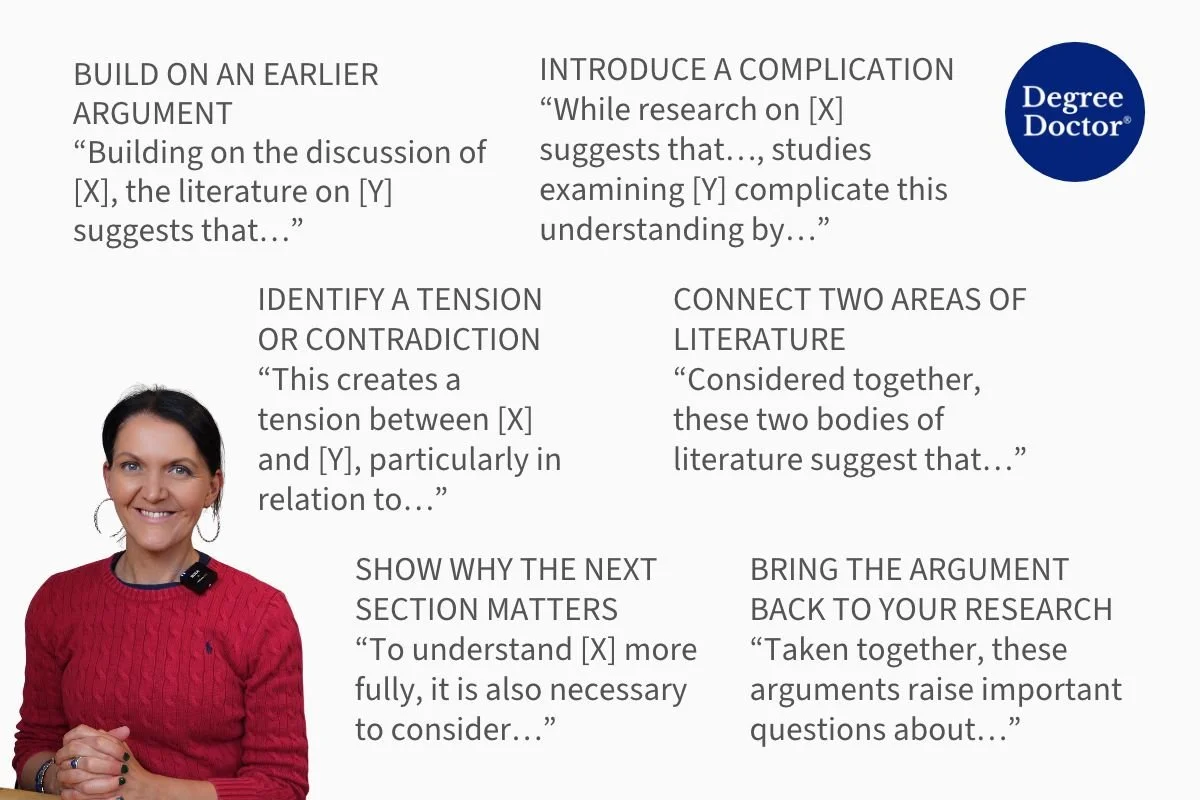
Struggling to make the thread visible in your literature review? These six sentence starters can help you. Remember, the connections need to come from your analysis, not just the words you use!
Step 5: Check what your literature review is building towards
Here's the final question I'd like you to consider:
"What does my reader understand by the end of this literature review that they didn't understand at the beginning?"
Please don't answer, "They understand the literature."
That's not quite what we're aiming for. 😀
In our housing officers example, perhaps the literature review establishes that:
Housing officers' decisions are shaped by policy, but aren't entirely determined by it.
Professional discretion can enable flexibility, although it may also produce inconsistencies.
Organisational pressures influence how discretion is exercised.
Existing research offers different explanations of frontline decision-making, but leaves questions about how housing officers themselves understand and negotiate these competing demands.
Now we have a much clearer sense of what the literature review is doing. That’s one of the most important things to take away from this post in my view: the word DOING. The example lit review is developing an argument about the complexity of frontline decision-making, which in turn helps establish why the research is worth doing.
What is your literature review DOING?
A quick exercise: Can you find the thread in your own literature review?
1. List your main headings. No paragraphs. Just headings.
2. Write one sentence explaining why each section is necessary. Not what it covers, we don’t need another summary, why it matters.
3. Draw arrows between your sections. Next to each arrow, explain how the argument develops from one section to the next.
4. Identify the main argument emerging from your reading. What are you beginning to understand about your research problem when you consider the literature together?
5. Check whether that argument is visible on the page. Can your reader follow it, or are some of the connections still sitting inside your head?
If you can't answer these questions yet, that's useful information. It tells you where you need to do some more thinking.
Where now?
I have a few bits and pieces about the literature review to check out next if you this blogpost made you think, “Oh, she’s explaining this in a generally okay way without sounding like she’s swallowed a dictionary”. Here they are.
📤 “I’m struggling to actually WRITE stuff and I think my brain has stopped working. FML.”
Before you throw your PhD in the bin and run off to open a coffee shop near the beach, give this a go: Writing Reset. It’s a 10-minute writing exercise that might help you. If not, mine’s a Caramel Macchiato. 😉
🤓 “No, Elizabeth. I have no time to mess around. Take my money and show me how to get this damn literature review written!”
Okay, I appreciate your candour, let’s not faff about. Go look at my Literature Review PhD Survival Guide. BUT, before you do - if you buy this, you need to actually do the stuff that I tell you to do in it, yes? Fill the worksheets out with your own ideas and notes, complete the exercises. You’re wasting your money otherwise, okay? It will just be another fudging thing gathering dust in your downloads folder. You probably have enough in there already, yes? Okay then, as you were.
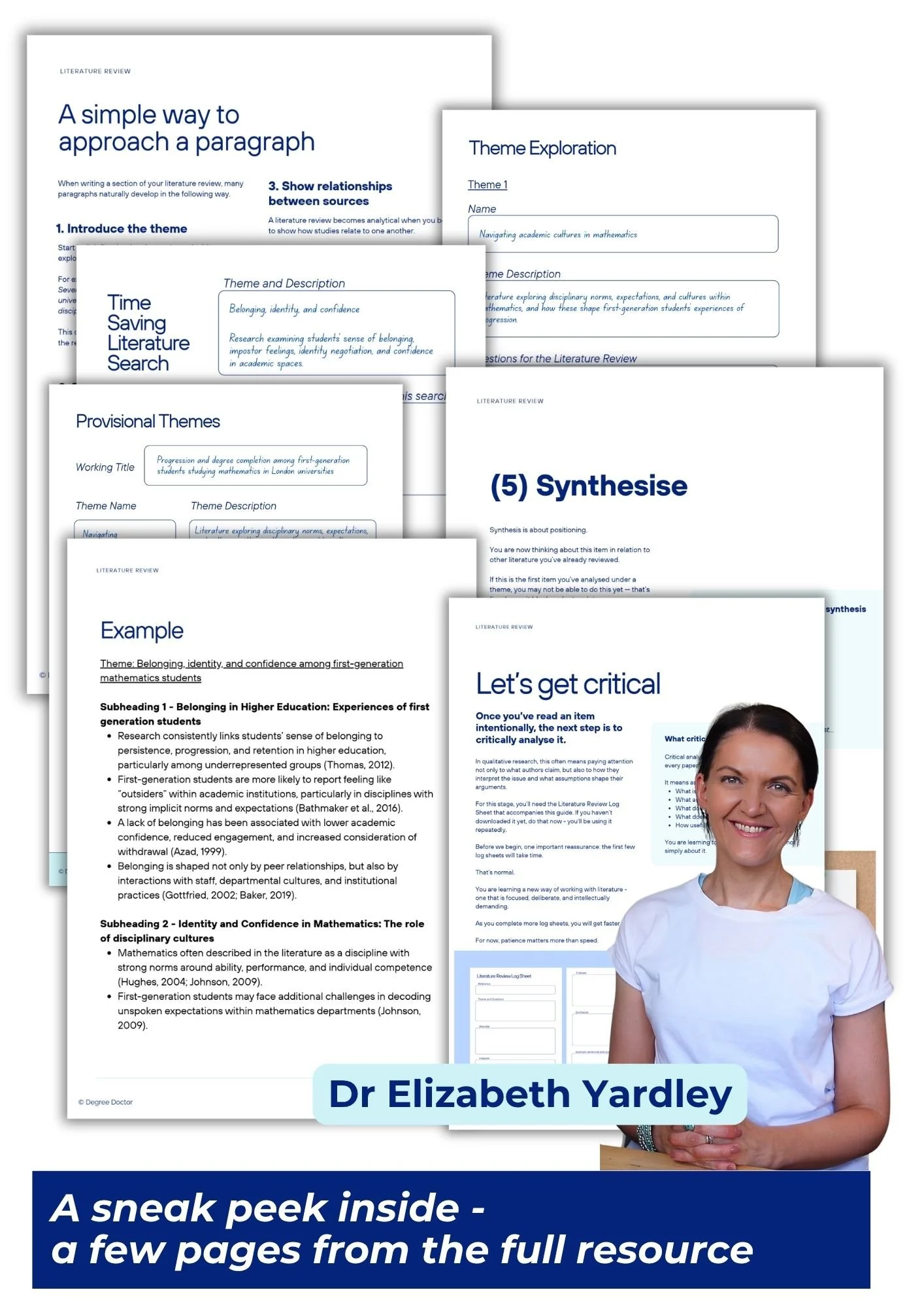
Remember, the thread in your literature review isn't hiding somewhere in your document, waiting to be discovered. It's something you develop as you work out what the literature is telling you and how those arguments connect. You've probably got more of the pieces than you think. Now it's time to put them together.