How do I make my PhD thesis chapters connect?
Ever reached the final stages of your PhD, looked at all those chapters you've spent YEARS writing, and wondered how on earth they're supposed to fit together? It might feel like they’ve all been written by past versions of your PhD self.
A member of my PhD community recently described it rather brilliantly:
“I tried to fit my thesis together at the end, thinking I was nearly home and dry, then started the discussion chapter and realised it was going to take me a bit longer than I thought because the thesis wasn't thesis-ing. It was like one of those 1980s game shows of random tasks.”
I mean, YES. 😂
You've spent years reading, collecting data, analysing it, writing chapters, rewriting chapters... and now you're expected to make the whole lot work together.
No pressure, right?! Here's something that might help.
Your PhD thesis chapters don't need to say the same thing
They need to contribute to the same overall argument.
That's a very important difference.
Your literature review, methodology, findings and discussion chapters are doing different jobs. They're not supposed to repeat each other or sound exactly alike.
What matters is whether your reader can understand how they relate to one another.
This is where something called the golden thread comes in. Side note - Golden Thread is also a variety of beer brewed in Shropshire in England, which is rather nice, both Shropshire and the beer. Anyhoo…
What is the golden thread in a PhD thesis?
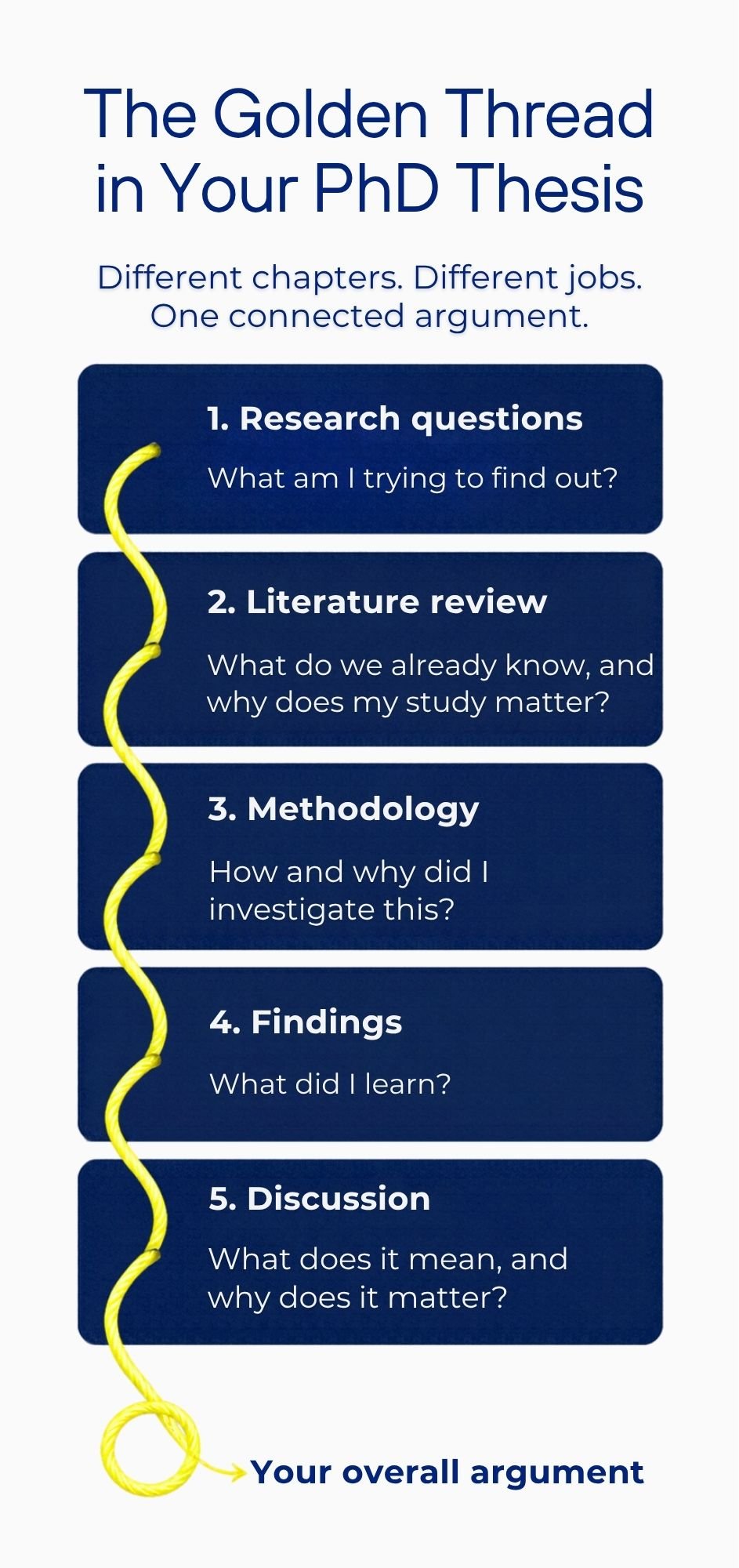
The golden thread is simply the connection between the different parts of your research.
Your research questions, literature, methodology, findings and discussion should all be speaking to one another, rather than heading off in completely different directions.
For example:
Your literature review helps explain what you're investigating and why.
Your methodology explains how you've gone about investigating it.
Your findings show what you've learned through that investigation.
Your discussion helps explain what those findings mean, how they relate to existing knowledge and why they matter.
See? Different jobs. Connected purpose.
Here's something else worth remembering.
You don't necessarily see your golden thread clearly at the beginning of your PhD.
In fact, you probably won’t because you’re not fudging psychic. It often becomes clearer as your research develops, particularly when you're writing your discussion chapter and working out what your findings actually mean. THAT’s when you figure out what you’ve actually done because the research you started doing probably won’t be the research you end up doing.
So if you're only now beginning to see how everything fits together, you might be doing some of the most important thinking of your doctorate.
Your golden thread isn't necessarily something you have perfectly worked out at the beginning of your PhD. It often becomes clearer as your research develops and you work out what your findings mean.
How can I make my PhD thesis chapters connect?
Before you start rewriting everything in a blind panic, answer three questions:
What was I trying to find out?
What have I actually learned through doing this research?
What does that help us understand that we didn't understand quite as well before?
Now look back at your chapters.
Can you see how they help you move from the first answer towards the third? Where are the connections already there? Where might you need to make them clearer for your reader?
You might discover that you need to revisit an earlier chapter or rethink part of your argument. That's okay. The point is to work out what needs attention before deciding that the whole thesis needs rebuilding. If indeed it does. It probably won’t - in my 20+ years supervising PhD students, none of my supervisees had to burn it all down and start over.
Still struggling to pull everything together?
One of the reasons this stage feels so fudging difficult is that writing your discussion chapter isn't just about writing stuff up, it’s about a whole new level of thinking.
You have to move beyond explaining what you found and start making judgements about what those findings mean.
That's not always something PhD researchers are explicitly taught how to do. Thanks, academia. 🙄
“Okay then, Elizabeth, what the fudge am I supposed to do now?” Start with my FREE guide: The Discussion Chapter – What They Don't Tell You. Download that here.
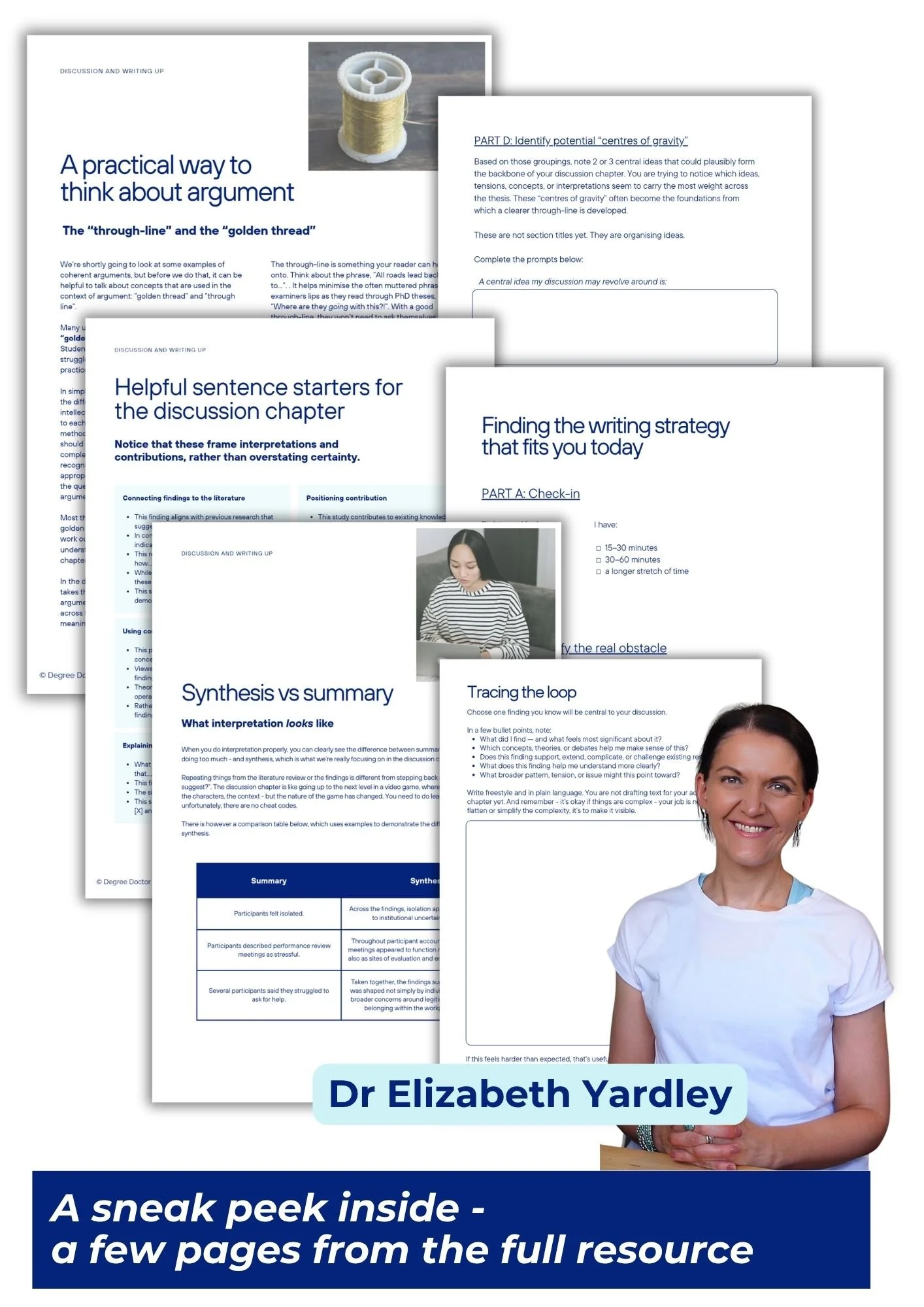
“Elizabeth, I’m nearly cooked here. Just take my £75 and show me what to do, please.” Okay, run to my shop and get my Discussion and Writing Up Guide. But please promise me this before you do: actually DO the activities and worksheets in it, don’t just read it, okay? We’re done reading now, you need to start DOING. The activities and worksheets are specifically designed for you to take what YOU found and get actual words on the page so you write your thesis. Because you probably have quite a few things in your ‘To read’ folder already, yes? Gotcha. 😉 Explore the guide below.