Narrative literature reviews. What are they all about, and would this kind of literature review work for your PhD?
You've come across the term narrative literature review, which sounds reasonably straightforward.
Then somebody mentions a systematic review, and somebody else starts talking about PRISMA. Insert exploding head emoji, right?! 🤯 You might have gone away and researched those and come back thinking, “Erm… what?!”
Now you're wondering whether a narrative literature review is less ‘academic’ or ‘rigorous’ because it doesn't necessarily come with an elaborate search protocol and a flowchart.
Marvellous. 🙃
Let's clear a few things up.
This is the second article in my series about choosing the right type of literature review for your research. In the first article, we looked at why the type of review you're conducting and the way you organise your literature review are two different things.
Today, we're looking at the narrative literature review.
What IS a narrative literature review?
Now, let's think about that word NARRATIVE for a moment.
We use it all the time in everyday life, don't we? Someone's trying to ‘control the narrative’, especially on Real Housewives. Two people have completely different narratives about what happened.
Whose narrative are we talking about in a narrative literature review?
Well, it's not about making up a lovely story that supports whatever you wanted to argue in the first place. Nopey-nope-nope.
You're developing YOUR account of what the existing literature tells us about a particular topic.
That means examining the different accounts, explanations, findings and arguments researchers have put forward, looking at where they agree, where they disagree and how their ideas connect.
Let's use our example of doctoral supervision.
Some researchers might emphasise the importance of supportive relationships between supervisors and doctoral students. Others might focus on power, independence or the institutional pressures shaping those relationships.
Your job is to examine those different perspectives and develop a coherent, critically informed account of what we currently understand about doctoral supervision and where your own research fits into that picture.
So yes, there's a story being developed here. But it's an evidence-based story you have to build from the literature and remain open to questioning.
THAT is why narrative doesn't mean descriptive.
Is a narrative literature review suitable for MY PhD?
Quite possibly! But (ready for the most annoying two words in academia?…) IT DEPENDS! Told you they were annoying. 😉
Narrative literature reviews are common in doctoral research, especially in the social sciences, but that doesn't mean they're automatically the right choice for everyone.
I'd encourage you to think about three things.
1. What are you trying to achieve?
This is always my starting point.
Are you trying to:
Understand how knowledge about your topic has developed?
Examine competing explanations?
Establish where your research fits within existing academic conversations?
Then narrative might be just your jam.
For example, you might be interested in how researchers have understood the relationship between doctoral supervision and researcher independence.
You'd want to explore different conceptualisations, theoretical perspectives and findings, and use those to develop your own understanding of the issue.
But if your purpose is to answer a narrowly defined question through a comprehensive, explicitly structured search and synthesis of existing studies, a systematic review might be more appropriate.
The question is: Which approach is appropriate for the intellectual work you're trying to do?
2. How broad is the literature you're trying to engage with?
This is where a lot of PhD researchers get themselves into a pickle.
You start reading about one thing, which leads to another thing, which introduces a fascinating concept, which leads to another 25 papers...
Then you're reading about something that has approximately three degrees of separation from your actual research question and you haven’t eaten for… a while (tummy rumble sound effect).
A narrative review gives you flexibility to explore relevant bodies of literature, including different theoretical and conceptual perspectives, but you still need boundaries.
You need to decide which conversations in the literature are central to your research, which – however interesting (or, more accurately, however distracting!) – aren't really helping you achieve your purpose.
A good narrative literature review makes a coherent argument about the literature that matters to your study.
Those decisions may need revisiting as your research develops.
3. Can you explain and justify your approach?
Here's something I really want to emphasise.
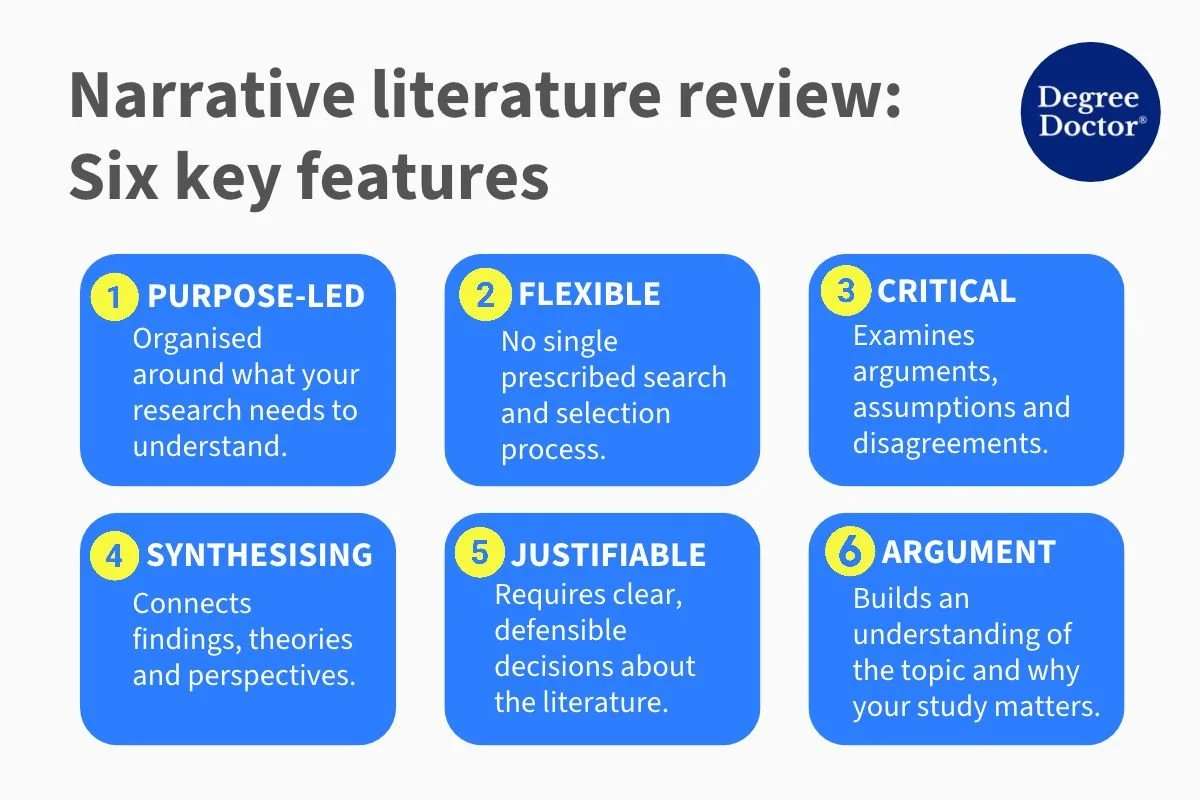
A narrative literature review can absolutely be academically rigorous, and the rigour comes from how you approach the work.
Can you explain how you've identified relevant literature? Why you've included particular studies or bodies of work? How you've considered different perspectives rather than just selecting research that agrees with you?
Can you explain how your interpretation of that literature supports the rationale for your own research?
You don't necessarily need to follow a strict protocol, but you DO need to make informed, defensible academic decisions.
And, of course, you need to consider the expectations of your discipline and doctoral programme. Some projects require a particular type of review, and that's something to establish with your supervisory team before you run off into the sunset with your narrative literature review.
So, should you choose a narrative literature review?
If your main purpose is to critically explore an area of research, examine how different ideas and findings connect, and build a coherent rationale for your own study, a narrative literature review may be a very good fit.
It gives you room to engage with the complexity of the literature without necessarily having to follow the procedures associated with a systematic review.
But that flexibility comes with responsibility – and you need the confidence to stand behind the decisions you make.
You need to make decisions about scope, relevance, interpretation and how you bring different studies into conversation with one another.
The real challenge often lies in working out what to DO with everything you've already read.
If you're thinking, ‘Okay, Elizabeth, that's lovely, but how on earth do I actually turn all these papers into a coherent literature review?’ – that's a whole other conversation...
For now, I want you to focus on choosing an approach that makes sense for YOUR research.
If a narrative literature review doesn't sound quite right, don't panic. There are other approaches to consider, including systematic, scoping and integrative reviews.
We'll be exploring those in the next articles in this series.
In the meantime…
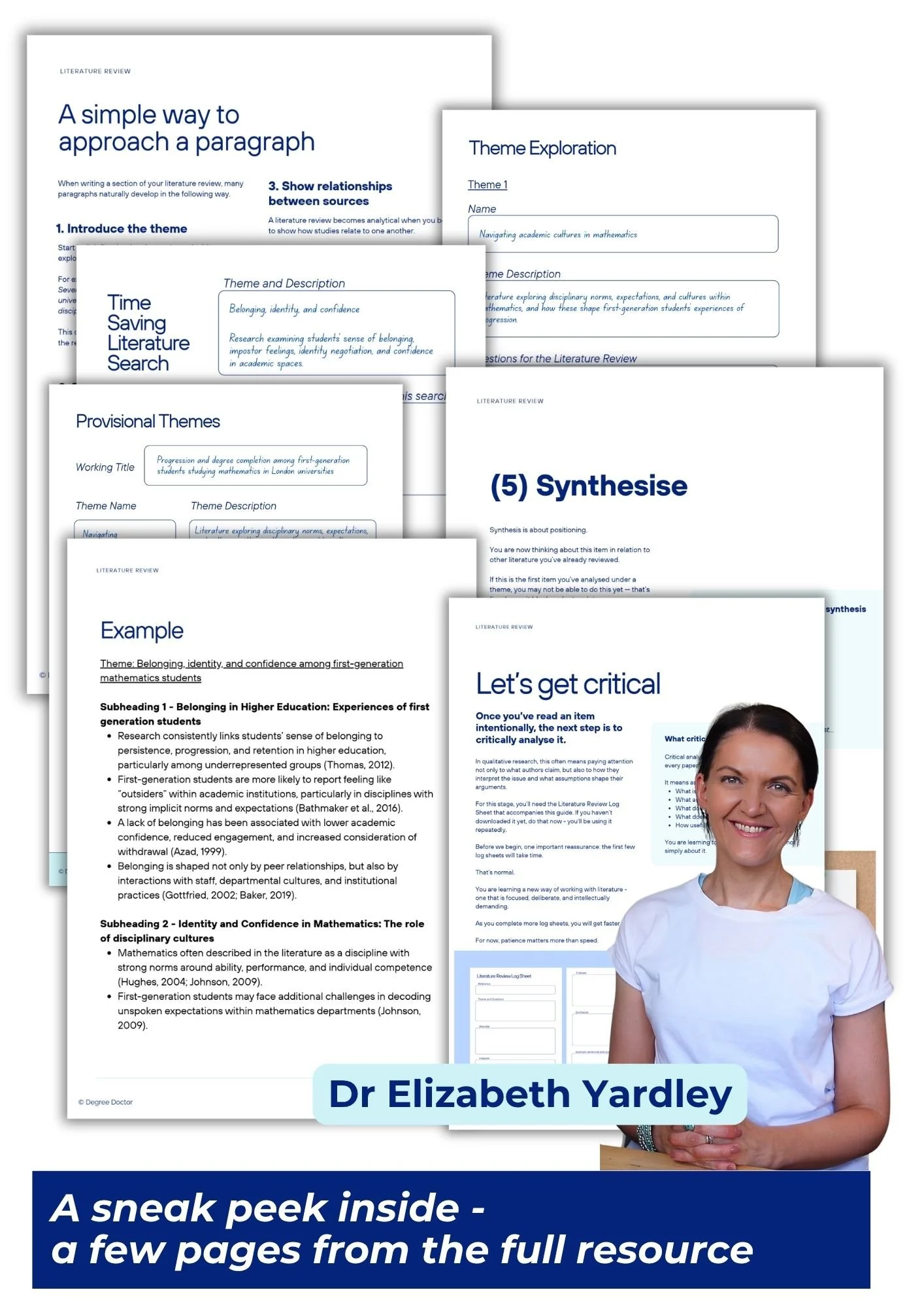
🤓 If you're thinking, ‘THAT one! I want to do a narrative literature review!’ then my Literature Review Guide will help you get that done because I actually make you fill in worksheets and write things. So, if you buy it, please DO those things, because otherwise, you’re just wasting your money. 😉 More details below.