Can you use Braun and Clarke's Reflexive Thematic Analysis with Critical Realism?
Yes! But I think there's a much more important question you should be asking yourself:
Is finding two approaches that CAN be used together the same as understanding WHY they work together in YOUR research?
Nopety-nope-nope. Not the same thing.
If you're doing a qualitative PhD and you've decided to adopt a Critical Realist position AND use Braun and Clarke's reflexive thematic analysis (RTA), you might be wondering whether the two are actually compatible.
Perfectly reasonable question, because I’m constantly talking to PhD researchers about alignment 🙄 (yes - I saw your eye roll!) - banging on about how their philosophical assumptions, methodological decisions and analytical approaches need to fit together in a non-Frankenstein way that doesn’t require too much mental gymnastics to justify.
So naturally, you want to make sure you've chosen a combination that works. Let’s see how the particular combo of RTA and Critical Realism might or might not be a good fit.
First, what does Critical Realism actually mean?
Critical Realism is a philosophical position that, broadly speaking, assumes that a reality exists independently of our knowledge of it. The tree still falls in the forest, even though we’re not there to see it, to use an overused analogy. Whatevs.
However, our understanding of that reality is always partial because it’s shaped by things like our own worldview and the contexts in which things become ‘knowledge’.
So something can be real without us necessarily having direct or complete access to it.
Let's come up with a better example than the tree. Imagine you're researching the experiences of housing officers supporting tenants who are struggling financially.
You might be interested in how organisational policies and wider economic conditions shape what housing officers can actually do.
From a Critical Realist perspective, those structures and conditions don't stop existing just because different housing officers experience or describe them differently.
But the accounts your participants give you aren't transparent windows into reality either. They're accounts shaped by people's experiences and circumstances.
That matters when you come to analyse them.
So, can you use Braun and Clarke's reflexive thematic analysis?
Yep!
Braun and Clarke's RTA is a theoretically flexible approach to qualitative data analysis.
That means it isn't glued to one particular philosophical position. It can be used within different theoretical and philosophical frameworks, provided you're clear about your assumptions and how these shape your analytical decisions.
So there's no automatic incompatibility between Critical Realism and RTA. It’s not like trying to dip an Oreo into gravy. Eww.
But please don't stop there - keep going. Knowing that they're compatible doesn't actually tell us very much about what YOU intend to do with your data. That's the bit we need to get into and that’s the thing your examiners will be asking themselves as they read your thesis.
Here's where things get interesting
Let's go back to our housing officers.
Imagine several participants describe feeling powerless when they're trying to help tenants experiencing financial hardship.
As you work through your analysis, you begin developing a theme around the tensions between professional responsibility and organisational constraints.
Okay. So far, so good.
But now I want you to think about what you're actually doing with that theme. Three possibilities (not exhaustive):
Are you trying to understand how housing officers experience and make sense of these tensions?
Or are you using their accounts, alongside your understanding of organisational structures and existing theory, to develop an explanation of WHY these tensions arise?
Or you're interested in both.
There's nothing inherently wrong with that.
But these involve different analytical emphases, and they have implications for the claims you can reasonably make from your research.
For example, identifying a pattern in participants' accounts isn't quite the same as establishing that a particular organisational mechanism produced their experiences.
You might be able to develop a plausible explanation of the conditions contributing to those experiences.
But you'll need to show how you arrived at that explanation, and what evidence supports it.
Your themes don't magically become causal mechanisms just because you've adopted a Critical Realist position.
That's precisely why thinking about your philosophical position and analytical approach together is so important.
Stop looking for permission and start thinking about justification
Now, I understand why researchers want to find published studies that have used the same combination of approaches. You’re like, “Surely, I can’t be the first person to do this? Anybody out there?! Tell me how to do this! Hello?…”
It can be reassuring to discover that somebody else has done something similar, and looking at how other researchers have justified their decisions can be genuinely useful.
But I wouldn't want you to treat those studies as proof that your own choices are automatically appropriate.
What worked for somebody else's research questions, data and analytical aims might not work for yours.
This is where I think PhD researchers can get themselves into a bit of a pickle.
They become so focused on establishing whether they're allowed to combine particular approaches that they lose sight of what they're actually trying to achieve.
I want you to think about something slightly different.
Not just: "Can I use these approaches together?"
But: "What does combining these approaches allow me to understand, explain or argue about my research phenomenon?"
That's a much more useful question.

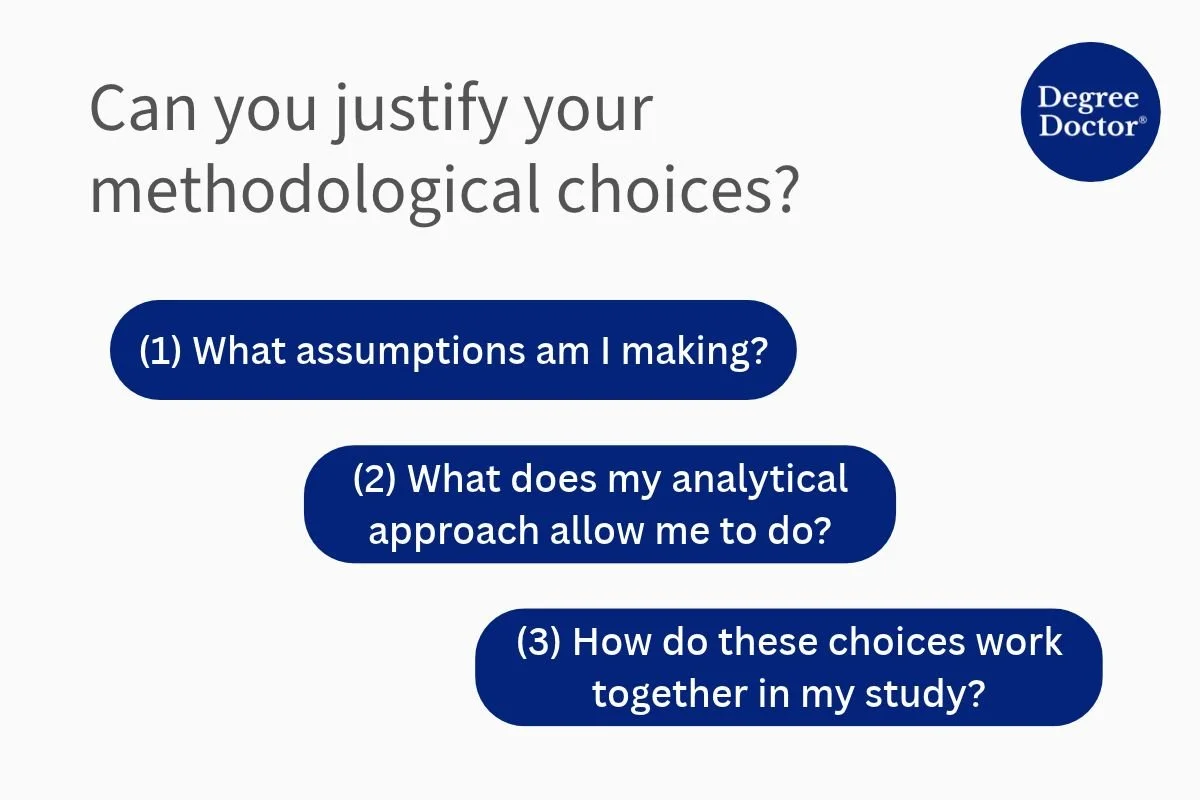
Three questions to help you justify your methodological choices
If you're currently trying to work out whether Critical Realism and RTA make sense together in your study, I'd suggest starting with these three questions.
1. What assumptions am I making?
Think about how you’re approaching what you’re studying - why do you see it in this way?
For our housing officers example, you might assume that organisational structures have real consequences for professional practice, while recognising that participants' accounts offer partial, situated understandings of those consequences.
2. What does my analytical approach allow me to do?
Think about why RTA is appropriate for your research questions.
What connections between people's experiences and perspectives are you trying to identify and make sense of?
What role will your assumptions and how you deal with with the data play in constructing your themes?
What will your analysis NOT allow you to claim?
That last question is super important, by the way. Boundaries matter.
3. How do these choices work together in MY study?
This is where you need to bring everything together.
How will your Critical Realist assumptions influence the way you interpret participants' accounts?
How will you move from those accounts towards your analytical arguments?
How will you justify the claims you make about what you're studying?
If you can answer these questions clearly, you're getting somewhere.
What should I actually write in my methodology chapter?
Here's something I'd avoid:
"This study adopts a Critical Realist paradigm and uses Braun and Clarke's six-phase reflexive thematic analysis."
Now, there's nothing necessarily wrong with that sentence. It's just that it doesn't explain very much!
You've told your reader WHAT you've chosen, but not WHY, or how those choices work together.
Instead, you need to explain the reasoning behind your decisions.
For example, in our hypothetical housing officers study, you might explain that your Critical Realist position allows you to recognise the potential influence of organisational structures while acknowledging that participants' accounts are situated and interpreted.
You could then explain why RTA is appropriate for developing an interpretative analysis of patterns of meaning across those accounts.
Crucially, you'd need to show how those interpretations contribute to your wider understanding of it, without claiming that your themes provide direct or definitive access to underlying mechanisms.
See what we're doing here?
We're explaining the relationship between the appraoches - RTA and Critical Realism. That's a much stronger methodological justification.
So, what's the takeaway?
Yes, you can use Braun and Clarke's reflexive thematic analysis with Critical Realism.
But - big but - don't mistake compatibility for justification.
Your job is to explain why you've made the choices that you have and demonstrate how they contribute to answering your research questions.
If that’s a struggle, you probably haven't quite worked through the reasoning behind them yet. Which is something you CAN work on.
Before you go hunting for another paper that combines Critical Realism and RTA, have a go at answering those three questions. You might find they're much more useful than another hour spent searching!
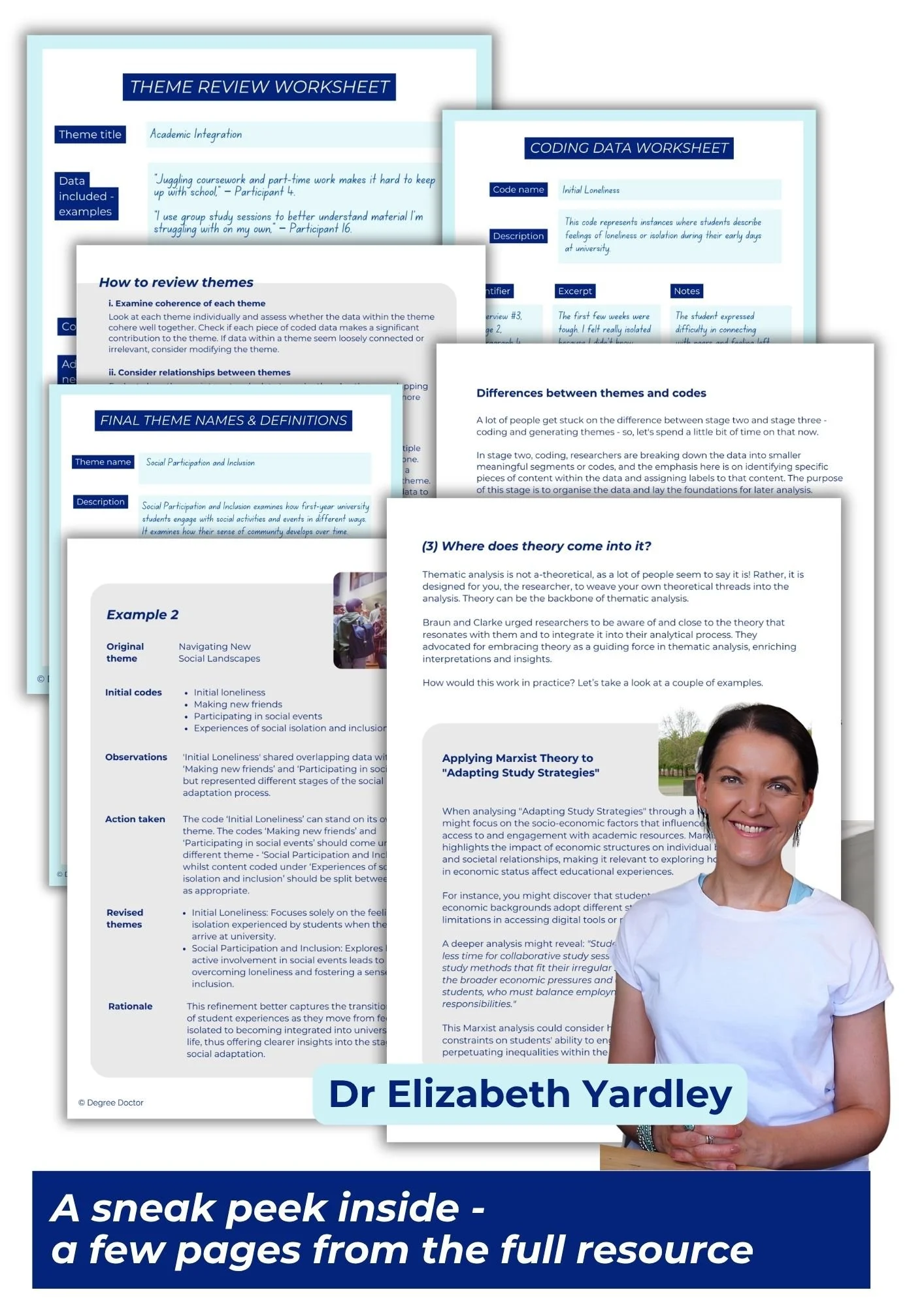
Need some help with reflexive thematic analysis?
If you're using Braun and Clarke's RTA in your own research, my Braun & Clarke Reflexive Thematic Analysis Guide walks you through the analytical process, with practical exercises to help you make sense of your data and the decisions you're making along the way. And can I just say this one thing - if you buy this, please do the damn exercises, because that’s how you’ll get your analysis done - otherwise, you’re just wasting your money. Okay? 😉
If it's the philosophical side of things that's making your brain hurt, you might also find my articles on Critical Realism and ontology, epistemology and research paradigms helpful - you’ll find them in this section of my blog.