When to stop reading for your thematic literature review (and start writing)
If you’re writing a thematic literature review or narrative literature review, you probably recognise this moment:
You’ve read extensively.
Your notes are detailed.
Your reference manager is overflowing.
And yet you still think:
“I just need a few more papers before I start writing.”
This is one of the most common traps in a PhD.
Especially when your literature review is organised by themes or topics rather than chronology, methodology, or study design - which is exactly how most social science and qualitative PhDs structure theirs.
Here is the reality:
You will never feel finished reading.
A strong thematic or narrative literature review is not built on reading everything.
It is built on recognising patterns - and having the confidence to organise them.
Why thematic and narrative literature reviews make stopping harder
In a systematic review, there are explicit stopping rules.
In a thematic or narrative literature review, there aren’t.
You are making interpretive decisions about:
which debates matter
which concepts are central
how the field is organised
where tensions sit
That freedom can feel uncomfortable.
The more you read, the more you see.
The more you see, the more you worry you’re missing something.
But the aim of a thematic literature review is not completeness.
It is coherence.
Your job is to show the shape of the field - not catalogue every contribution within it.
(1) Stopping rule one: you can organise the field into themes
The defining feature of a thematic literature review is that it is structured around ideas, not authors.
You know you are ready to stop reading (for now) when you can say:
“There are three main ways this topic has been conceptualised…”
or
“The literature clusters around four recurring tensions…”
Instead of moving paper by paper, you are grouping research into conceptual themes, theoretical debates, recurring assumptions, methodological divides or contextual differences.
When you can explain your field this way, you are no longer collecting, you are synthesising.
Further reading often begins to confirm what you already know rather than fundamentally reshaping your structure.
That repetition is a signal.
It means you are ready to write.
(2) Stopping rule two: new articles fit into your structure
Another marker that you’ve read enough for a thematic or narrative literature review is predictability.
You skim a new paper and immediately think:
“This belongs under my theme on institutional trust.”
“This challenges my section on identity formation.”
“This adds nuance to the debate about power.”
If you can place new research within your emerging structure quickly, you have developed a mental map of the field.
At that point, reading more rarely changes the architecture of your review. Writing will.
(3) Stopping rule three: your questions become interpretive
Early-stage reading is driven by exploratory questions:
What has been written?
What are the key concepts?
Who are the major authors?
Later, your questions shift:
How do these ideas connect?
What assumptions underpin this debate?
Where are the conceptual gaps?
How does my study reposition this conversation?
When you move from gathering to interpreting, you have entered the analytical phase.
And a thematic or narrative literature review is fundamentally an interpretive act.
You are shaping an argument about how the field is organised.
That work cannot be completed through reading alone.
Why writing strengthens a narrative literature review
Many PhD researchers assume clarity must precede writing.
In practice, writing produces clarity.
When you attempt to structure your thematic literature review, you will quickly discover which themes are well-supported, where your argument feels thin, and where targeted reading is genuinely needed.
Targeted reading is powerful.
Unstructured reading is not.
The moment you begin drafting sections organised by theme, your role shifts from reader to researcher.
That shift is what strengthens a narrative literature review.
You’re not trying to prove you read everything
Stopping reading is not about limiting your knowledge.
It is about recognising that a thematic or narrative literature review is an argument, not an archive.
You are not trying to prove you have read everything.
You are showing that you understand the landscape well enough to organise it.
Once you can do that, you are ready to write.
If you want structured support
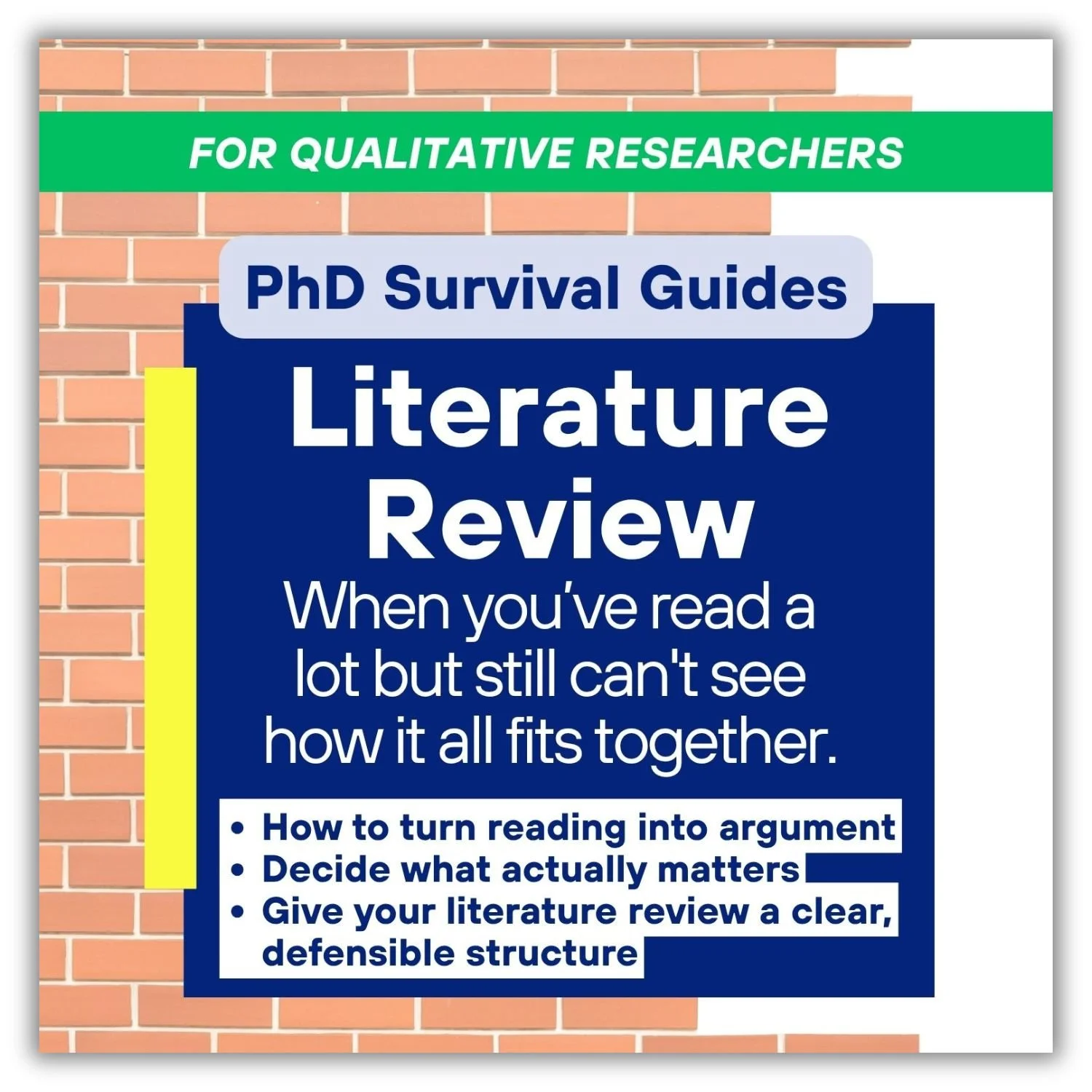
If you are writing a thematic or narrative literature review and feel stuck between reading and writing, my Literature Review PhD Survival Guide walks you through:
identifying and refining themes
structuring sections coherently
synthesising rather than summarising
positioning your study clearly within debates
It offers calm, structured support for researchers who want depth - without drowning in sources.
Because more reading does not always improve your literature review.
Clear synthesis does.