Why does my literature review feel disjointed after I’ve analysed my qualitative data?
If you’re a PhD researcher returning to your literature review after qualitative data collection or early analysis, and something feels off, this is 100% normal.
In fact - it’s to be expected. I worry when people tell me that their literature review is still working great after data collection. I worry they haven’t read it recently!
So, don’t despair if you’re reading through a literature review you wrote months (or years) ago, thinking, “Mmm, this isn’t working anymore”, or cringing slightly.
It might feel disjointed, slightly outdated, or just no longer quite aligned with the research you’ve actually done.
This is the point where many doctoral candidates reach the same conclusion: “I think I need to rewrite this”, or “Maybe I just need to read more”. In most cases, neither of those are the real issue.
What’s actually happening
What you’re experiencing is a shift in understanding.
For example, you might have a section in your literature review on “stress and wellbeing” that once felt central. Now you’ve analysed your data, what’s actually emerging is something more specific - perhaps how people interpret expectations, or how they internalise pressure in particular ways.
The original section isn’t wrong. It just no longer quite lands where your research now sits.
I remember one time, when one of my former supervisees came back to their literature review after analysing their interviews and said, “I don’t understand - this chapter made sense before and I was so pleased with it, but now it just feels… off.”
Nothing had gone wrong. In fact, it was the opposite. Their analysis had moved their thinking forward, but the literature review was still anchored in where they had started.
By the time you reach data collection and analysis in a qualitative PhD, your research is no longer what it was when you first wrote your literature review.
Your research questions have sharpened. The conceptual focus of your study has narrowed or deepened. Your sensitivity to certain ideas has increased. Your understanding of what matters has changed.
The literature review in front of you now was written at an earlier stage - based on an earlier version of your thinking, and if that structure hasn’t evolved alongside your research, a gap opens up.
The real issue: conceptual drift
Many researchers interpret this feeling as:
“I haven’t read enough.”
But far more often, the issue is this:
Your literature review is still organised around concepts that are no longer central to your research.
This is what creates that sense of disconnection.
The structure - the themes, the headings, the way the argument is organised - is anchored in a previous version of the project.
Meanwhile, your analysis is pointing somewhere more specific, grounded, and precise.
Unfortunately, the two are no longer speaking to each other.
This is what conceptual drift looks like in practice - enough to make everything feel slightly out of sync - as you can see from the example below from a nursing PhD.
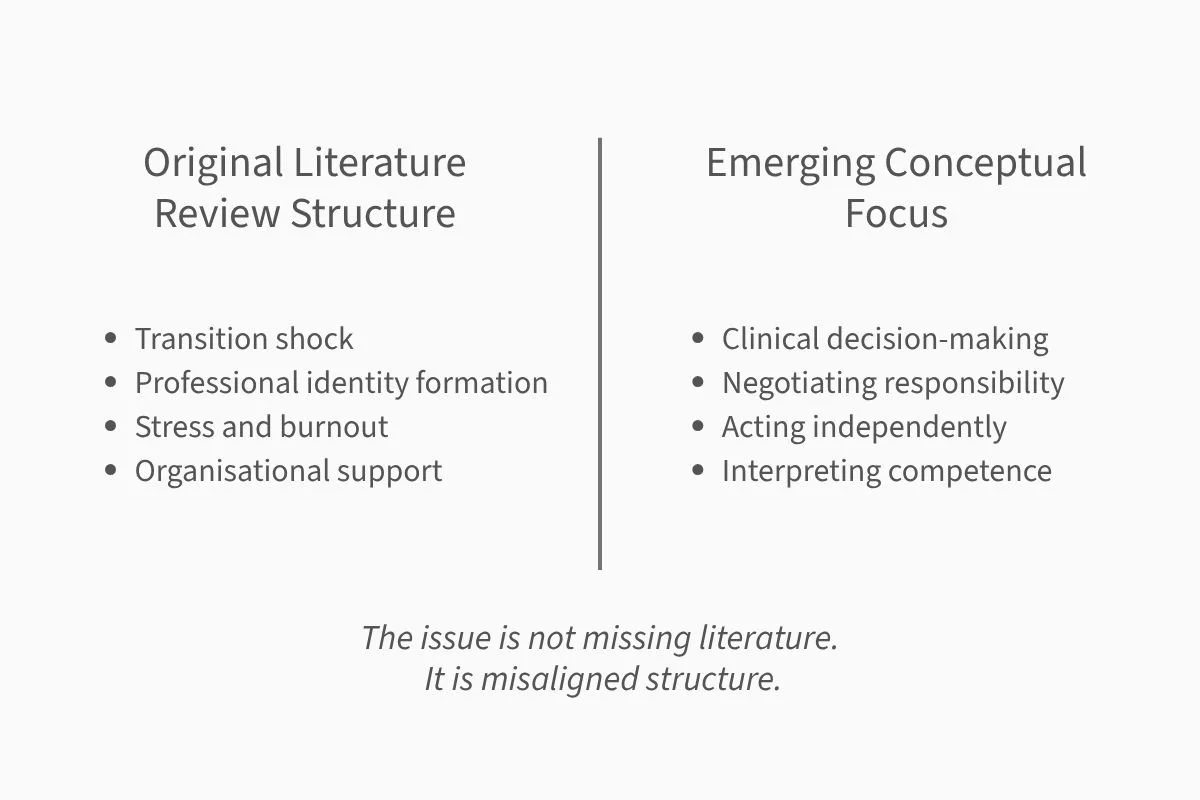
When your structure no longer reflects your thinking, the issue is alignment - not volume of reading.
Why reading more doesn’t fix this
At this stage, most qualitative researchers already have dozens of papers, detailed notes, and a substantial drafted chapter.
The instinct to “read more” often adds volume without resolving the underlying issue because the problem is not the amount of literature. It’s the way that literature is organised in relation to your current understanding.
You can read another twenty papers and still feel stuck if the structure holding that knowledge hasn’t been reconsidered - this is usually the point where people start to feel like they’re going in circles.
I’ve seen people respond to this by doubling down on reading. One student I worked with added dozens of new papers to their review at this stage, and still felt like it wasn’t coming together. The issue wasn’t a lack of literature. It was that the structure hadn’t caught up with what their research had become.
Many PhD candidates lose time at this juncture because they try to solve a structural problem with more input, but what’s required is re-evaluation.
Reclaiming interpretive authority
Early in the PhD, your literature review is largely responsive.
You’re learning the field, mapping existing conversations, and trying to position your study.
However, later in the process, particularly after engaging with your data, something changes - you are no longer just receiving the literature, you are interpreting it.
In selecting what matters and reorganising it in light of your findings, you are making a move toward interpretive authority. This requires a different kind of work.
Not, “What does the literature say?”, but, “What concepts does my research actually depend on now?”.
Where disconnection actually shows up
When alignment breaks down, it tends to show up in non-obvious ways, which can be hard to spot. However, there will be a few subtle signs that all is not well, like:
The themes feel slightly too broad
Certain sections feel less relevant than they once did
Important ideas emerging from your data aren’t clearly reflected
The chapter doesn’t quite “lead into” your findings anymore
This is not because the literature review is “wrong” or in need of a major overhaul - it’s because it is incomplete in relation to your current research.
For instance, you might notice that one of your main themes in the literature review - something that took a lot of time to build - barely appears in your findings anymore.
Or that a concept that keeps showing up in your data is mentioned only briefly, almost in passing, in your literature review.
That mismatch is usually the clue.
Realignment, not rewriting
The mistake many researchers make at this point is assuming they need to start again. That is rarely necessary.
What’s needed is something more precise - a process of realignment.
This begins with a putting your existing literature review structure alongside what your research has become.
On one side - your current themes and the way your chapter is organised. On the other - the key concepts emerging from your data and the issues your analysis is actually engaging with
Then take a look at them both together and ask yourself:
Where do these align?
Where do they diverge?
What is missing?
I spoke with a PhD researcher recently who was upset that one of their main literature review themes - something they had spent literal months developing - barely appeared in their findings at all. At the same time, an issue that was central to their data was something they hadn’t come across at all in their literature review. The task for them wasn’t to start again, it was to rebalance what actually mattered.
In the example below, you can see how the structure could be realigned.
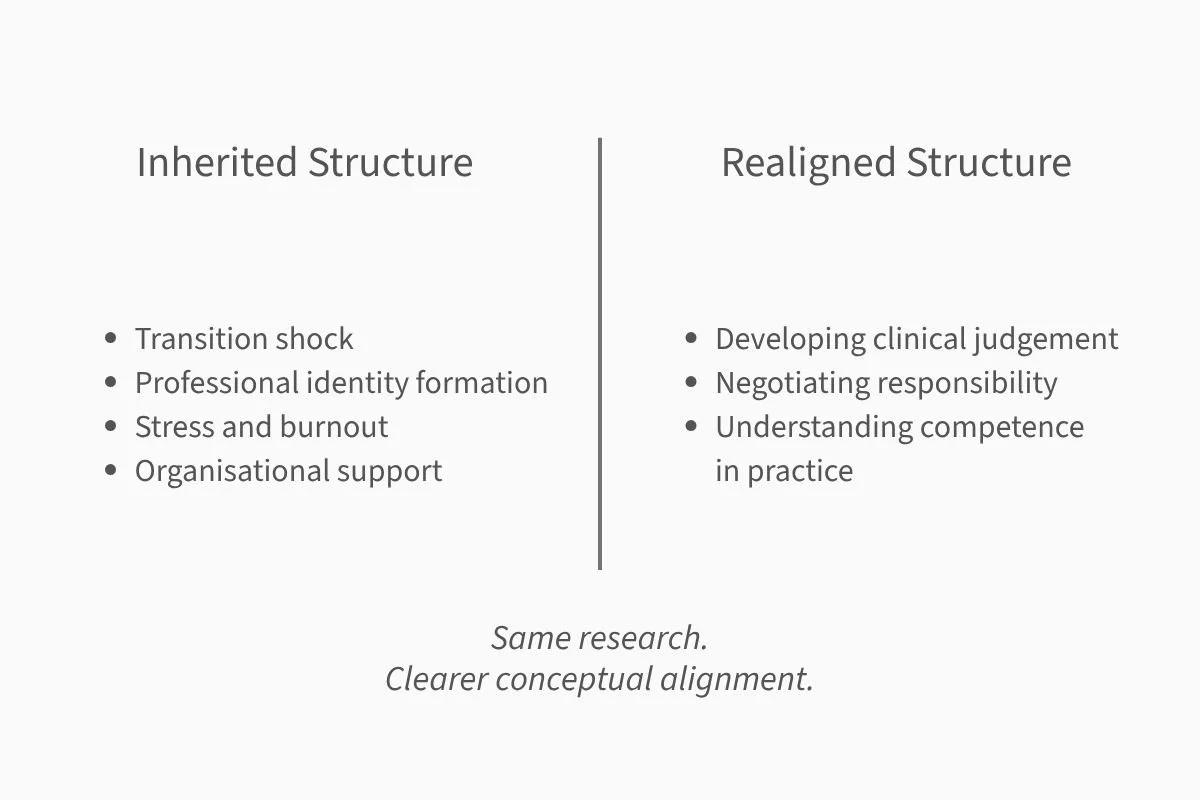
Realignment isn’t about starting again. It’s about tightening the structure so it actually reflects what your research has become.
Strengthening conceptual alignment
When you do this work properly, three things usually become visible.
Some areas still hold.
Certain concepts - often more foundational ones - remain relevant. However, they may need to be sharpened or reframed. Other areas lose centrality - they may still matter, but they no longer organise the argument - they might shift from being core themes to supporting context.
There are gaps - concepts that are now clearly central to your research, but are underdeveloped in your literature review.
This is the critical point - because this is where your literature review is no longer doing its full job, as it no longer reflects the structure of your thinking.
What this means in practice
Once you see this clearly, the work becomes more focused.
You are not starting again, expanding everything, or reading indiscriminately.
You are refining existing sections, repositioning others, and engaging more deliberately with literature that supports your current conceptual focus.
This is targeted, conceptual work and it changes how the rest of your thesis comes together.
The relationship to the discussion chapter
One concern that often follows is this:
“If I’ve realigned my literature review to match my research, what’s left for the discussion chapter?”
These two chapters are doing fundamentally different things.
Your literature review establishes the conceptual landscape. It clarifies how key ideas are understood, where tensions and gaps exist, and the intellectual territory your research sits within
Your discussion chapter, by contrast, is where your research enters that landscape. This is where you extend existing ideas, confirm or challenge interpretations, and develop the conversation through your findings.
Even a well-aligned literature review is not making those claims. It is preparing the ground for them.
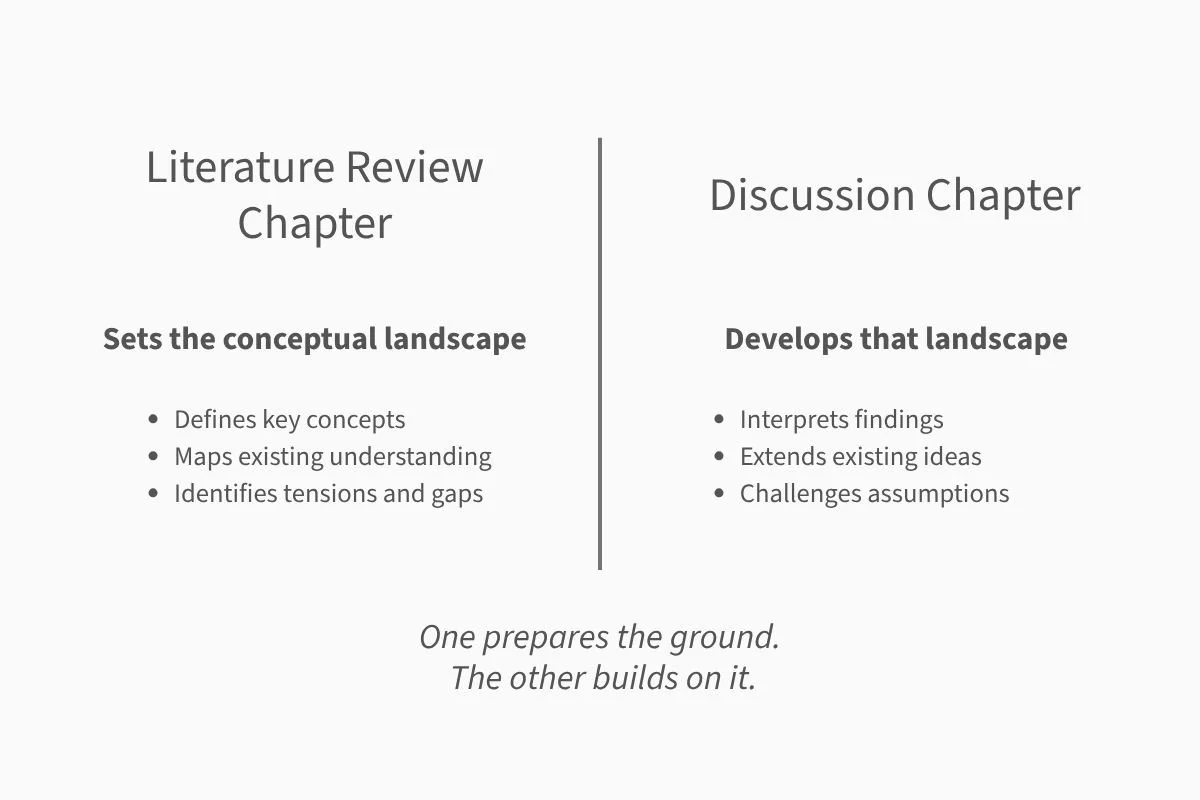
The literature review prepares the ground. The discussion develops it.
A shift toward coherence
What this process ultimately gives you is coherence across your thesis.
Your concepts are clearer, your structure is more deliberate, your argument develops more naturally - and the work starts to feel more stable.
If you’re ready to work through this properly
This kind of realignment - this “let’s get this all playing nicely together” - is not always straightforward to do alone. It’s also the kind of work that’s surprisingly hard to see clearly when you’re deep inside your own project.
It requires clarity about your conceptual foundations, confidence in your interpretive role, and a structured way of evaluating and reshaping your work.
If you’re ready to work through this properly, this is exactly what I cover in my Literature Review Survival Guide. You might also find it useful to revisit your broader conceptual foundations - particularly if the sense of drift feels deeper than just structure. That’s something I walk through in my Clarifying Your Research PhD Survival Guide.
You can explore both within my Complete PhD System below.