Why your qualitative PhD feels so uncertain - and why that doesn’t mean you’re doing it wrong
There’s a stage in a qualitative PhD where you find yourself circling the same question:
Is this actually okay?
Completely understandable. So, let me tell you a story that will help you answer that question properly.
I was recently in Jersey in the UK Channel Islands, wandering through the sort of small independent shops that seem to be disappearing elsewhere.
Shelves lined with ceramics, textiles, bits of jewellery. Proper handmade things. You could see the slight variations in them - differences in shape, colour, finish. Nothing identical. Nothing trying to be.
I remember picking up a small ceramic bowl and turning it over in my hands.
It would have been ridiculous to say to the person behind the counter:
Well… you didn’t quite get that right, did you?
I didn’t point out that it wasn’t perfectly symmetrical. I didn’t wonder aloud whether another version might have been smoother, rounder, more correct. Of course I didn’t.
Because that is not how we evaluate handmade work.
We understand that variation is part of the value. We recognise that judgement, touch, attention and process are present in the final piece.
Yet many researchers approach qualitative PhD work - especially qualitative analysis - in the opposite way.
They look at their themes and immediately begin circling: Is this right? Is it too obvious? Have I done this properly?
Underneath those questions, there is often something more difficult: I don’t know if this is good enough. I feel like I’m making this up.
That experience is more common than most people realise.
It also does not mean you are doing your PhD wrong.
When your qualitative PhD starts to feel less certain, not more
There is often a stage in a qualitative PhD where, from the outside, things appear to be progressing well.
You’ve collected your data, started analysing it, maybe you’re drafting chapters or thinking about writing up.
People assume this is the point where confidence arrives. Instead, it is often the point where certainty begins to thin out.
You’ve spent time with transcripts, fieldnotes, documents, observations. You’ve coded material, grouped ideas, noticed patterns. Then you step back and think:
Are these themes actually right?
Is this rigorous enough?
Have I done too much… or not enough?
Many researchers assume they should feel more sure by now and worry something has gone wrong. Usually, something else is happening.
Why qualitative analysis can feel so unsettling
Early in the PhD, research methods often look structured on paper.
There are stages, steps, frameworks, checklists. That can feel reassuring.
As the project develops, the work changes. You’re asked to interpret, make judgements, justify decisions, and explain why your reading of the data makes sense.
That is where discomfort often begins, because you’re being asked to think as a researcher.
This can feel strangely exposing because judgement is harder to lean on than rules. It is less tidy. It rarely comes with the feeling of certainty people expect. At times, it can feel as though you are inventing everything as you go.
You are not “just making it all up”. You are working in a form of research that requires interpretation, reflexivity, and reasoned decision-making.
Your themes are not supposed to be machine-made
This is where the handmade bowl matters.
You are not extracting one perfect set of hidden themes from your data, as though they were buried there waiting intact.
You are developing an interpretation.
That interpretation is shaped by:
what you notice
what you connect
what you consider meaningful
what your research questions make visible
how you understand the context
what theoretical ideas help you think
Another thoughtful researcher may notice different things, ask different questions, or organise meanings differently.
That is not evidence that one of you is right and the other one is wrong. It reflects the nature of qualitative inquiry.
Your analysis is, in a very real sense, handmade.
It is crafted and it is curated.
Why “Is this good enough?” keeps you stuck
When researchers do not have a usable way to evaluate their analysis, they often default to one vague question:
Is this good enough?
The problem is that “good enough” is not a meaningful standard.
It does not tell you what to strengthen, what to refine, what is already working, where the gaps are, or how to justify your choices. It simply keeps you circling.
A more helpful set of questions might be:
Can I explain how I moved from data to interpretation?
Are my themes coherent and distinct enough to be useful?
Do they illuminate something meaningful in relation to my research question?
Have I shown enough evidence for the claims I am making?
Have I acknowledged complexity rather than forced neatness?
Those are questions you can actually work with.
What rigour looks like in qualitative research
Some uncertainty comes from measuring qualitative work against standards borrowed from very different research traditions.
If rigour means control, prediction, detachment, and replicability in your mind, qualitative research can feel like it is always falling short.
But as qualitative resaerchers, we’re not aiming for those things, we are doing something else. Rigour in qualitative work often looks more like:
transparency of decision-making
depth of engagement with data
coherence between question, method and claims
reflexive awareness of your role in the research
careful interpretation grounded in evidence
intellectual honesty about limits and ambiguity
This can feel less concrete at first, particularly if you work in departments where other approaches are treated as the default.
Why this stage of the PhD matters
The uncertainty many researchers dislike at this point is often a sign of transition.
You are moving from being someone who follows research instructions to someone who exercises research judgement.
That shift can feel uncomfortable precisely because it is developmental. You’re building capacities that did not exist fully formed at the start: discernment, confidence, restraint, justification, trust in your own reasoning.
Those qualities usually grow unevenly and uncomfortably, they’re something you get more at ease with in time.
What helps when everything feels uncertain
This stage improves when you have a more grounded way of working through uncertainty - usually that means structure.
Not rigid formulas or generic advice, but a clear framework for making decisions about methodology, coding, themes, interpretation and writing up what you have done.
When researchers have that kind of structure, they tend to doubt themselves less because they can see the reasoning behind their own choices.
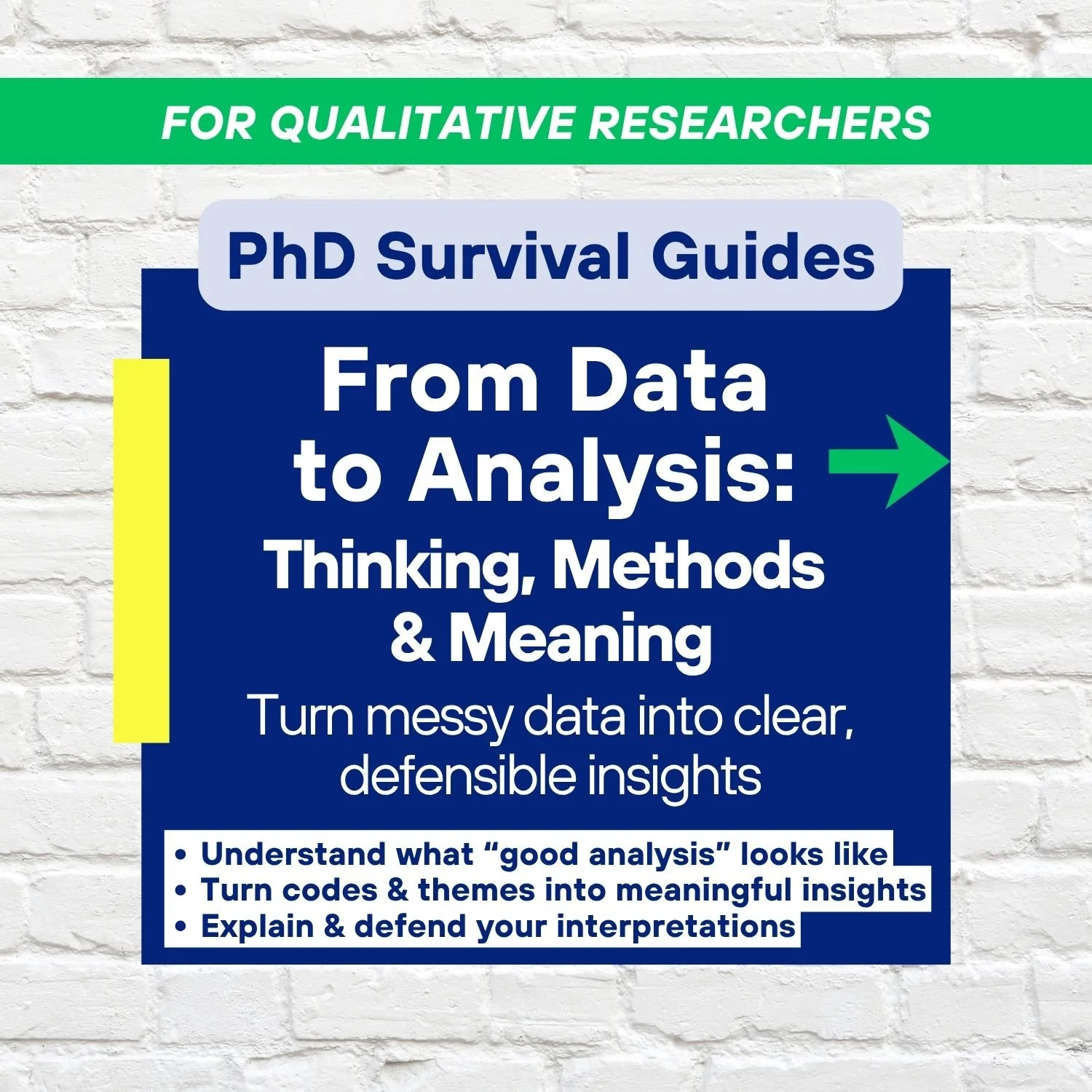
If that is the stage you are in now, my PhD Survival Guides: Methodology, Data Collection & Analysis was designed for exactly this part of the journey - helping you make coherent decisions and stand behind them with more confidence. Learn more about it here.
“I can describe what I did. I just don’t know if I trust my own judgement.”
This is the point in the PhD where your research starts demanding something different: interpretation, judgement, coherence, and confidence in your reasoning. This guide was written for that stage.
Swipe through the images above to see what’s inside.
Get the full Survival Guide set here.
If you have any questions, feel free to contact me. I’ll be happy to help.
By purchasing this product, you agree to our Terms & Conditions.