Why your PhD supervisor keeps changing their mind - and what it actually means in qualitative research
When it comes to supervision, there’s a point in many PhDs that people don’t really prepare you for. Most of the doctoral students I’ve supported through qualitative research have hit this supervision hurdle. It usually pops up during the middle stages of the doctorate, when you’re a couple of years in. Here’s what happens:
You come out of a supervision meeting thinking you know what to do next. In the meeting, you wrote things down, the conversation felt clear enough, and nothing stood out as confusing at the time.
Then you sit down to actually do the work.
You try to pick up where the conversation left off. However, something doesn’t quite… hold together.
You read through your notes again and try your hardest to think back to parts of the meeting in your head. You start trying to reconstruct what they meant rather than what they said.
At that point, most people make a decision to move forward without going back to ask for clarification, instead interpreting what was said, filling in the gaps as best they can, and proceeding on that basis.
Weeks later, when you next catch up, your supervisor looks at what you’ve written and and says something like:
“I think this needs to go in a different direction.”
Or:
“I’m not sure this is quite what we agreed.”
You feel that sinking feeling, urgh. You thought that was what they were asking for.
Where your mind goes next
Most PhD students don’t respond to that moment by questioning the clarity of the instruction. They question themselves:
Did I misunderstand that?
Have I missed something obvious?
Am I out of my depth here?
Once that line of thinking opens up, it tends to stay open because your PhD supervisor is not just another person giving feedback, but someone you respect, whose judgement carries weight, and who represents the level you are trying to reach.
When there is a mismatch, it doesn’t feel neutral. It feels personal. Ouch.
Why you don’t ask the question in the meeting
If we’re being real, it would make sense to stop and ask for clarity, wouldn’t it?
To say, “Can you show me what that would look like?” or “Can we pin down what you mean by that?”.
But many PhD students don’t do that - they leave the meeting with uncertainty and carry it away with them.
I’ve seen this repeatedly over the years, both supervising PhD researchers and supporting them from the sidelines. The hesitation isn’t about laziness or lack of engagement. It’s about how much the relationship matters.
There is a strong instinct to handle that relationship carefully.
You don’t want to slow the meeting down because you know you only have an hour and the clock is ticking.
You don’t want to ask something that sounds obvious.
You don’t want to get that look your supervisor gives you sometimes, you know the one? That, “Maybe I was wrong about you being up to this” one.
For many people, there is a deeper concern sitting underneath all of that:
You don’t want to frustrate your supervisor - or annoy them - so you take responsibility for figuring it out afterwards and reconnect the dots on your own.
Why it starts to feel like the goalposts are moving
When this happens more than once, it starts to feel like a pattern.
You follow the direction you were given. The direction changes.
You respond to the feedback. The emphasis shifts.
Over time, it becomes harder to trust that what you are doing now will still be right at the next meeting.
That’s where the sense of instability comes from.
This might not be because your supervisor is being deliberately inconsistent (in most cases, they’re really not trying to trip you up), but because the expectations are not being made fully explicit.
What is happening on the supervision side
From the supervision side, the experience is different.
Having supervised PhD students and worked for over twenty years in UK universities, I can tell you that most supervisors are not working from a fixed picture of what your project should look like.
They understand research. They understand standards. They know what strong work looks like in their field.
Your project, though, is still developing.
I have never started a supervision journey thinking, “I know exactly what they need to do and what they’re going to find”, like some woo-woo academic psychic. I have, however, thought, “I am so excited to see where they take this. I’m going to enjoy supporting this person.”
There’s something else happening here that doesn’t always get named clearly enough.
The supervision relationship itself changes as you move through the PhD.
At the beginning, you are very much in student mode. You are learning the field, learning the methods, learning how research works. At that stage, your supervisor is guiding quite a lot of the content. They help shape direction. They point you towards what matters. They are more directive because that is what is needed.
But as you move further in, particularly once you have collected your data and started analysing it, something shifts.
You begin to know your project in a way that nobody else does.
You have spent hours with your data. You have made decisions. You have seen patterns emerge. You are becoming the person who understands this study most deeply.
At that point, your supervisor’s role changes.
They are no longer guiding the content in the same way. They are guiding the process.
They ask questions. Sometimes quite awkward ones. Not because they are trying to catch you out, but because they don’t already know the answers.
They don’t know your data in the way that you do.
They are, in many ways, coming alongside you and working it through with you.
So when you bring them a draft, they respond to what is now visible on the page. That response can shift the focus. It can bring something else into view. It can raise a question that simply wasn’t there before.
From their perspective, the project is becoming clearer.
From your perspective, it can feel like the target has moved.
Why qualitative research makes this more pronounced
In qualitative research, this dynamic is stronger.
You are not working through a fixed sequence where everything is decided in advance but through interpretation, meaning, and conceptual development.
You might spend weeks refining your interview design, only to be told that the conceptual framework now needs attention.
You might produce a detailed findings chapter, only to be told that your analytical voice needs strengthening.
Each stage reveals the next layer of work.
That progression makes sense when you step back from it. It is much harder to recognise when you are in the middle of it and trying to meet expectations that haven’t been fully defined.
The shift that changes the experience
At some point, continuing to leave meetings with unanswered questions stops working.
You spend too much time trying to interpret what was meant so you stop carrying uncertainty away from the meeting and bring it into the conversation.
It sounds like this:
“When you say develop this further, what would that look like on the page?”
Or:
“Is this something you’d like written up, or something you want me to think through first?”
Or:
“So for next time, the priority is this rather than that. Is that right?”
These questions turn vague feedback into something concrete, make expectations visible, and give your supervisor the opportunity to confirm or correct your understanding before you invest more time.
The ‘I should know this by now’ curve
There’s also a pattern to this that I’ve seen over and over again. And yes, I have drawn a graph to represent it (sorry, not sorry).
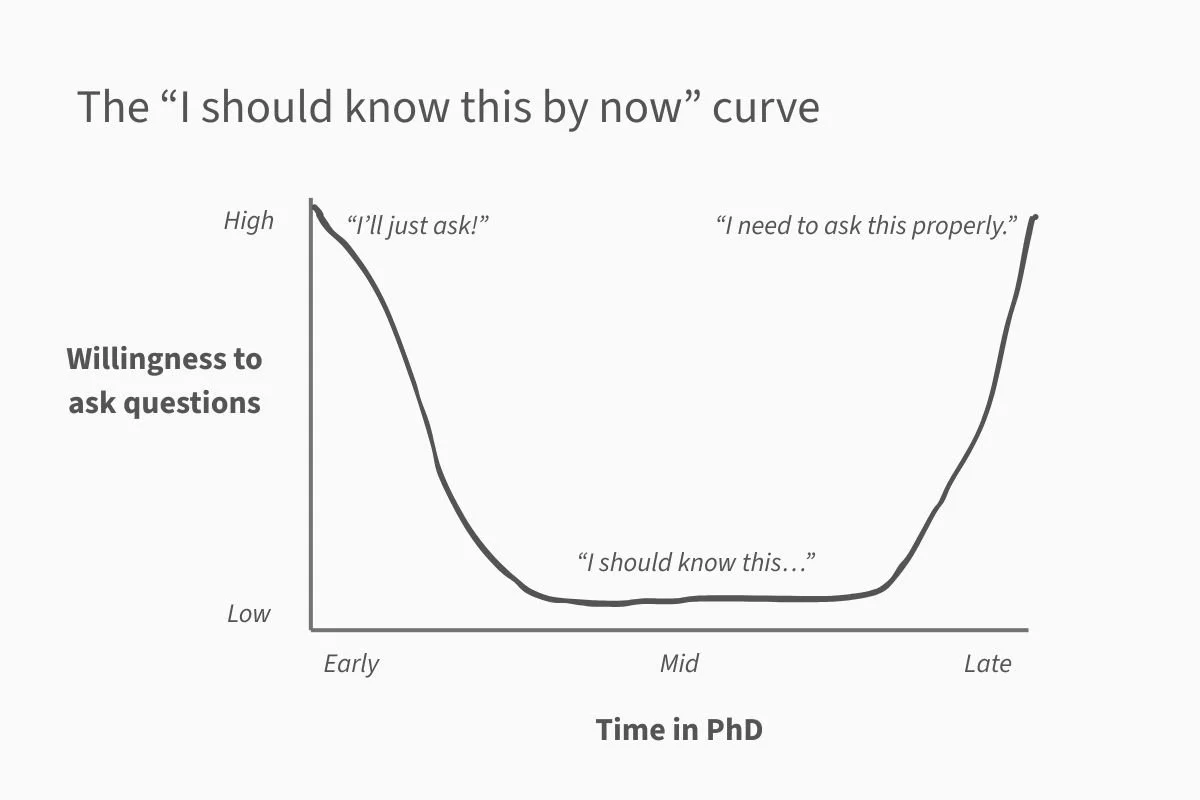
Many PhD students stop asking questions at the point they need them most
At the very start of a PhD, most students are quite open about not knowing things. You embrace the keen-bean beginner energy. You ask questions freely because that’s expected. You’re new, you’re learning, and nobody is expecting you to have it all figured out.
Then something happens in the middle.
You’re no longer brand new, but you’re not finished either. This is where many people start to feel like they should be able to work things out for themselves. You become more cautious. More aware of how you might come across. You start filtering your questions, holding some of them back, trying to resolve things on your own first.
That’s often exactly where this supervision issue shows up.
Later on, towards the final stages, something moves again. At that point, the priority becomes getting the work done properly and getting it finished. The hesitation drops away. You ask the question because you need the answer.
Sometimes that comes with a bit of frustration. Sometimes it comes after going round in circles for longer than you would have liked.
But by that stage, you’ve realised something important:
Asking the question earlier would have saved you time.
Why this matters more than it might seem
Without clarification, you are always working from your own interpretation.
Sometimes that interpretation will be right. Sometimes it won’t.
When you bring the question into the meeting, you remove the guesswork. You move from trying to get it right on your own to working with your supervisor to define what “right” looks like in the next step.
Asking these questions can feel exposing at first.
It can feel like you are admitting that something wasn’t clear, or interrupting the flow of the conversation.
In practice, it changes how you are positioned within that conversation.
You are no longer the person who receives feedback and tries to decode it later.
You are the person who engages with the feedback as it is being given.
That shift matters. It aligns much more closely with what doctoral work actually involves, which is not following instructions, but developing clarity through discussion, interpretation, and decision-making.
Instead of trying to anticipate what your supervisor wants, you make the expectations part of the conversation.
Instead of leaving with uncertainty, you leave with something you can act on.
Instead of questioning whether you are getting it right, you focus on making the next step clear.
If you want to approach this more deliberately
If you are navigating this stage of a PhD and your supervisor’s feedback feels difficult to pin down, this is exactly the kind of thinking I work through in the PhD Survival Guides.
The Methodology, Data Collection and Analysis guide in particular focuses on how to make clear, defensible decisions as your qualitative research develops.
It doesn’t remove the need for judgement or supervision. It gives you a structure for using it well. It’s here when you’re ready for it.
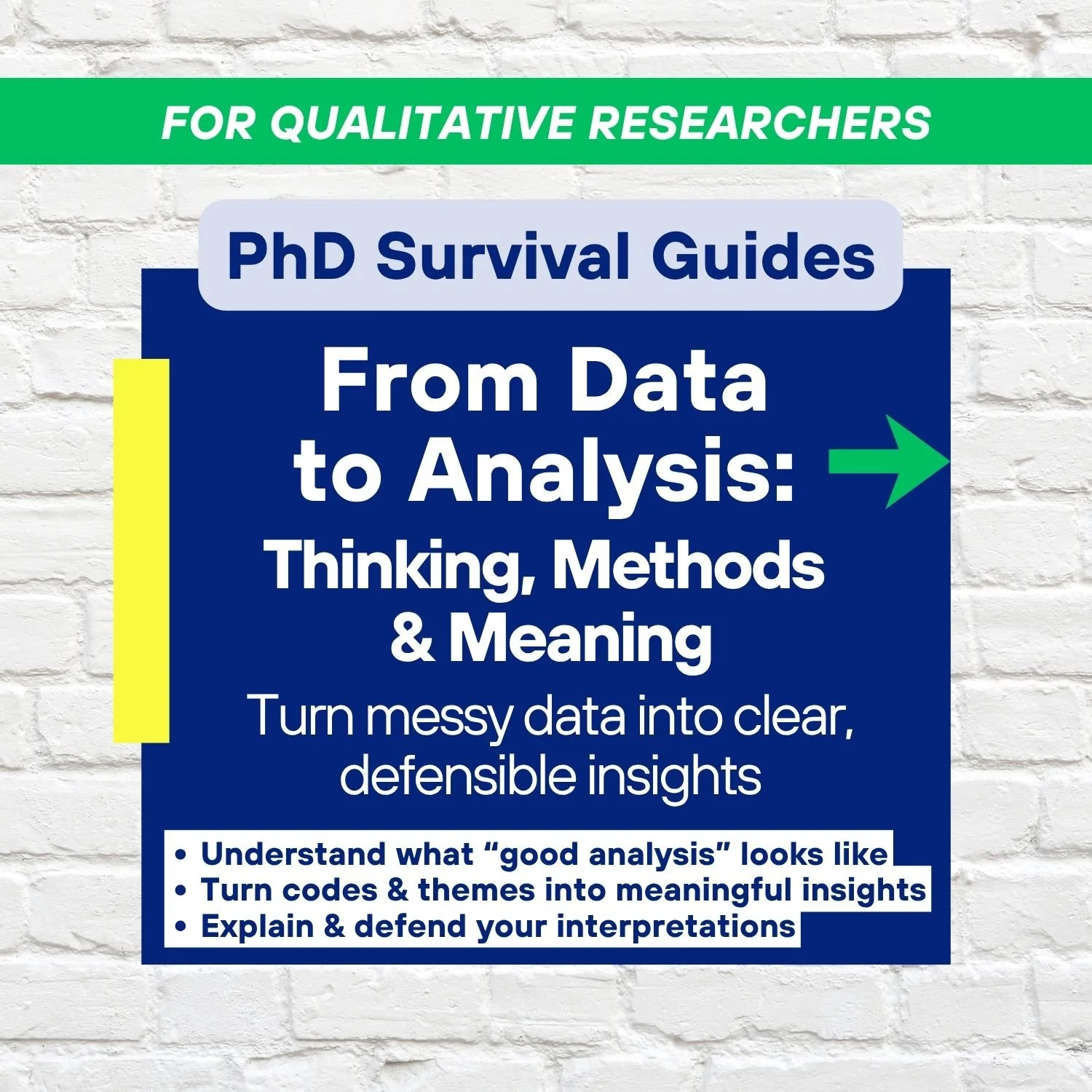
“I can describe what I did. I just don’t know if I trust my own judgement.”
This is the point in the PhD where your research starts demanding something different: interpretation, judgement, coherence, and confidence in your reasoning. This guide was written for that stage.
Swipe through the images above to see what’s inside.
Get the full Survival Guide set here.
If you have any questions, feel free to contact me. I’ll be happy to help.
By purchasing this product, you agree to our Terms & Conditions.