PhD productivity: what to do when you feel like you've fallen behind
Summer can be kind of weird if you’re a PhD researcher. You might have imagined that everything slowing down would magically create loads of lovely empty space for you to crack on with the PhD, except your busy adult life doesn’t necessarily get the memo. Work carries on, family life carries on, holidays, childcare, weddings, life admin and all the other things that occupy your time carry on, and all that PhD bandwidth you thought you’d have gets gobbled up.
Meanwhile, university campuses become a little echoey and, if you do find yourself having to go in for some reason, you feel like Cillian Murphy at the start of 28 Days Later. Like, where did everybody go? You do get immediate responses to every email you send – but they’re from the out-of-office auto replies.
Why PhD productivity often disappears over the summer
Then, we get towards the end of August into early September, and everything springs back to life again, like someone pressed the play button after the video was on pause for the best part of three months.
This can be kind of triggering, because all of a sudden – boom – you’re jolted back into PhD life and you get that guilty feeling. The feeling that you’ve “wasted” the summer.
Back in May or June, you probably had an idea of what you were going to get done over the summer period. Perhaps finish that chapter, catch up with the reading, sort out the analysis, write that conference abstract – finally get on top of things. But now, it’s September, and you’re like, “For goodness sake”.
Falling behind on your PhD isn't always a discipline problem
You might respond to this by thinking, “Right, I need to get my act together now, this can’t continue”.
Before you rush off to download a new productivity app or begin another PhD morning routine (it’s really going to work, this one, you can feel it in your bones) – let me interrupt you.
Is this really about throwing more hours at the PhD and forcing more “discipline” on yourself? Is that magically going to get thousands of words on the page? Really?
I want you to stop for a moment and look at the conditions in which you’re trying to do a PhD.
Are you doing this pretty much on your own?
Are you shoehorning PhD time into an already busy adult life?
Are you the only person in your family and social circle who really knows what you’re trying to do at any given time?
When you get stuck, do you just try to figure it all out in your own head?
Maybe part of what’s making this harder than it needs to be is that you’re trying to carry all of this work on your own.
When everything is happening inside your own head, relatively ordinary PhD problems can get very big, very quickly.
When ordinary PhD problems turn into big ones
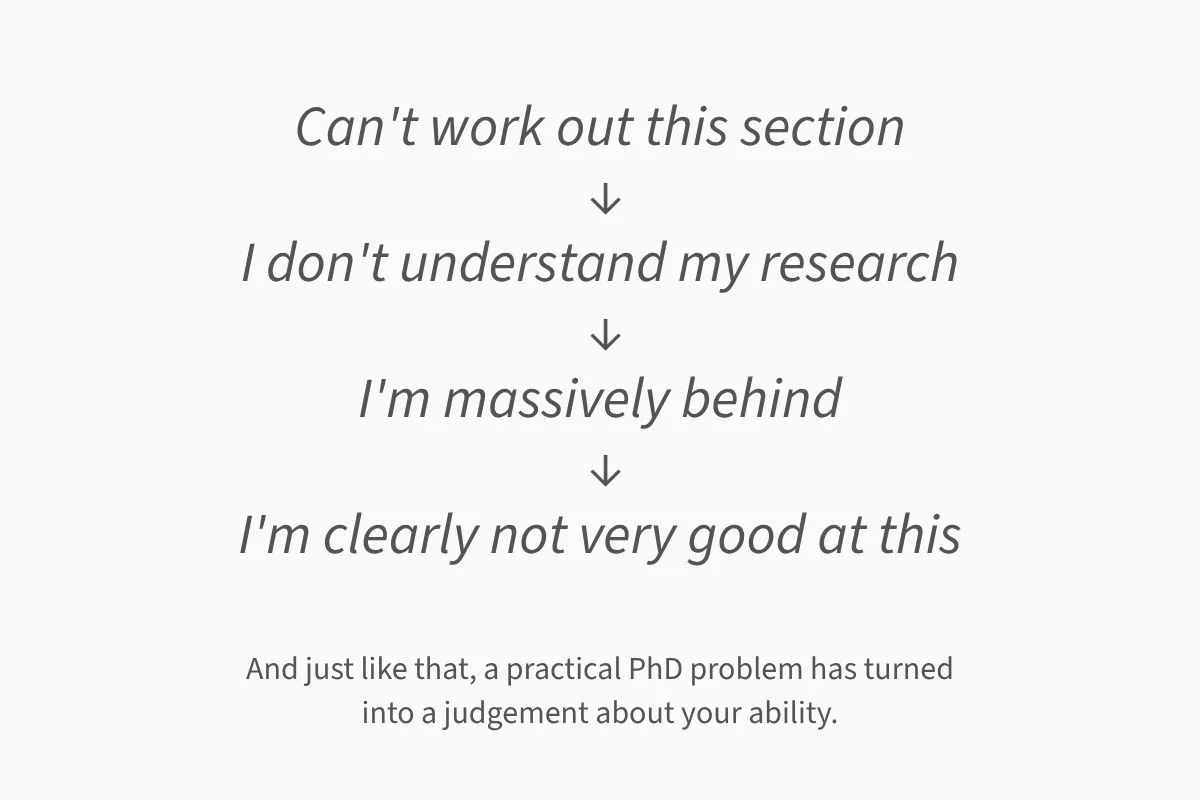
“I can’t work out what I’m trying to say in this section” becomes “I don’t understand my own research”, which becomes “I’m massively behind”, which becomes “I’m clearly not very good at this”.
Perhaps September doesn’t need to be about punishing yourself for what you didn’t do over the summer. Maybe it can just be a point at which you take stock of where you actually are, work out what matters now, identify what you need to focus on next, and make sure you’re not trying to figure absolutely everything out by yourself.
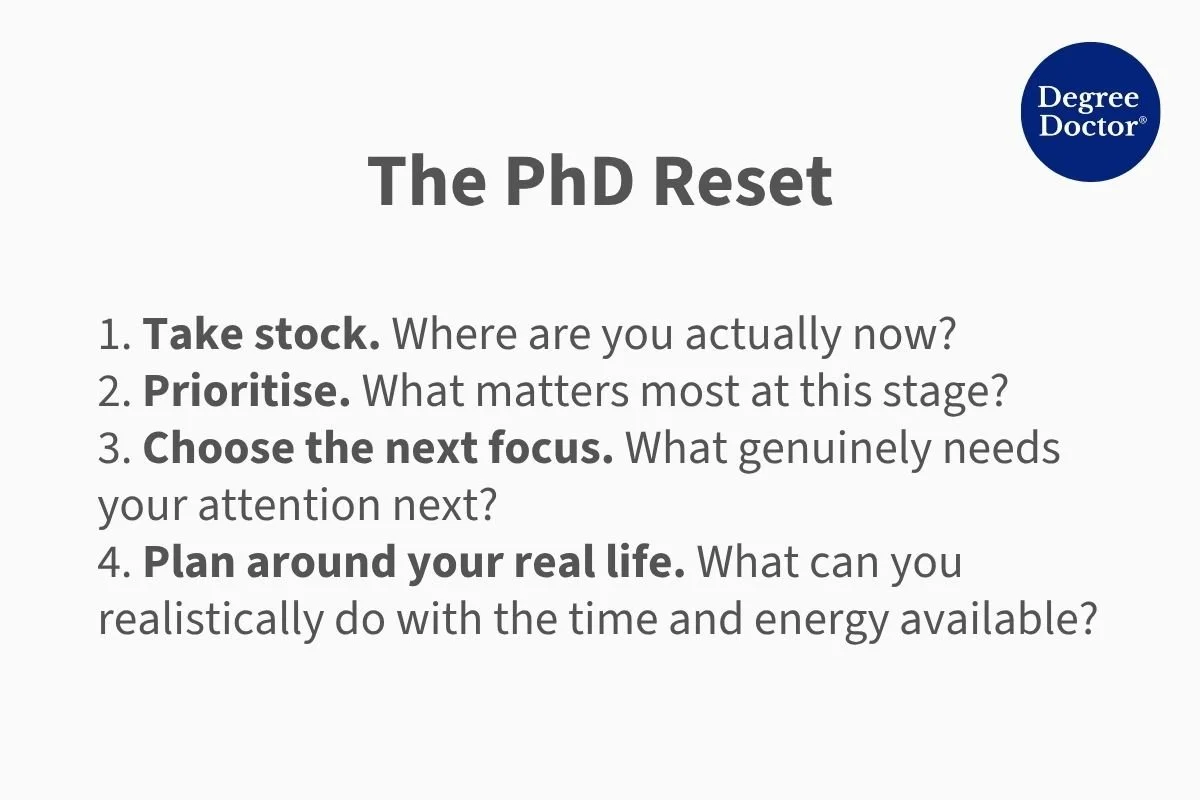
Turn your PhD reset into a realistic plan
If you're looking at the months ahead and thinking, "Right, I need to get a handle on this", start by working out where you are, what matters next, and how your PhD is going to fit around the life you're living (not the one you think you should be living).
That's exactly what my Annual PhD Planner is designed to help you do.
It gives you space to map out the bigger picture of your PhD, keep track of important milestones and deadlines, decide what needs your attention each month, and turn all of that into realistic weekly plans.
It helps you make steady progress on your PhD without pretending the rest of your life doesn't exist.
Click here to get yours.