“Is it me, or is this PhD thing actually really hard?”
Something came up recently in my Momentum PhD community that highlighted one of the most frustrating things about PhD life.
One of our members asked whether anyone else had ever felt a bit foolish for not realising quite how difficult doing a PhD would be. She'd done well academically before - school, undergraduate degree, postgraduate study - and had assumed she'd feel reasonably confident doing this too.
Instead, she found herself thinking: HOW is it this hard? Is it me?
Why starting a PhD can knock your confidence
I think there's something really important hiding inside that question.
After the initial PhD honeymoon period – when it’s all new stationery and geeky optimism – doubt can start creeping in. There’s not necessarily one single trigger that sets it off, but an accumulation of lots of little things.
That might include rereading a supervisor comment five times and still not being sure what they want. Maybe it’s spending an entire day reading, keen to understand something that you can’t get your head around, only to end up… more confused. Or someone asks you what your PhD is about and you spend five minutes waffling and talking around it. The person who asked you still doesn’t know what your thesis is about, and now, maybe you don’t either.
Is it just you? Maybe you’re not cut out for PhD study? Things that you think should be straightforward now feel incredibly difficult. Maybe you have reached the upper limits of your academic capability?
That’s probably not what’s going on at all, because the PhD is a whole different beast. A PhD isn’t a harder version of previous academic study. You’re not simply changing gear. You’re getting out of your car and into an aeroplane that you don’t know how to fly.
A PhD is a different kind of academic work
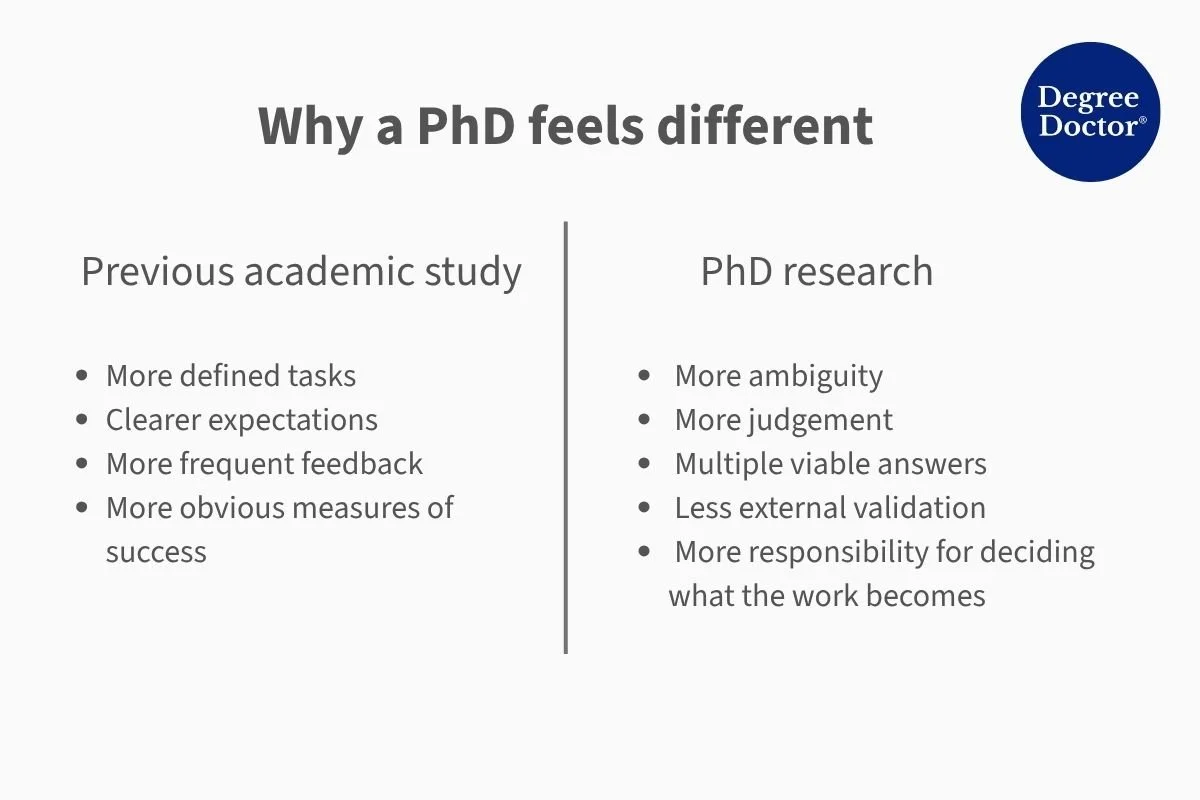
A PhD has more ambiguity, more judgement, fewer obvious answers, no single “right” answer but multiple viable alternatives, longer periods of time without external validation, and much more responsibility for deciding what the work should become.
You’re expected to become an independent researcher while simultaneously feeling less certain of your own judgement.
Why PhD self-doubt gets worse when you're doing it alone
This gets a whole lot worse if you live inside your own head. When you don’t talk regularly to other PhD researchers, there’s very little calibration. You don’t see that they are feeling exactly like you and have their own little collection of half-written chapters, methodological wobbling, days spent getting absolutely nowhere and a variety of increasingly attractive daydreams about opening a bakery or going to live off grid in a nice VW campervan (I always coveted a light blue one for some reason).
You mostly see your own mess from the inside and everybody else’s proficiency from the outside. That can lead to you mistaking your confusion and uncertainty for a lack of competence when it is simply part and parcel of the PhD experience.
Some of your "you things" are actually "PhD things"
One of the useful things about being around other researchers is discovering that the things you thought were “you things” are actually “PhD things”. It’s not just you who’s unsure whether there’s “enough” theory in your thesis, or who’s got to the discussion chapter and realised you need to go back and change the literature review, or who’s done months of work and suddenly found yourself thinking, “Okay... what do I actually do next?”
Don’t get me wrong – hanging out with other PhD researchers is not going to magically solve all your PhD problems, but having somewhere to think alongside other people can stop every uncertainty turning into a full-blown existential crisis that has you asking ChatGPT, “How can I retrain as a pastry chef?”.
So, coming back to the idea that you thought you were good at academia until you started a PhD - you ARE good at academia. You’ve just moved into a form of academic work where uncertainty is much more visible, and where not knowing is often part of the work rather than evidence that you’re not capable of doing it.
Did this blogpost help clear a few things up?
If so, you might be interested in these:
▶️ WATCH: More about why the PhD feels so difficult
Why does your PhD feels so hard? Especially the further into the doctoral journey you go - shouldn't your research be getting easier now? My YouTube video explains why.
📥 DOWNLOAD: 10 PhD struggles, solved!
Grab my free PDF guide providing real answers to the doubts and worries every PhD researcher has (but doesn’t always say out loud).
📗 READ: The Hidden Curriculum
My short book, The Hidden Curriculum of Qualitative PhD Research - Why qualitative research feels so confusing, and why it’s probably not you, reveals the unwritten rules of the PhD.
Read the book
→ Read the book