Critical Analysis for Qualitative PhD Students: Moving beyond description
If you’re working on a qualitative PhD literature review in the social sciences, you’ve probably had this feedback at some point:
“You need to be more critical.”
It is one of the most common comments supervisors give and one of the least clearly explained.
Most students assume it means they need to sound more intellectual, or more argumentative. Usually, that just makes the writing feel tense and unnatural.
I actually think learning to drive is a much more useful way to understand critical analysis.
I passed my driving test first time. Yes, I know. Deeply annoying behaviour.
What struck me afterwards was how much driving depended on sequence and movement. You cannot just sit in the car admiring the dashboard and expect to arrive somewhere useful.
You start the engine, check your mirrors, signal, pull out into traffic, adjust depending on road conditions, speed, and where you actually need to go.
Miss a stage and things become awkward fairly quickly.
That is often what happens in PhD writing.
Many qualitative researchers stop too early in the process. They describe the literature carefully, maybe even thoughtfully, but never fully pull out into the traffic of analysis.
At doctoral level, critical analysis usually involves moving through five overlapping stages:
Describe. Interpret. Evaluate. Synthesise. Position.
Let’s go through them.
(1) Describe: Start the engine
This is the stage students often become embarrassed about because they have been warned so frequently against “being descriptive.”
Description matters.
Before you can critically engage with a piece of literature, you need to understand what it is actually doing. What is the author arguing? What theoretical lens are they using? How was the data generated? What assumptions shape the analysis?
In qualitative research especially, description often involves noticing how meaning is constructed. How are participants represented? What gets emphasised? What disappears quietly into the background?
Description is grounding, it’s necessary.
Without it, the rest of the analysis tends to wobble around like somebody stalling repeatedly at a roundabout. Anyone relate to that? Yes, me too.
(2) Interpret: Begin moving
Once you understand what a piece of literature is doing, the next question becomes:
“What does this mean for my research?”
This is where many students begin hesitating because interpretation requires you to actively work with the literature rather than simply summarise it.
If an author argues that identity is fluid and relational, what might that mean for how you approach your interviews?
If a paper suggests institutional structures shape experience, how does that influence the way you frame your research questions?
If a study critiques dominant policy narratives, what assumptions does that make you reconsider in your own work?
Interpretation is where the car actually starts moving.
You are no longer sitting safely parked in summary mode.
You are allowing the literature to influence, sharpen, complicate, or challenge your own thinking.
Importantly, your own perspective matters here too. Your experiences, training, theoretical leanings, and professional background shape how you interpret what you read. That is not flawed or biased - it is reflexivity.
(3) Evaluate: Check the road conditions
Evaluation is where you begin making calm, reasoned judgements about how convincing the research actually is.
Does the argument follow through coherently?
Do the methods support the claims being made?
Are there blind spots, tensions, or limitations?
In qualitative research, evaluation often comes down to depth, transparency, coherence, and analytical honesty. Does the researcher sit carefully with complexity? Are contradictions acknowledged? Is reflexivity visible?
This stage is not about attacking authors, because let’s be fait - no study can do everything.
Critical evaluation is usually much more measured than students expect. You are not trying to demolish the literature. You are assessing what it allows us to understand, and where its limits begin to show.
A bit like driving, this is where you stop assuming the road ahead is automatically clear simply because you have started moving.
(4) Synthesise: Pull out into the traffic
This is the stage where many literature reviews either become genuinely doctoral… or remain a collection of separate summaries.
Synthesis means stepping back and looking across the literature rather than discussing studies one at a time.
Where are the patterns?
Where do authors agree?
Where are the tensions or competing perspectives?
Which theoretical approaches dominate the field?
This is the intellectual equivalent of finally joining the motorway. You are now navigating multiple moving parts at once rather than focusing on one isolated vehicle.
This is where many students grip the steering wheel slightly too hard.
Synthesis is difficult because it requires you to hold multiple ideas simultaneously and notice relationships between them.
Across twenty years of supporting qualitative PhD researchers, this is probably the point where I have seen the most panic set in. Students often have extensive notes on individual papers but struggle to transform those notes into a coherent analytical argument.
Moving from that to synthesis takes time. It is supposed to take time.
So, if you are finding it difficult to move from “notes on studies” to “themes and debates across the field,” you are very much not alone.
(5) Position: Find your lane
This is the doctoral move.
After describing, interpreting, evaluating, and synthesising the literature, you need to show where your own research sits within it.
What gaps remain?
What assumptions do you want to question?
What does your qualitative study allow you to see more clearly?
Positioning is not about claiming your research will revolutionise the field. Most examiners become deeply suspicious when students start sounding as though they alone have solved some big, longstanding problem. I am speaking as an experienced PhD examiner who’s seen a lot of lofty claims like that and thought, “Really?!”.
It is about showing that your study has a clear and reasoned place within ongoing conversations. Contributions to knowledge in the PhD world are small and incremental - that’s how scholarship moves forward, in little shuffles.
Much like motorway driving, you do not need to be racing aggressively in the outside lane to be making meaningful progress.
Personally, I am perfectly happy in the slower lane at sixty miles an hour, ideally somewhere with very low speed limits and minimal chaos. One of the reasons I love Jersey in the Channel Islands is that the top speed limit is 40mph. Bliss.
Anyway - research positioning works similarly. You do not need to force yourself into grand theoretical claims that feel unnatural just because you think doctoral writing is supposed to sound dramatic.
You need to know where your work sits and why it matters. That is enough.
What supervisors usually mean by “be more critical”
When supervisors say a literature review is “too descriptive,” they are usually noticing that the writing has stopped too early in the process.
Sometimes students remain in description, or evaluate individual studies but never synthesise broader patterns, or synthesise effectively but never clearly position their own study.
Critical analysis in qualitative research is about movement, clarity, and coherence. It’s about showing that you understand the landscape of your field and can navigate your way through it thoughtfully.
If you want more structured support
If you are currently deep in your literature review and struggling to move beyond description into stronger analysis and synthesis, my Literature Review PhD Survival Guide was designed for exactly this stage of the doctorate.
It helps qualitative PhD researchers develop themes, strengthen critical engagement, and position their research more confidently without disappearing into overcomplicated academic writing.
You can explore the guide here.
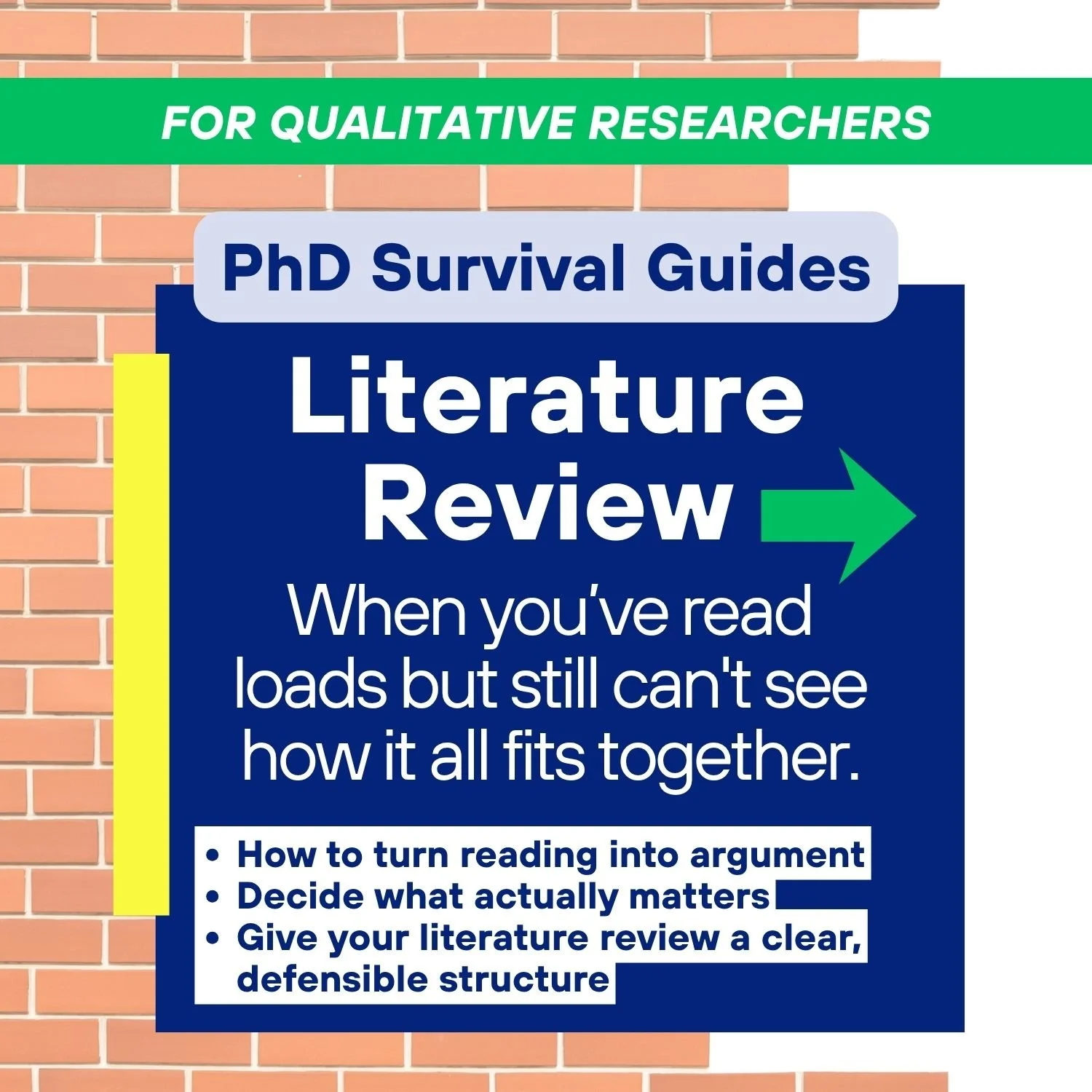
“I’ve read so much, but I still don’t know what I’m trying to say”
You've read countless papers, but your literature review still feels like disconnected summaries rather than a clear argument. You now need a structure for making sense of what you've read - this guide gives you that structure.
Swipe through the images to explore the frameworks, worksheets, and guidance included.
Get the full Survival Guide set here.
Got questions? Contact me using this form, I’ll be happy to help.
By purchasing this product, you agree to our Terms & Conditions.