Critical analysis for qualitative PhD students - moving beyond description
“You need to be more critical.”
It’s one of the most common pieces of feedback doctoral students receive, and one of the most frustrating.
You’ve read carefully. You’ve summarised accurately. You understand the argument.
So what’s missing?
For qualitative PhD researchers, the issue is rarely intelligence or effort.
It’s that the writing stops too early.
Critical analysis at doctoral level isn’t just about describing, interpreting and evaluating a single text. It requires two additional moves: synthesising across the field and positioning your own work within it.
That’s what transforms competent writing into doctoral scholarship.
Let’s walk through the five stages.
1. Describe: Show you understand the argument
Before you can critique anything, you must demonstrate that you understand it properly.
What is the author arguing?
What are they claiming to be true?
What evidence are they using?
What theoretical lens are they working within?
In qualitative research, you should also notice:
How participants are represented
How data was generated
Whether reflexivity is visible
What assumptions sit beneath the analysis
Description is not regurgitation. It is disciplined attention.
But if your writing stops here, it will feel descriptive rather than critical.
2. Interpret: What does this mean for your study?
Interpretation is where many qualitative PhD students begin to deepen their thinking.
This stage asks: If this argument is sound, what does that imply for my research?
Does this refine your conceptual framing?
Does it challenge an assumption you were making?
Does it sharpen your research questions?
Interpretation is about application.
You are no longer simply explaining what the author meant. You are asking how their work influences your own study.
For qualitative researchers, this often involves theoretical awareness. Is this grounded in feminism? Critical race theory? Symbolic interactionism? What does that mean for how you frame your own project?
Interpretation turns reading into active intellectual work.
3. Evaluate: Form a measured judgement
Evaluation moves you into judgement.
How convincing is this argument?
Does the evidence genuinely support the claims?
Are methodological decisions transparent and defensible?
What are the limitations?
In qualitative research, evaluation often includes considering:
Depth versus breadth
Reflexive awareness
Contextual sensitivity
Transferability
Evaluation should be balanced and reasoned - not dismissive.
But even evaluation isn’t enough at doctoral level.
4. Synthesise: Step back and see the patterns
Synthesis is where many PhD students struggle.
Instead of analysing texts in isolation, you look across them.
Where do authors agree?
Where do they diverge?
Are there competing theoretical camps?
Are there unresolved tensions?
You begin grouping literature by theoretical orientation, by methodological approach, or by conceptual framing.
This is what transforms a literature review from a sequence of summaries into an argument.
For qualitative PhD researchers, synthesis is essential because your contribution often lies in how you interpret patterns across the field - not just within one study.
5. Position: Make your contribution visible
Positioning is the doctoral move.
After describing, interpreting, evaluating and synthesising, you must answer:
Where do I stand?
What is missing in the literature?
What assumptions need questioning?
How does my qualitative study respond to these debates?
Positioning doesn’t require grand claims.
It requires clarity.
Your examiner needs to see how your project fits into, extends, or reshapes the existing conversation.
Without positioning, your work may feel knowledgeable.
With positioning, it feels doctoral.
Getting past “too descriptive”
If you’re being told your writing is “too descriptive,” it usually means one of three things:
You stopped at description.
You evaluated without synthesising.
You synthesised without positioning yourself clearly.
Critical analysis in a qualitative PhD is about movement.
From understanding → to application → to judgement → to integration → to contribution.
If synthesis and positioning are where you feel least confident, you’re not alone. These are the most conceptually demanding stages of a doctoral literature review.
My Literature Review PhD Survival Guide walks you through how to move beyond description, develop themes, strengthen synthesis, and position your study clearly - without overclaiming or overcomplicating.
Because at doctoral level, critical analysis isn’t about being harsh.
It’s about being clear.
When you’re ready, it’s right here.
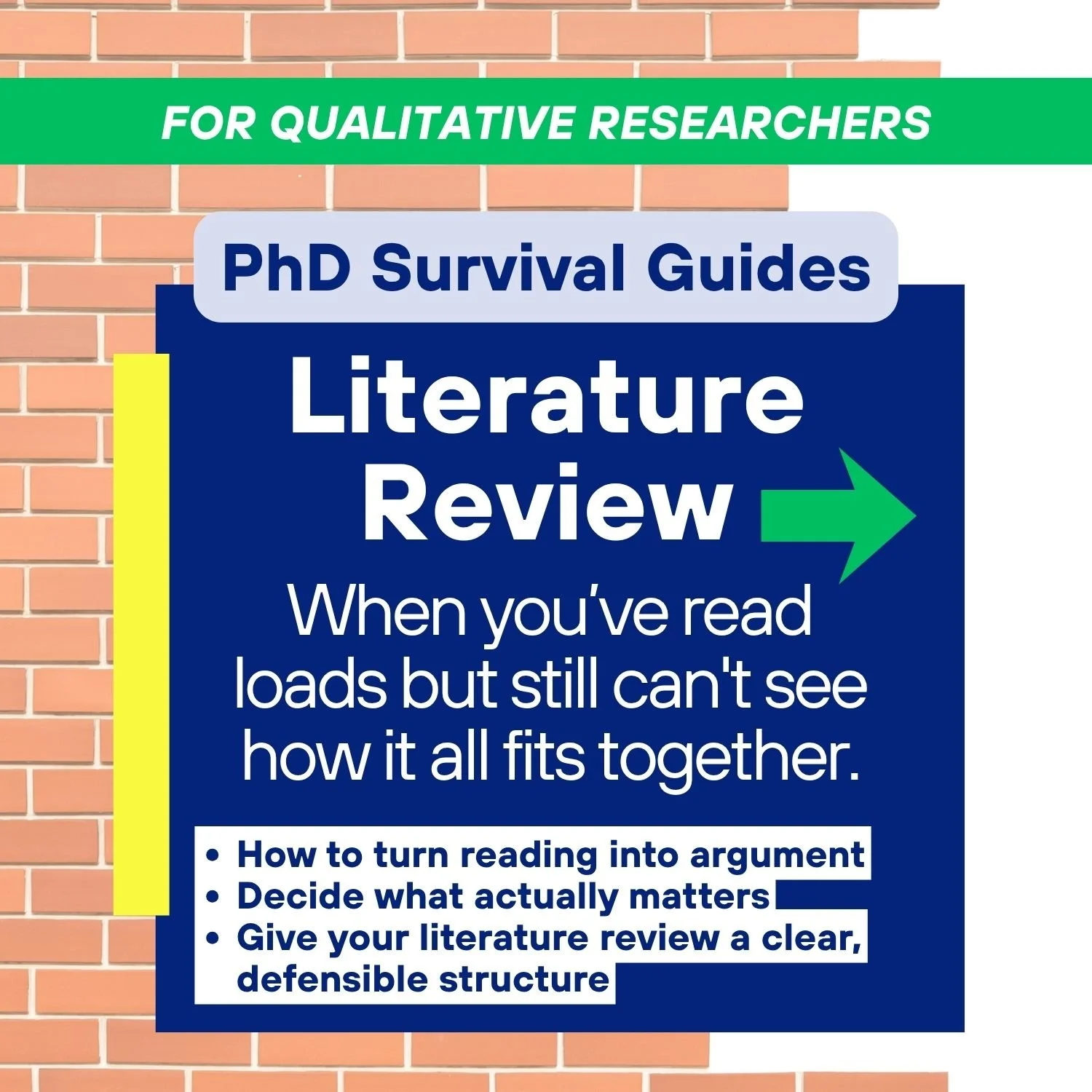
“I’ve read so much, but I still don’t know what I’m trying to say”
You've read countless papers, but your literature review still feels like disconnected summaries rather than a clear argument. You now need a structure for making sense of what you've read - this guide gives you that structure.
Swipe through the images to explore the frameworks, worksheets, and guidance included.
Get the full Survival Guide set here.
Got questions? Contact me using this form, I’ll be happy to help.
By purchasing this product, you agree to our Terms & Conditions.