Using AI Ethically in a Qualitative PhD: What’s okay - and what isn’t - in your dissertation?
AI isn’t going away.
If you’re working on a qualitative PhD dissertation, you’ve probably experimented with tools like ChatGPT - or at least wondered whether you should. There’s a lot of noise around this topic. Some people frame AI as academic misconduct waiting to happen. Others treat it like a productivity miracle.
The reality is more nuanced.
As someone who has supported thousands of qualitative PhD researchers through the most demanding stages of their dissertations, I don’t see AI as inherently unethical.
But I do see risk.
The risk isn’t that AI will “cheat” for you.
The risk is that it can subtly dilute your thinking if you let it do work that is supposed to be yours.
So the real question isn’t: Can I use AI?
It’s: How do I use it without compromising the intellectual integrity of my PhD?
Here are three principles that matter for qualitative researchers in particular.
1. AI is there to assist your thinking - not replace it
Your PhD is not an information retrieval exercise. It’s an original piece of scholarship grounded in interpretation, judgement, and positionality.
AI can support certain tasks. For example:
Clarifying a definition
Generating a rough outline you intend to reshape
Rephrasing a sentence you’ve already written
Helping you brainstorm alternative angles
But it should never be doing the core intellectual labour of your dissertation.
It cannot:
Interpret your qualitative data for you.
Decide what your contribution is.
Position your findings within a field in a way that reflects your judgement.
Develop your theoretical stance.
Those moves are doctoral work.
If you find yourself pasting chunks of AI-generated text directly into your thesis without significant rewriting and reshaping, that’s usually a sign you’ve crossed from assistance into substitution.
A useful test is this: if you removed AI from the process, would the intellectual direction of your project change?
If the answer is yes, you’re relying too heavily on it.
2. Stay transparent with yourself (and your supervisor)
Ethical AI use isn’t just about institutional policy. It’s about intellectual honesty.
If you feel slightly uncomfortable about how you’re using AI, that discomfort is worth paying attention to. Qualitative research rests on reflexivity - and that includes reflexivity about your tools.
A simple internal check is to imagine explaining your process clearly to your supervisor:
“I used AI to help me brainstorm possible structures for this chapter.”
“I asked it to clarify the differences between two theoretical perspectives before I went back to the original texts.”
“I used it to help tighten up my wording after I’d completed my analysis.”
If you would hesitate to explain what you did, that’s a signal to reassess.
The goal isn’t fear. It’s alignment.
Your dissertation should still feel like yours - shaped by your interpretive judgement and grounded in your engagement with the literature and data.
3. Stay Critical - Especially as a qualitative researcher
AI tools produce confident answers. That doesn’t mean they produce careful ones.
If you ask AI to explain a theory, suggest literature themes, or outline a discussion chapter, you still need to apply your own critical filter.
Ask:
Is this accurate?
Is it oversimplifying?
Is it contextually appropriate for my study?
Does this reflect my actual data?
What might be missing?
Qualitative research is sensitive to nuance, context, and interpretation. AI tends to flatten nuance unless you actively resist that.
You remain responsible for the coherence of your argument, the integrity of your analysis, and the originality of your contribution.
AI cannot take responsibility for those things. You can.
“Qualitative research is sensitive to nuance, context, and interpretation. AI tends to flatten nuance unless you actively resist that.”
Where AI use becomes risky: Writing up
The most sensitive stage for AI use in a qualitative PhD is writing up - especially the findings, discussion, and conclusion chapters.
This is where:
You interpret meaning.
You position your work within the literature.
You articulate your contribution.
You make bounded, defensible claims.
If AI starts shaping those arguments for you, your voice can become diluted. The work may sound polished, but slightly generic. Subtle theoretical commitments can get blurred.
The discussion chapter, in particular, is where your whole PhD comes back together - your findings, your literature review, your conceptual framework, and your methodological decisions.
That integrative reasoning cannot be outsourced.
If you’re feeling uncertain at this stage - not about AI, but about how to confidently articulate your contribution - that’s usually not a technology problem. It’s a structural clarity problem.
This is exactly why my Discussion & Writing Up Guide exists . It walks you through how to reconnect findings, literature, and theory in a way that makes your reasoning visible - without forcing grand claims or relying on external tools to “polish” your argument.
When your intellectual structure is clear, you’re far less tempted to lean too heavily on AI.
Is AI the enemy?
AI is not the enemy of qualitative research.
But neither is it a substitute for doctoral thinking.
Used well, it can save time on lower-level tasks and help you refine your writing. Used carelessly, it can flatten your voice and weaken your intellectual ownership of the work.
The standard is simple: Your dissertation should still reflect your interpretive judgement, your theoretical stance, and your contribution to the field.
If it does, you’re on solid ground.
When you’re ready for structured support
If you’re in the writing-up stage of your qualitative PhD and finding that the real challenge isn’t technology but confidence - confidence in your interpretation, your contribution, and your argument - that’s normal.
My Discussion & Writing Up Guide offers calm, structured support for this stage of the journey. It helps you move from findings to meaning without overclaiming or second-guessing yourself.
No panic. No shortcuts. Just clear next steps.
It’s here when you need it.
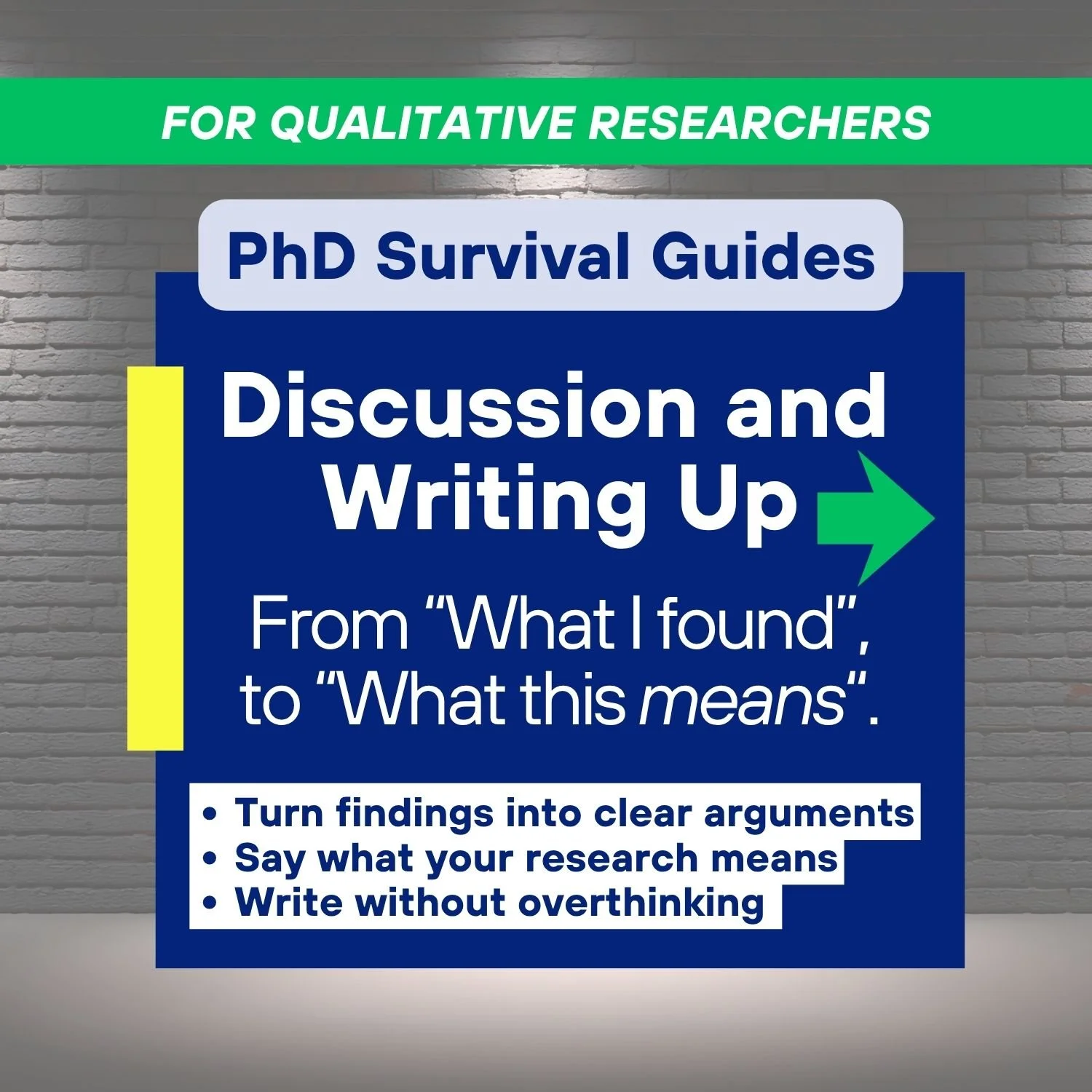
Move from “What I found” to “What this means” - clearly and confidently.
This guide is for qualitative PhD researchers who need to turn their findings into a clear, defensible argument.
If your discussion or conclusion feels uncertain, fragile, or harder than it should be, this guide shows you how to move from uncertainty to a clear, defensible discussion.
If you’ve ever thought:
“What if this isn’t enough for a PhD?”
“Should I go back and change my literature review?”
“I’ve done the work, but I can’t explain what it adds up to.”
This is the stage where qualitative research becomes interpretive - and many researchers struggle to explain what their findings mean.
This guide helps you:
Connect your analysis to literature, concepts, and theory
Turn your findings into a clear, defensible argument
Articulate your contribution without overclaiming or underselling
Write a discussion and conclusion chapter you feel confident to submit
This is a digital download. You’ll get immediate access to the full guide and worksheets as soon as you purchase, so you can get unstuck and start making progress straight away.
Swipe through the images to see exactly what’s inside.
For a more streamlined and coherent approach, you can access all four PhD Survival Guides in the full series here.
Got questions? Contact me using this form, I’ll be happy to help.
By purchasing this product, you agree to our Terms and Conditions.