Thematic Literature Review: How to decide what not to include - a guide for qualitative researchers
Most qualitative PhD researchers reach a stage where their thematic literature review starts to feel out of control and the overwhelm begins to take over.
You begin with a focused question. You find a few key papers. And then, quite quickly, the edges blur. One article leads to another. Then another. Before long, you’re sitting with pages of notes, a long list of references, and a growing sense that everything feels potentially relevant.
This is usually the point where this question emerges: How do I decide what not to include?
The difficulty is rarely finding literature - as the many unread PDFs in your downloads folder will attest to - it’s knowing where to stop.
Why this feels particularly difficult in qualitative research
In qualitative work, this challenge can feel more acute.
You’re not just looking for variables or measurable relationships. You’re engaging with concepts, meanings, perspectives, and interpretations. That means a wider range of literature can feel relevant - sometimes loosely, sometimes indirectly.
When everything feels like it might connect, it becomes much harder to draw boundaries. What often happens is this:
You include more than you need. Not because you don’t understand your topic, but because you don’t yet feel fully confident in excluding things.
However, over time, this starts to create a different problem. Your literature review becomes broad, but not especially clear. It moves across ideas, but without a strong sense of direction. And instead of building an argument, it begins to read more like a collection.
This is where many qualitative researchers feel stuck.
A different way of thinking about inclusion
One of the most useful shifts you can make here is this:
Your literature review is not trying to show everything that exists.
It is trying to show what matters for your study.
And in a thematic literature review, that matters even more because you are not just summarising studies - you are organising them into themes that speak directly to your research focus. That means every piece of literature you include needs to do something, like:
build a theme
deepen an argument
clarify a tension
or position your study within the field
If it doesn’t do one of those things, it may still be interesting - but it is probably not necessary.
Coming back to your study (again and again)
When the literature starts to feel overwhelming, the most reliable place to return to is your own research.
What are you trying to understand?
What is your study actually about?
What kinds of questions are you asking?
Your aims, your research questions, your conceptual focus - these are what allow you to make decisions about relevance.
If you can’t clearly link a piece of literature to your study - if you find yourself stretching to justify its place - that’s usually a sign that it may not belong in this literature review.
The pull of “interesting but not useful”
There’s also a very human part of this process that’s worth acknowledging. You will come across work that is genuinely interesting. Thought-provoking. Well-written. Widely cited.
It will be tempting to include it. Especially when it feels intellectually rich.
However, qualitative research requires a certain kind of discipline here because something can be insightful, influential, or important in the wider field, and still not be directly relevant to what you are doing.
Learning to let that go is part of developing as a researcher in recognising that your literature review is not the place for everything that sparks your interest.
Creating structure without overcomplicating it
One practical way to support this process is to begin grouping your literature into meaningful clusters.
Over time, you will start to see that some studies sit at the centre of your work. They speak directly to your research focus and begin to form the backbone of your themes.
Others sit slightly further out. They provide context, background, or contrast, but they are not carrying your argument.
Then there is a third category - the literature that feels connected, but only loosely.
You don’t need to force all of these into your review.
In fact, one of the most useful things you can do is keep a record of what you’ve chosen not to include because that decision-making process - what you included, what you set aside, and why - is part of your development as a researcher.
Justifying what you leave out
Another concern that often comes up is this: “How do I justify excluding literature?”
In practice, you rarely need to justify every individual exclusion. What matters more is that your overall approach is clear and defensible. That means being transparent about the focus of your review, the kinds of studies you prioritised, and the boundaries you have set.
For example, you might focus on a particular population, a specific context, a defined time period, or a particular conceptual approach. Once those boundaries are clear, exclusion becomes a natural consequence of focus - not something you need to apologise for.
Letting the review evolve
It’s also worth remembering that your literature review is not fixed from the outset. As your understanding deepens, your sense of what is relevant will shift.
Something that felt peripheral early on may become central later, and something that initially seemed important may gradually fall away. This isn’t a problem. It’s part of how qualitative research develops.
The key is not to get it perfect immediately - but to stay engaged with the process of refining, shaping, and clarifying over time.
Knowing what not to include is not about being restrictive.
It’s about being intentional.
A strong thematic literature review is not the one that includes the most material. It’s the one where every piece of literature has a clear place - and where the overall structure helps the reader understand how your study fits within the field.
If you want more structured support with this
If you’re at the stage where you’ve found a lot of literature, but you’re not entirely sure how to shape it into something coherent and focused, that’s a very common point in a qualitative PhD.
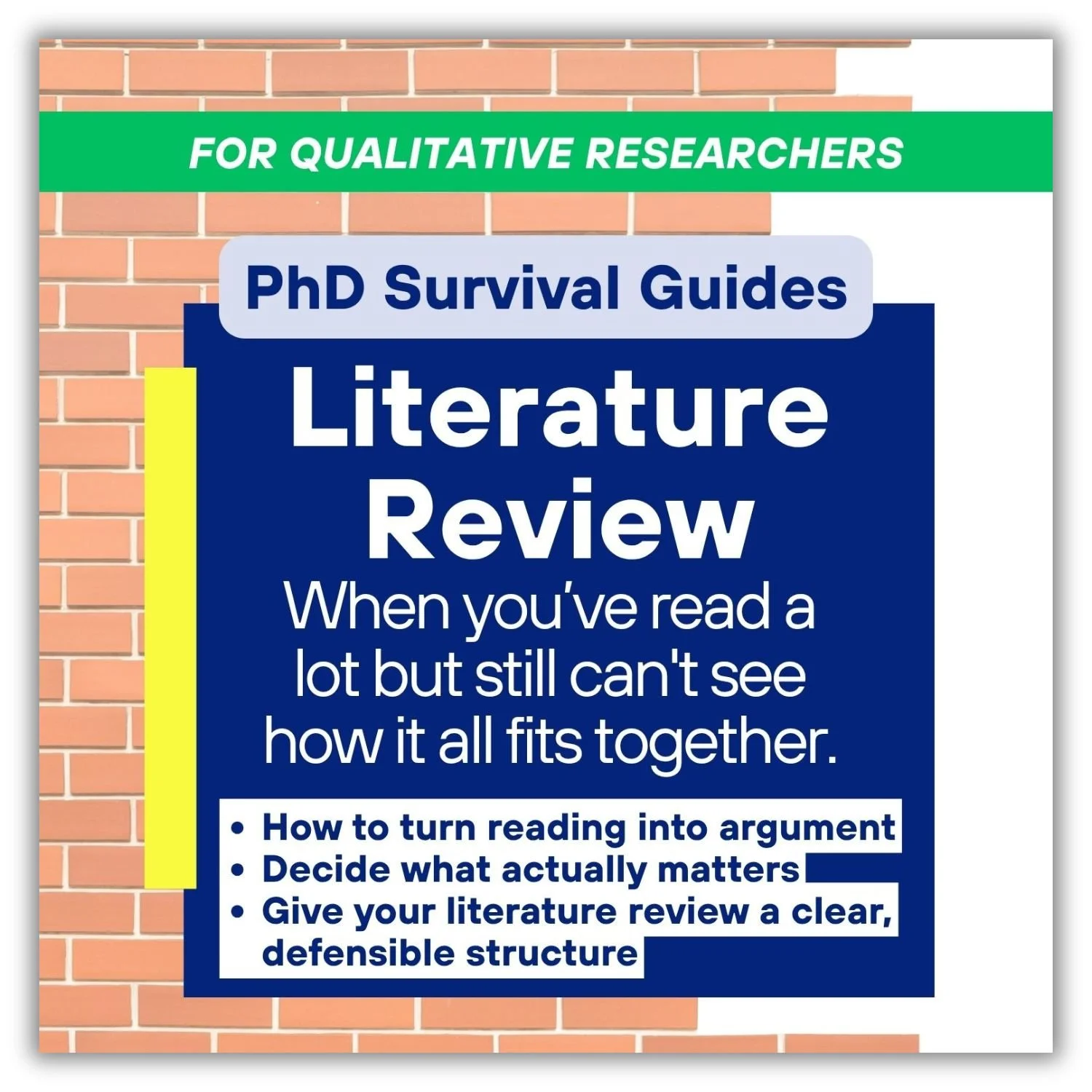
My Literature Review PhD Survival Guide walks you through how to move from a broad, scattered set of readings to a structured, thematic review that actually supports your study.
Not just what to include - but how to organise it, how to develop themes, and how to write it in a way that feels clear and grounded.