How to reduce the wordcount when you’ve written too much!
You’ve written too much again, haven’t you?
Your chapter is far too long. Your supervisor has circled the word count in red. And now you’re staring at thousands of words wondering:
How on earth do I cut this down without losing anything important?
This is an incredibly common problem in qualitative PhD research.
Qualitative research writing often involves detailed explanations, rich participant quotes, and careful interpretation of meaning. That depth is important - but it can also lead to chapters that spiral far beyond the word limit.
The good news is that strong qualitative writing is not about saying more - it’s about saying things clearly and precisely.
In this post, I’ll walk you through practical strategies you can use to reduce your word count while strengthening your argument and analysis.
Let’s start trimming that chapter.
Why qualitative research writing often becomes too long
In qualitative research, writing often expands because researchers feel they must:
• explain theoretical concepts in detail
• provide extensive literature context
• include long interview quotes
• carefully interpret meaning and nuance
All of this matters - but too much explanation can dilute your analysis.
Your goal is not to include everything you could possibly say. Your goal is to present clear, focused interpretation supported by the most relevant evidence.
1. Eliminate redundancies
Redundancy happens when you express the same idea more than once.
Example:
Original - The study is important and significant for understanding participants' experiences.
Revised - The study is significant for understanding participants' experiences.
When editing qualitative research writing, ask yourself:
Have I already made this point elsewhere?
If the answer is yes, cut it.
2. Remove filler words
Words like:
very
really
actually
basically
quite
just
rarely add meaning.
Example:
Original - This theme is really important in understanding participants' experiences.
Revised - This theme is important in understanding participants' experiences.
Removing filler words strengthens your writing and reduces unnecessary word count.
3. Simplify wordy phrases
Academic writing often contains phrases that can easily be shortened. Examples:
Instead of, “At this point in time”, use, “Now”.
Instead of, “Due to the fact that”, use, “Because”.
Instead of, “A majority of”, use, “Most”.
Instead of, “For the purpose of”, use, “For”.
Instead of, “Has the ability to”, use, “Can”.
Instead of, “In the event that”, use, “If”.
These small edits can remove hundreds of words across a chapter.
4. Tighten up participant quotes
This is especially important in qualitative research writing.
Interview extracts can easily become too long. Often, you only need the most relevant section of a participant quote.
Example:
Original - "I felt ignored during meetings and sometimes it seemed like my opinions didn't really matter, which made me feel excluded from the team discussions."
Edited - "I felt ignored during meetings… my opinions didn't really matter."
5. Use active voice where possible
Passive voice often adds unnecessary words.
Example:
Original - It was found that participants experienced increased stress during the transition period.
Revised - Participants experienced increased stress during the transition period.
The revised sentence is shorter and clearer.
6. Combine sentences
Sometimes two sentences can become one.
Example:
Original - The researcher conducted interviews with 12 participants. These interviews explored their experiences of remote working.
Revised - The researcher conducted interviews with 12 participants to explore their experiences of remote working.
Small changes like this reduce repetition.
7. Review each paragraph critically
When editing your qualitative research chapters, ask:
• Is this paragraph necessary?
• Does it move the argument forward?
• Does it repeat something I've already said?
Challenge yourself to remove one sentence per paragraph. You’ll often find the chapter becomes clearer and sharper.
8. Trim literature summaries
Literature review sections often become long because researchers summarise too many sources in detail.
Instead of explaining each paper individually, focus on synthesising patterns in the literature.
Instead of writing three separate paragraphs summarising studies, write one paragraph explaining the shared argument across those studies.
This strengthens the literature review while reducing word count.
9. Reduce unnecessary adjectives
Academic writing often becomes bloated with adjectives.
Example:
Original - The researcher carefully and meticulously reviewed the extensive literature on the topic.
Revised - The researcher reviewed the literature on the topic.
Most adjectives can be removed without losing meaning.
10. Tighten your conclusion
Conclusions often repeat too much.
Instead of restating everything you've already written, focus on:
• key findings
• interpretation
• implications
Example:
Original - In conclusion, this chapter has shown that participants experienced significant challenges during the transition period and these findings support the argument that workplace structures influence wellbeing.
Revised - This chapter shows that workplace structures significantly shaped participants' wellbeing during the transition period.
Shorter and clearer.
Clarity and complexity
Reducing word count in qualitative research writing is not about stripping away complexity.
It is about communicating your analysis clearly and efficiently.
Strong qualitative research does not require excessive wording.
It requires precise explanation supported by the most relevant evidence.
Need help writing your discussion chapter?
If you're currently writing up your findings or discussion chapter, my Discussion & Writing Up PhD Survival Guide walks you through the process step by step.
It covers:
• structuring the chapter
• linking analysis to literature
• writing strong discussion sections
• turning qualitative insights into clear arguments
You can explore it here.
And if you'd like more support with qualitative research and PhD writing, you're very welcome to join my email community, where I share practical guidance each week for navigating the PhD journey.
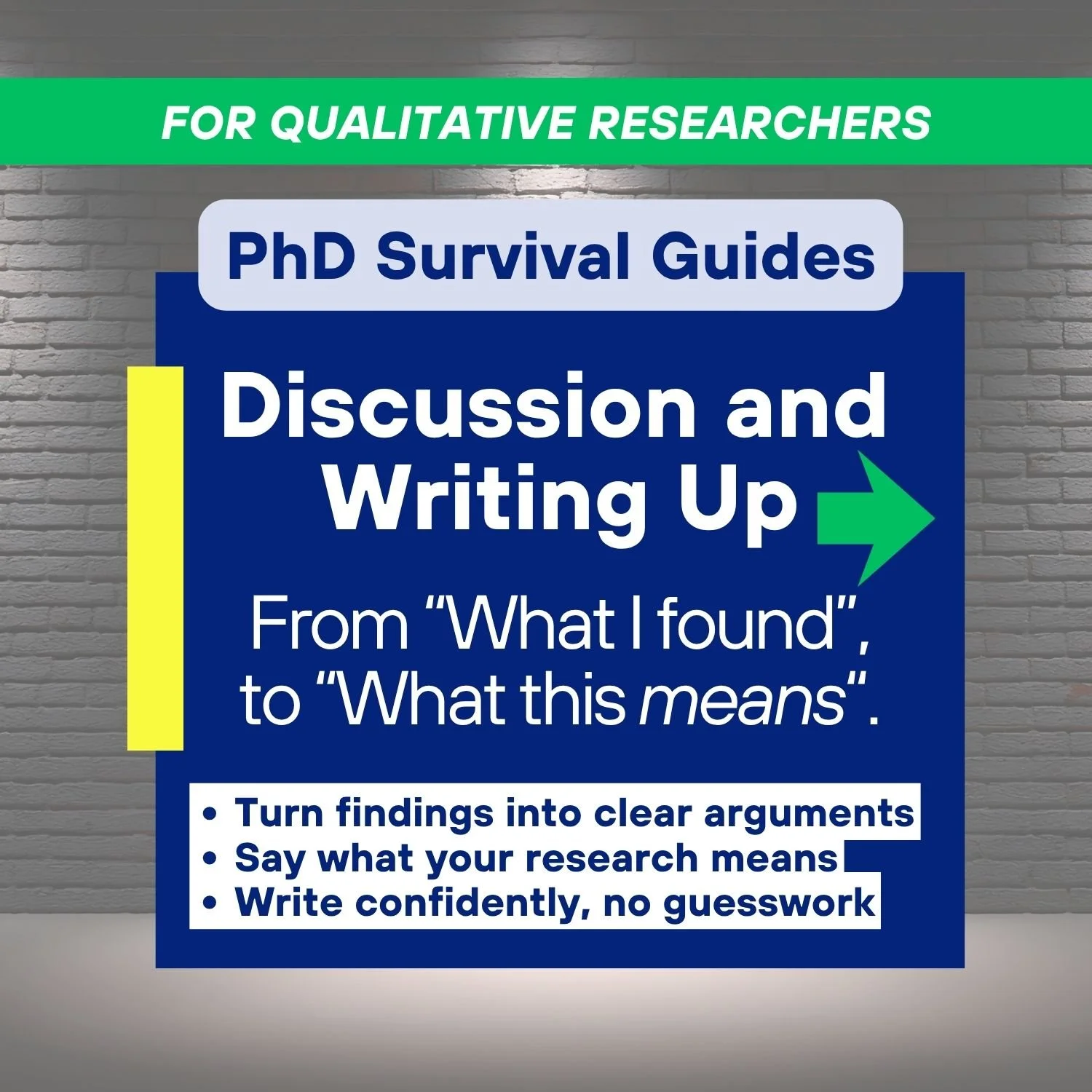
Move from “what I found” to “what this means” - without going round in circles.
This guide is for qualitative PhD researchers who have findings, themes, data, notes, and chapter drafts… but still feel unsure how to turn them into a clear discussion.
This is the stage where your PhD has to become more than a set of chapters, it has to become an argument. That’s exactly what this guide helps you work through.
Swipe through the images to explore the frameworks, worksheets, and guidance included.
Get the full Survival Guide set here.
Got questions? Contact me using this form, I’ll be happy to help.
By purchasing this product, you agree to our Terms and Conditions.