How to choose participant quotes in qualitative research - without overloading your findings chapter
One of the most common dilemmas in writing up qualitative research is deciding which participant quotes to include.
You’re analysing your interview transcripts.
You’ve highlighted dozens of powerful moments.
And now you’re writing your qualitative findings chapter and realising something uncomfortable:
You simply can’t include them all.
For many qualitative PhD researchers, this is surprisingly difficult.
Participant quotes often feel meaningful because:
you spent time building rapport with participants
people trusted you with their experiences
the quotes capture nuance and emotion
So deleting a quote can feel uncomfortable - almost like you’re erasing someone’s voice.
But including too many quotes creates another problem. Your chapter stops looking like analysis and starts looking like a transcript.
The key challenge in qualitative research writing is finding the right balance between participant voice and researcher interpretation.
Let’s look at five practical ways to decide which quotes belong in your findings chapter.
The key principle: quotes should support your analysis
In qualitative research, quotes are not the analysis.
They are evidence that supports the analysis.
Each quote should serve a clear purpose.
A useful rule is that every quote should do at least one of these things:
• illustrate a key theme
• provide insight into a pattern in the data
• add nuance or contrast to your interpretation
If a quote does none of those things, it probably doesn’t need to be included.
Your job as a qualitative researcher is not to include everything participants said.
Your job is to interpret the meaning of the data.
1. Use quotes to illustrate themes
In most qualitative studies, findings chapters are structured around themes or patterns in the data.
Quotes should illustrate those themes.
Example:
Participants frequently described the importance of community support during recovery. As one participant explained, “The support from my neighbours has been the backbone of my recovery.”
Here the quote does something specific.
It illustrates the theme.
Without the theme, the quote would just be an isolated comment.
2. Summarise repeated experiences
In interview-based qualitative research, many participants will say similar things.
Instead of quoting everyone individually, summarise the pattern.
Example:
Many participants described feeling isolated during the pandemic.
Then include one representative quote:
As one participant explained, “I felt like I was living in a bubble, completely cut off from the world.”
This approach keeps the analysis concise while still allowing participants’ voices to appear.
3. Aim for balance within each theme
A common question in qualitative research writing is:
How many quotes should I include per theme?
There is no universal rule, but a useful guideline is:
1-4 quotes per theme or sub-theme.
This usually provides enough evidence without overwhelming the reader.
For example:
Some participants described positive healthcare experiences, such as quick appointment access. One participant noted, “I was able to see my doctor within two days.”
Others described significant barriers, including long wait times. As one participant explained, “I had to wait nearly three months to see a specialist.”
This creates balance while maintaining analytical focus.
4. Use paraphrasing to maintain flow
Too many quotes can interrupt the flow of a findings chapter.
In these cases, paraphrasing can help.
Example:
Instead of quoting:
“I had to wait three months to see a specialist.”
You might write:
Participants reported waiting up to three months for specialist appointments.
You are still presenting the data - just more efficiently.
This keeps your analytical voice at the centre of the chapter.
5. Keep longer quotes for especially powerful moments
Occasionally, a participant quote captures the core meaning of a theme so clearly that it deserves more space.
In these cases, a longer quote can be appropriate.
For example:
“I’ve lived in this neighbourhood for 30 years, and I’ve never felt so disconnected from my community as I did during lockdown…”
Longer quotes work best when they capture emotional depth, illustrate complex experiences, or represent a central theme.
When using longer quotes, explain why they matter.
Example:
This quote highlights how social isolation extended beyond physical distancing to affect participants’ sense of belonging within their communities.
The analysis should always frame the quote.
A final thought on qualitative research writing
If you feel reluctant to remove quotes, that usually means you care deeply about representing participants fairly.
That’s a strength.
But remember: qualitative research is not about including everything people said.
It is about interpreting meaning within the data.
Participant quotes should enrich your analysis - not replace it.
Your analytical voice is what ultimately gives the research its contribution.
Need help writing up your qualitative findings?
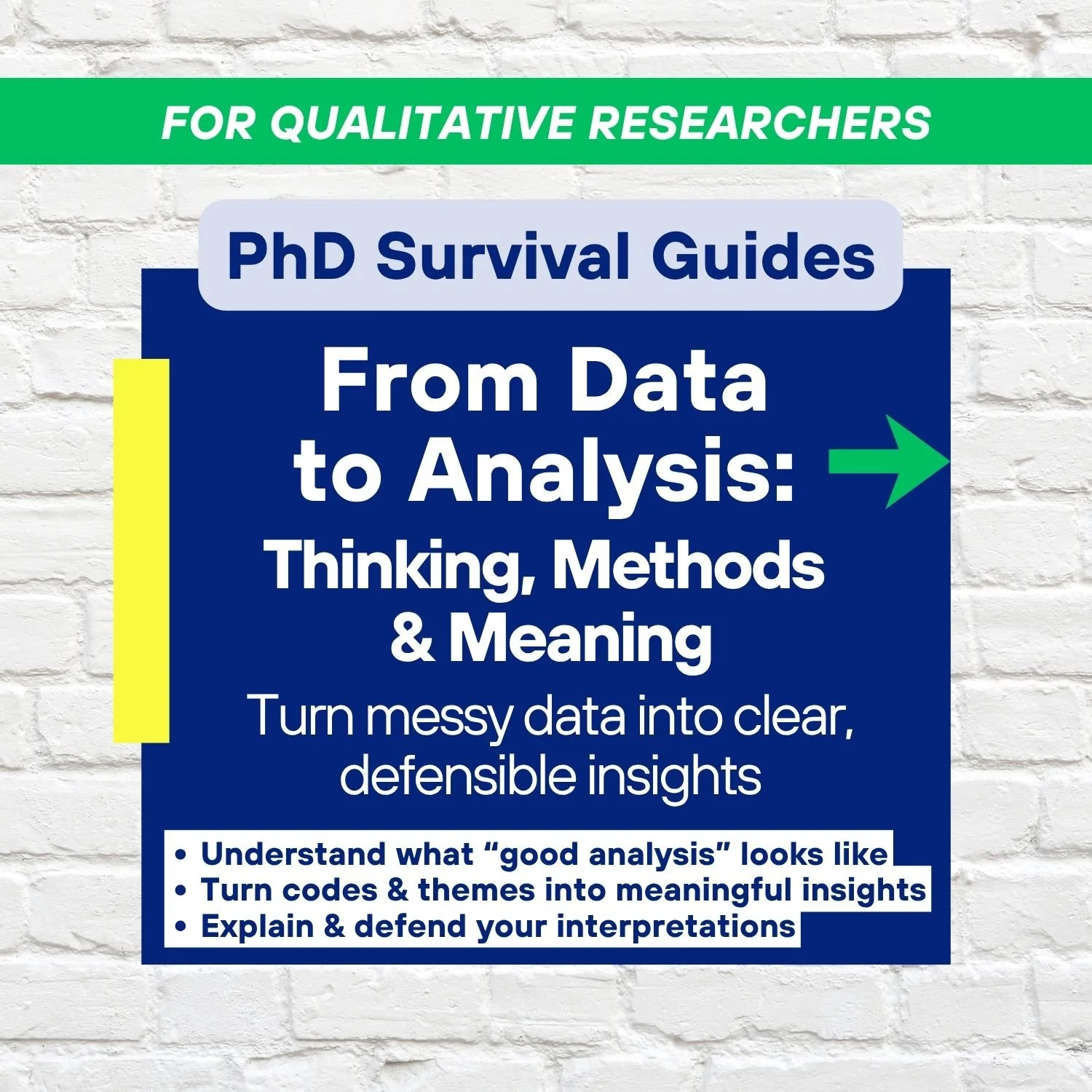
If you’re currently writing your qualitative findings or discussion chapter, my Methodology, Data Collection and Analysis PhD Survival Guide walks you through the process.
Inside the guide, you’ll learn how to:
• structure qualitative findings chapters
• connect findings to the literature
• bridge to a strong discussion section
You can explore the guide here.
Join the email community
If you’d like more support with qualitative research, thematic analysis, and writing up your PhD, you’re very welcome to join my email community.
I share practical advice each week to help qualitative researchers move their projects forward.
You can sign up here.
“I can describe what I did. I just don’t know if I trust my own judgement.”
This is the point in the PhD where your research starts demanding something different: interpretation, judgement, coherence, and confidence in your reasoning. This guide was written for that stage.
Swipe through the images above to see what’s inside.
Get the full Survival Guide set here.
If you have any questions, feel free to contact me. I’ll be happy to help.
By purchasing this product, you agree to our Terms & Conditions.