Why smart PhD researchers constantly feel like they’re doing it wrong
You might feel like you’re doing your PhD wrong. You’re probably not. What’s likely happening instead is this:
You’re looking at the things you’re doing - which feel like metaphorical academic faceplants - and interpreting them as evidence your research isn’t “good enough”.
Things like looping back, throwing your analysis in the bin and starting it all over again, rewriting your literature review for the fourth time. All evidence you’re messing this up, right?
Erm, no actually. Everything you think you’re doing badly is actually proof you’re doing qualitative research exactly as it should be done.
Let me tell you a story that helps illustrate this.
Your PhD “fails” and my Instagram account
Back in the autumn of 2021, I started the Degree Doctor Instagram account.
At the time, I had absolutely no idea what I was doing.
None.
I did not understand Instagram strategy, audience growth, content design, engagement metrics, or platform algorithms, yawn, bored.
At the beginning, many posts did absolutely nothing. No comments. Very little engagement. Sometimes almost no likes whatsoever. Then every now and again one post would perform a bit differently and I would stare at the analytics, reverse engineer it, and try to identify what I’d accidentally done right.
Why did that one get five likes instead of none?
Was it the wording? The topic? The timing?
Was it clearer somehow? More useful? Less cluttered?
I remember feeling disproportionately encouraged whenever I noticed even the smallest uptick in my follower count or more pings than usual as people liked or commented.
I was constantly scanning for approval, like “Universe! Send me a SIGN this isn’t a complete waste of time!”
You are probably doing something very similar with your qualitative study.
You’re looking for proof that your PhD is “working”. A positive supervisor comment, a productive writing session, a paragraph that flows better after days (or weeks) of wrestling with it. Tiny signals that perhaps, despite the confusion, you’re moving in roughly the right direction.
A journey without Google Maps
Your earlier educational experiences trained you to expect visible indicators of competence. You knew whether you passed, whether your marks improved, whether your teacher thought you were on the right track, and roughly how your work compared with everyone else’s.
Your PhD is different.
This has a unique sting in qualitative research, where your decisions are interpretive rather than procedural. You’re doing difficult things without constant reassurance you’re succeeding. You’re there redrafting paragraphs, refining your analysis, thinking, “Will someone please tell me whether this is correct now?!”.
That can feel destabilising for intelligent people who are used to receiving regular feedback that they’re doing well.
You say to yourself, “If I were doing this properly, surely I would feel more certain than this.”
You wouldn’t. Welcome to the wonderful world of qualitative research, where the absence of certainty is not evidence of incompetence - it is evidence that you’re grappling with intellectually difficult material.
Your qualitative PhD journey will involve constant effort without visible results or outcomes. You work and work and work, yet your thesis can still feel blurry.
It’s like going somewhere you haven’t been before without Google Maps. You keep wondering whether you’ve taken a wrong turn somewhere, even though there aren’t actually many signs telling you what the “right” route was supposed to look like in the first place.
Learning to work without constant reassurance
When I look back now at those early Degree Doctor Instagram posts, I can see that progress was happening long before it felt obvious to me.
The account grew because I kept paying attention. I started noticing patterns. Certain topics resonated more than others. Some phrasing connected better. Some posts landed in ways I had not fully anticipated - usually it was the reels I had thrown together in 5 minutes than the ones I’d spent hours painstakingly putting together. FML.
But - over time, what initially felt chaotic gradually became a bit easier to get through when I found my rhythm and developed a process for learning to trust my own judgement.
Your qualitative doctoral research will follow a similar trajectory because your ability to work with uncertainty will gradually become stronger. Your judgement will develop and you’ll become better at recognising which doubts are useful and which are simply fear speaking very loudly.
One of the hardest things about your PhD is that many parts of the process only make sense retrospectively. While you’re deep inside the work, everything can feel wobbly. Later on, however, your arguments will start holding together more coherently simply because you’ve developed your process for navigating all of this.
“At this point I would quite like somebody to climb inside of my thesis and reconnect all the wires”
If that quote resonates a little too specifically, you’d benefit from my PhD Survival Guides.
They help you trust your judgement and understand exactly what you need to do next, which can be tough in middle and later stages of doctoral research.
When you’re ready for more structured support, these resources are here for you.
“I would like somebody to climb inside my thesis and reconnect all the wires”
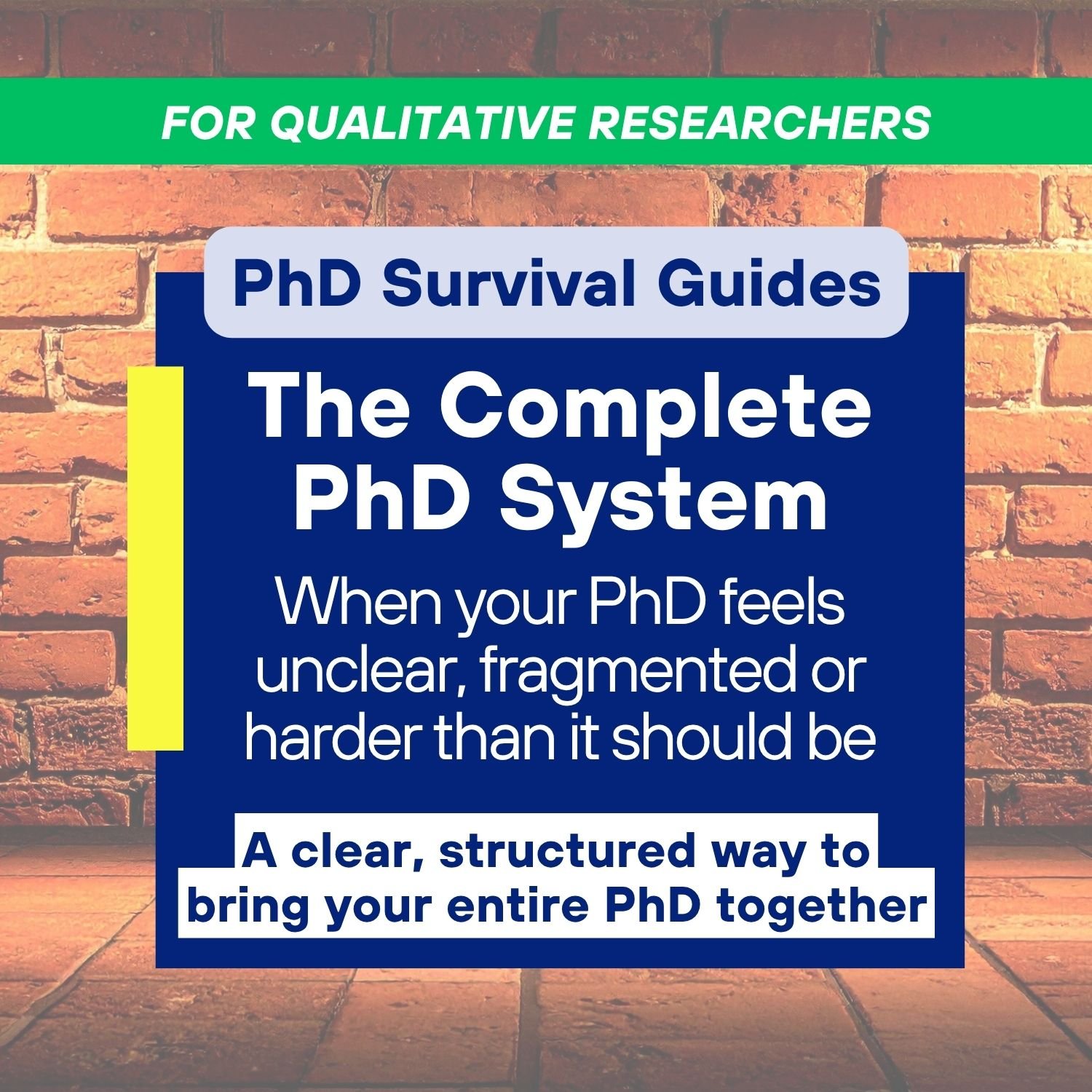
The Complete PhD System brings together all four PhD Survival Guides so your chapters begin making sense together as one connected piece of research - rather than separate sections that ended up in the same document.
My goal is to help you develop a clearer way of thinking about your research, trust your judgement more consistently, and understand what needs your attention next.
Because one of the hardest parts of a qualitative PhD is trying to hold the whole thing together in your head at the same time.
Swipe through the images for more details of what’s included.
Got questions? Contact me using this form, I’ll be happy to help.
By purchasing this product, you agree to our Terms and Conditions.