What PhD supervisors actually mean when they say your qualitative analysis “needs more depth”

If you’re writing a qualitative PhD findings chapter and getting feedback like:

“Needs more depth”

“Push the analysis further”

“This feels too descriptive”

“Be more critical”

you are very much not alone.

Over the last twenty years supporting qualitative PhD researchers, I can say that this is probably one of the most common - and frustrating - points where students begin doubting themselves.

Partly because nobody really explains what “more depth” actually means, and partly because by this stage of the doctorate, you are usually exhausted.

I often think this stage of the PhD feels a lot like starting a completely new job.

One of my earliest jobs was as a glass collector in a nightclub in the late 1990s. This was 1997, so people were still smoking indoors and every surface in the building seemed permanently sticky.

Everyone else working there looked incredibly competent.

They walked confidently through the club in their blue polo shirts with their baskets, somehow already knowing where all the abandoned glasses would be hiding. Behind speakers. On windowsills. Balanced mysteriously on top of door frames. Apparently nightclub customers in the 90s liked storing their used glassware in places no reasonable person would ever think to look.

Meanwhile, I would walk around with an almost empty basket thinking: “There genuinely aren’t any glasses anywhere.”

Then I would attempt to empty an ashtray and immediately spill ash all over the floor.

What I didn’t realise at the time was that everybody else who looked experienced had once been exactly the same. They had all learned gradually where to look, what mattered, what patterns to notice, and how the place actually worked.

That is often what qualitative analysis feels like at first.

Experienced researchers can seem as though they naturally “see” depth in the data, while you are left wondering whether you are somehow missing something obvious.

What this actually means is that you have not fully learned how to do this yet - this will take practice.
What supervisors usually mean by “too descriptive”

When supervisors say findings are “too descriptive,” they usually mean you are telling the reader what participants said, but not yet explaining why it matters.

That distinction changes everything - description reports, analysis interprets. For example:

Description: “Participants reported feeling unsupported.”

Analysis: “Participants’ accounts suggest that support was experienced not simply as the presence of help, but as responsiveness during moments of uncertainty.”

One repeats the surface of the data, the other begins interpreting meaning. That is what supervisors are usually looking for when they ask for “more depth.”
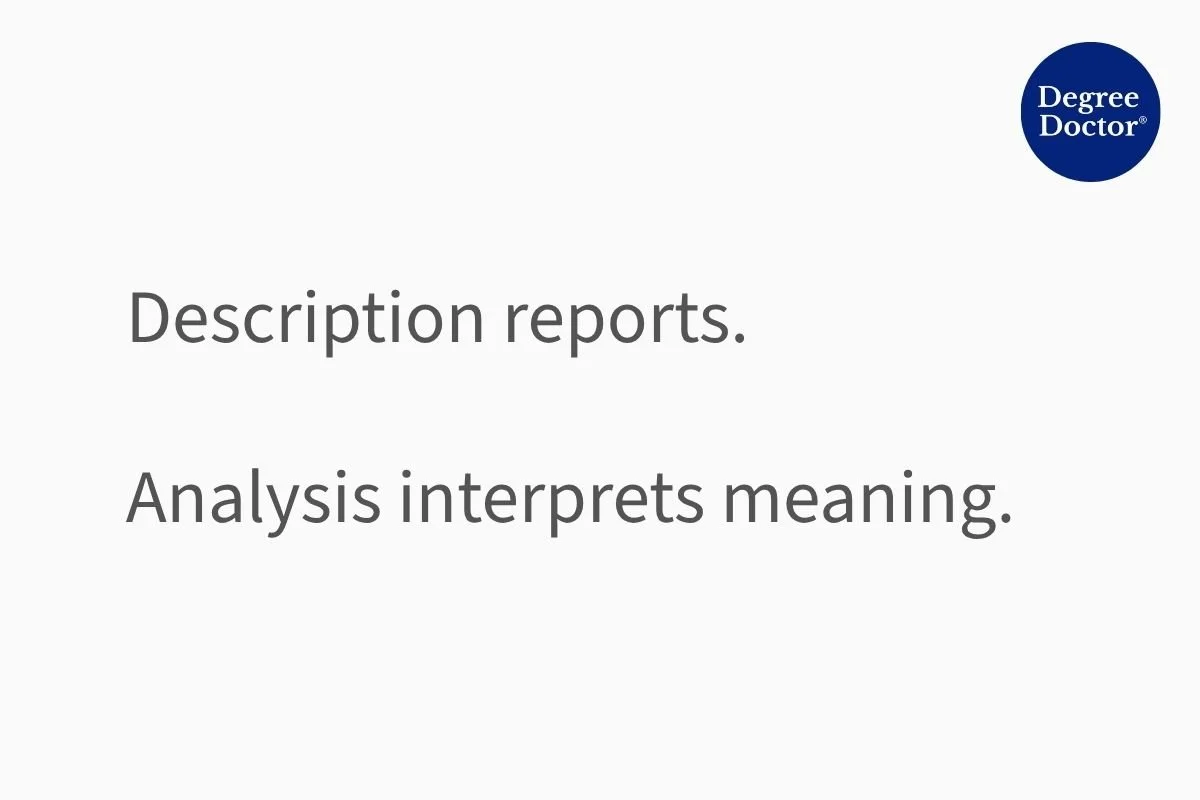
Quote graphic explaining that description reports while analysis interprets meaning.

The museum of qualitative findings

Qualitative findings chapters are usually the place where you demonstrate what you found when you worked carefully and systematically with the data.

Your role is to guide the reader through what your data actually suggests.

I sometimes tell people to imagine their thesis as a museum.

Your examiner is walking through it with you. You are not simply pointing silently at exhibits and hoping they understand why they matter. You are guiding them through the interpretation.

Why is this here?

What does it show?

How does it connect to the broader story emerging across the data?

A simple way to move beyond description

One of the easiest ways to deepen your findings chapter is to pause after each section and ask yourself a few additional questions:

  • What does this show beyond these individual quotes?

  • Why might this matter?

  • What broader pattern is emerging?

  • What feels significant, contradictory, or interesting here?

  • How does this connect to my research question?

Many students stop one step too early - they present the quotes, summarise what was said, and move on. The deeper analysis usually appears in the next layer of thinking.

Much like my first nightclub shifts, qualitative analysis becomes easier once you begin recognising how to be more thorough and spend more time looking.

An example: moving from description to analysis

Imagine you are researching newly qualified teachers and their experiences of interacting with parents.

One participant says:

“Sometimes parents email late at night and expect an immediate reply. I worry that if I don’t respond quickly, they’ll think I’m not taking their child seriously.”

A descriptive write-up might say:

“Several participants described pressure from parents to respond quickly to communication.”

There is nothing technically wrong with that sentence, but it remains close to the surface. A more analytical version might look like this:

“Several participants described pressure to remain constantly available to parents. For newly qualified teachers, communication appeared to extend beyond school hours, creating uncertainty around professional boundaries. Responsiveness was linked not simply to efficiency, but to concerns about appearing competent, committed, and caring.”

Now we have moved beyond the individual quote, towards a broader pattern, then into interpretation about professional identity and emotional pressure.

Nothing new was being invented - the researcher simply carried the thinking one stage further.

The literature question: “What’s left for the discussion chapter?”

This is another point where many students start wondering: “If I bring literature into the findings chapter, what will I have left to say in the discussion?”

The answer depends partly on disciplinary expectations because different fields structure findings and discussion chapters differently. Some disciplines separate them very clearly. Others expect findings, interpretation, and literature to be woven together throughout.

The important question is not: “Which structure is correct?”

It is: “What does my discipline expect?”

This is one to chat to your supervisor about.

If you do bring literature into your findings chapter, it helps to remember this: You are locating the finding within wider conversations, not writing a second literature review halfway through the thesis.

The discussion chapter asks:

  • What do these findings mean overall?

  • How do the themes connect?

  • What theoretical contribution emerges?

  • How do the findings reshape existing understandings?

  • What implications follow from this work?

The findings chapter says: “Here is what emerged.”

The discussion chapter says: “Here is why that matters.”

If you’re still doubting yourself

If your findings feel descriptive, that often means you are underconfident in your interpretation, trying too hard to remain “neutral”, or nobody has clearly shown you how interpretive writing actually works.

Across years of supporting qualitative researchers, I have seen many capable PhD students mistake uncertainty for incompetence. Those are not the same thing. Most people feel awkward when they first begin learning how to move from description into interpretation.

Just like I once walked around a nightclub carrying an almost empty glass basket wondering where on earth all the glasses were hiding, eventually, you start recognising the patterns. Once you do, qualitative analysis becomes much less mysterious.

If you want more structured support

If you’re currently sitting in front of a findings chapter wondering whether your analysis is “deep enough,” my From Data to Findings: Thinking, Methods and Meaning PhD Survival Guide was designed for exactly this stage of the doctorate.

It helps qualitative PhD researchers move beyond surface-level description and develop stronger interpretation, clearer analytical thinking, and more confident findings chapters.
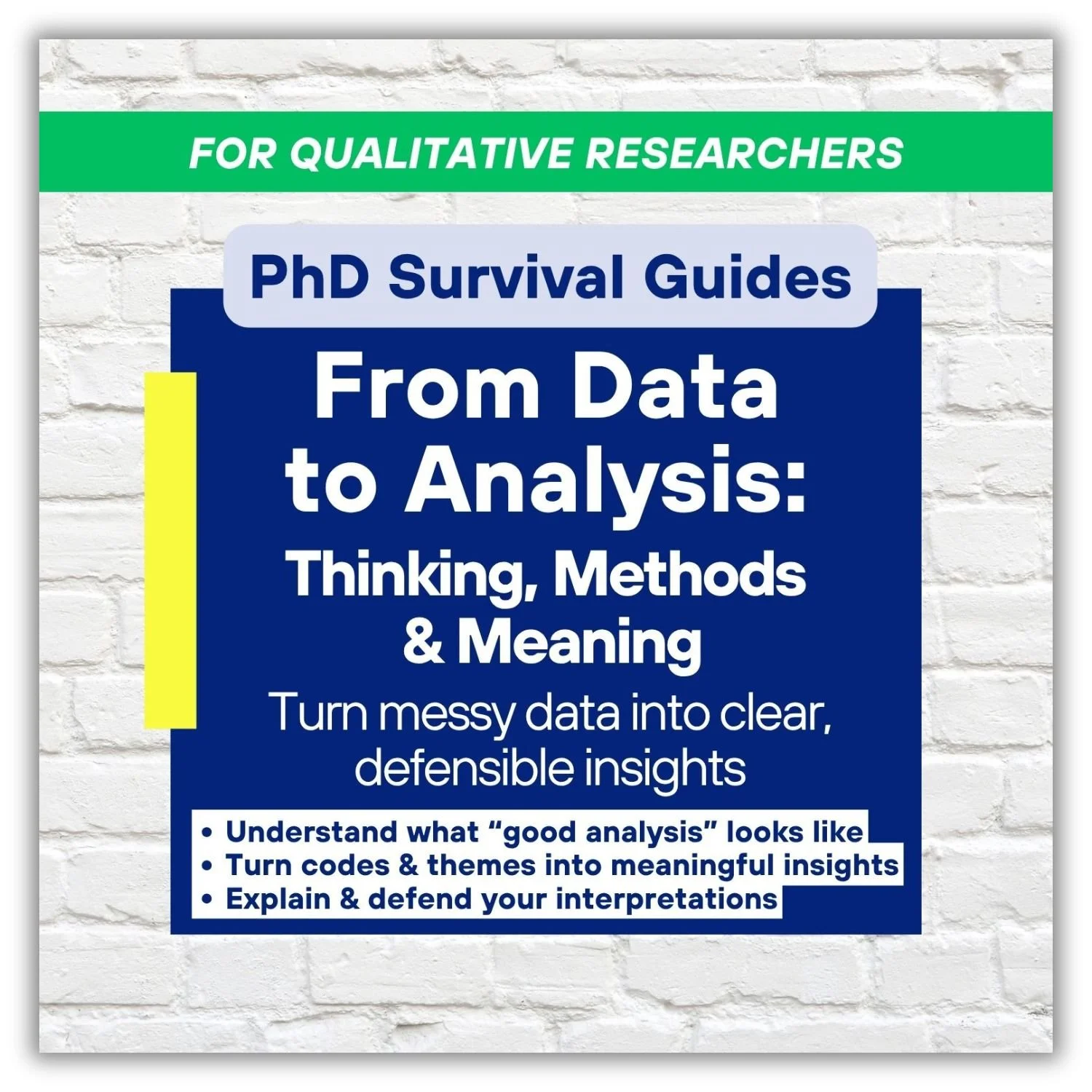
I developed it because this stage of the PhD can feel very exposing. You’re being asked to trust your own interpretation while simultaneously worrying that you are somehow “doing it wrong.” You’re tired and the line between description, analysis, findings, and discussion has started blurring together.

I know that structured support helps with that.

You can explore the guide here.

Data to Analysis PhD Survival Guide
£95.00

From “I’m not sure this makes sense” to a clear, defensible research design.

If your qualitative data analysis feels unclear, disconnected, or harder than it should, this guide will help you make sense of your decisions and explain them with confidence.

Many capable researchers reach the point where things stop feeling straightforward.

You may have data, but feel unsure what to do with it.

You may be writing your methodology chapter, but not know how to explain or justify your choices.

You may sense that parts of the project no longer fit together as clearly as they should.

That usually means you have reached the stage where qualitative research asks for coherence, judgement, and clarity - this guide is designed to help you through that stage.

Inside, I show you how to bring your research questions, methods, data collection, and analysis into a coherent whole, so that your project makes sense to you and can be clearly communicated to others.

You’ll learn how to:

  • align your research questions, methods, and data

  • understand what you are doing when you analyse qualitative material

  • make decisions you can justify with confidence

  • approach your methodology chapter with more clarity and structure

  • move forward without constantly doubting yourself

Whether you are refining your design, collecting data, analysing interviews or documents, or trying to write everything up clearly, this guide meets you where you are.

Across 12 carefully sequenced sections and practical worksheets, it helps you move from uncertainty and overthinking to clarity, coherence, and steady progress.

This is a digital download, so you’ll receive immediate access after purchase and can begin straight away.

Swipe through the images above to see what’s inside.

If you’d like one complete system for your qualitative PhD, you can also access all four PhD Survival Guides here.

If you have any questions, feel free to contact me. I’ll be happy to help.

By purchasing this product, you agree to our Terms & Conditions.

Next
Next

Why the PhD is one of the first times many intelligent people cannot clearly tell how well they are doing