Critical Analysis for Qualitative PhD Students: Moving beyond description
If you’re working on a qualitative PhD literature review in the social sciences, you’ve probably had this feedback at some point:
“You need to be more critical.”
It’s one of the most common comments supervisors give - and one of the least clearly explained.
You’ve read the article carefully. You understand the argument. You’ve summarised it accurately. So what exactly are you meant to do differently?
For most qualitative PhD researchers, the issue isn’t intelligence or effort. It’s that the writing stops too early.
Strong critical analysis isn’t about being harsher. It isn’t about attacking authors. And it definitely isn’t about sounding more complicated.
It’s about movement.
At doctoral level, you’re expected to move through five layers of thinking:
Describe. Interpret. Evaluate. Synthesise. Position.
Let’s walk through them in a way that actually makes sense.
1. Describe: Slow down and get clear
This is the part students often rush - and then get told they’re “too descriptive,” which feels deeply unfair.
Description matters.
Before you can critique a piece of literature, you need to understand what it’s actually doing. What is the author arguing? What evidence are they using? What theoretical lens are they working within? How was the data generated?
In qualitative research especially, this stage is about noticing how meaning is constructed. How are participants represented? What assumptions sit quietly underneath the argument? Is reflexivity visible or absent?
Description isn’t regurgitation. It’s grounding. It makes sure you’re engaging with the real argument, not a simplified version of it.
And without that grounding, everything that follows feels unstable.
Once you understand what a piece of literature is doing, the next question isn’t just “Where does this sit in the field?”
It’s: If this is true, what does that mean for my research?
Interpretation is about application.
If this author argues that identity is fluid and relational, what does that imply for how you design your interviews?
If a study suggests structural inequality shapes experience, what does that mean for how you frame your research questions?
If a paper critiques dominant policy narratives, how does that shape the way you conceptualise your topic?
This is where literature stops being something you summarise and starts becoming something you work with.
You might still ask where the text sits in wider debates, or what theoretical lens it uses - feminism, critical race theory, symbolic interactionism, and so on - but the key move is this:
How does this influence, sharpen, complicate, or challenge the way I am thinking about my own project?
Interpretation at PhD level means allowing literature to do intellectual work in your study. It may refine your concepts. It may shift your focus. It may expose assumptions you didn’t realise you were making.
And yes, your own position still matters here. You don’t read neutrally. Your training, experiences, and theoretical leanings shape how you apply what you’re reading.
That isn’t bias to eliminate. It’s reflexivity to acknowledge.
At this stage, critical analysis becomes active. You’re no longer just understanding the literature, you’re letting it shape your doctoral thinking.
3. Evaluate: Make a calm judgement
Evaluation is where you decide how convincing the work is.
Does the argument follow through? Does the evidence genuinely support the claims? Are the methods transparent and appropriate? Are there obvious blind spots?
In qualitative research, evaluation often comes down to depth, coherence, and honesty. Is the analysis thoughtful? Does it sit carefully with the data? Are limitations acknowledged?
This isn’t about being dismissive. It’s about being measured.
No article can do everything. But you should be able to say, clearly and calmly, what it does well and where it falls short.
Many PhD students think this is the end of critical analysis.
It isn’t.
4. Synthesise: Step back and see the pattern
If you stop at evaluation, your literature review becomes a series of separate commentaries. What turns it into a strong doctoral chapter is synthesis.
Synthesis means looking across studies and asking:
What patterns are emerging here?
Where do authors agree?
Where are the tensions?
Are there competing theoretical camps?
Instead of reviewing articles one by one, you begin grouping them - perhaps by theoretical perspective, by methodological approach, or by how they frame the issue.
This is where your literature review starts to feel like an argument rather than a reading list.
And if this is the stage that feels overwhelming, you’re not alone. Synthesis is conceptually demanding because it requires holding multiple ideas at once and noticing relationships between them.
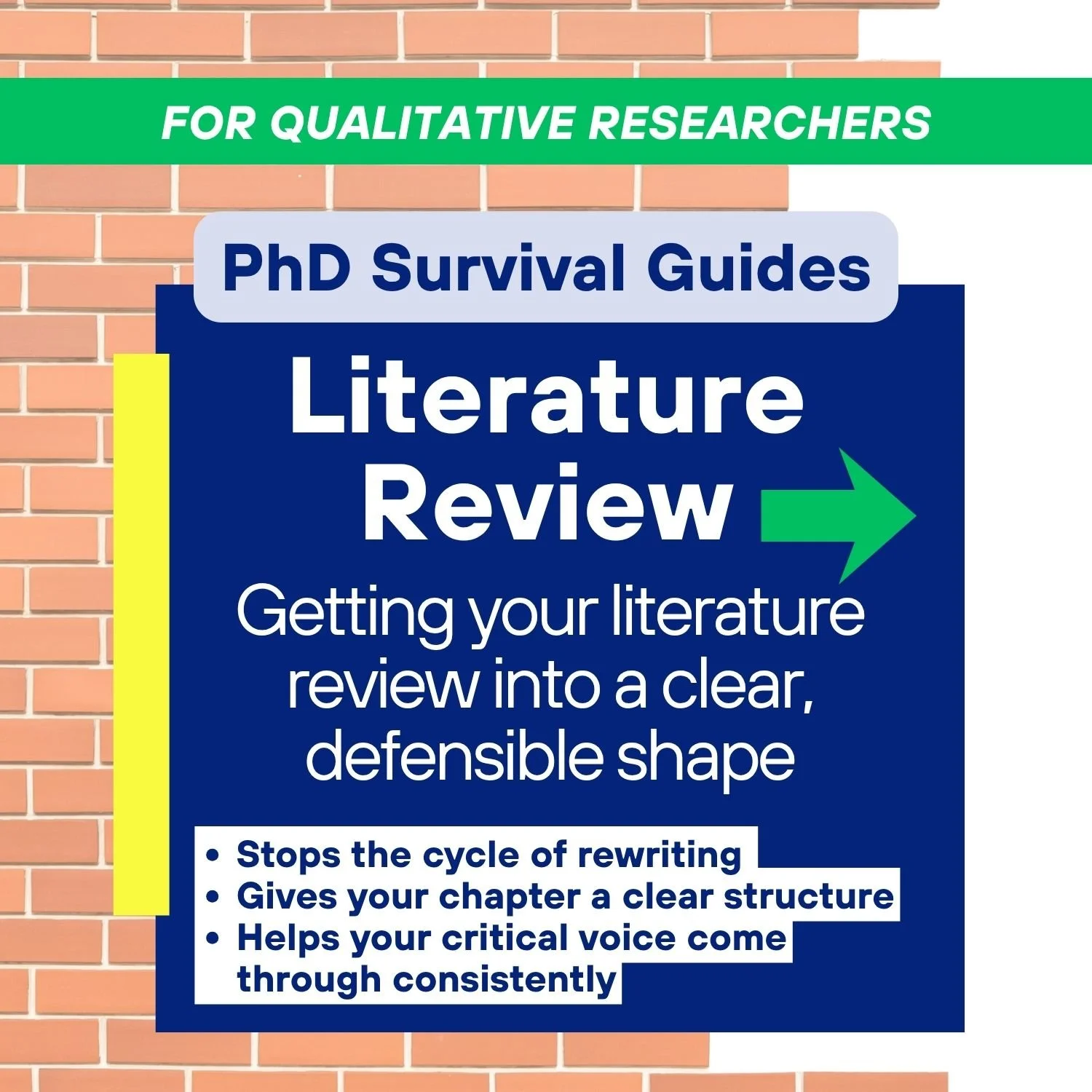
If you’re finding it hard to move from “notes on papers” to “coherent themes,” this is exactly the kind of work my Literature Review Guide is designed to support. It walks you through how to develop themes, critically analyse without over-noting, and build synthesis step by step - calmly, without panic.
5. Position: Where do you stand?
This is the doctoral move.
After you’ve described, interpreted, evaluated and synthesised, you need to show where your research fits.
What is missing in the existing literature?
What assumptions do you want to question?
What does your qualitative study allow you to see that others haven’t?
Positioning doesn’t mean claiming to revolutionise the field. It means showing that your project has a clear, reasoned place within it.
Without positioning, your literature review can feel knowledgeable but slightly detached.
With positioning, your project becomes anchored.
Let’s reframe the “be more critical” feedback
If your supervisor says your work is “too descriptive,” it usually means one of three things:
You’ve stopped at description.
You’ve evaluated without synthesising.
Or you’ve synthesised without positioning yourself clearly.
Critical analysis in a qualitative PhD is about clarity and coherence. It’s about showing that you understand the landscape of your field - and that you know where you’re standing within it.
These five stages aren’t a rigid checklist. You’ll move back and forth between them. But when all five are present, your literature review shifts from competent to confidently doctoral.
And that’s usually what your supervisor is really asking for.
When you’re ready for structured support
If you’re in the thick of your literature review and the line between description, analysis and synthesis feels blurry, you don’t need more pressure. You need structure.
My Literature Review Guide is built specifically for qualitative PhD researchers who are capable but second-guessing themselves. It helps you develop themes, strengthen critical engagement, and position your study clearly - without overcomplicating or overclaiming.
It’s here when you need it.