What goes in a qualitative PhD findings chapter? Should you refer back to the literature, or leave that for the discussion?
What goes in a qualitative PhD findings chapter - and whether you should refer back to the literature while writing it - are two of the most common sources of uncertainty at doctoral level.
You’ve done the data collection. You’ve worked through your analysis. You’ve started to see patterns, themes, and insights emerging.
Now you’re trying to write it up in a way that feels… right. Structured, but not rigid. Analytical, but not forced. Confident, but not overstated.
This is where things can start to feel slightly blurred.
The question behind the question
On the surface, the dilemma often sounds like this:
“Should I refer back to the literature in my findings chapter?”
Underneath, it’s usually something more conceptual:
Where does my analysis begin and end?
Am I allowed to interpret here, or is that for later?
What actually counts as a ‘finding’ in qualitative research?
These are not small questions. They sit right at the centre of what qualitative research is.
As such, before deciding on structure, it helps to step back and ask something simpler: What is the purpose of this chapter in your study?
What a qualitative findings chapter is really doing
In qualitative research, your findings chapter is not just a place where you “present results.”
It is where you make your analysis visible.
Where you show the reader how you moved from raw data to patterns and themes, and then on to something that can be understood and evaluated.
This is not a neutral process. It is interpretive. That’s why this chapter can feel more demanding than expected - because you are not just reporting what participants said.
You are showing how you have made sense of what they said.
So… should you refer back to the literature?
The honest answer is: it depends on how your thesis is structured.
Some qualitative projects integrate findings and discussion, weaving literature throughout. Others keep them more separate, holding back deeper engagement with the literature for a later chapter.
However, in practice, the distinction is often less rigid than it sounds because even when you are not explicitly citing literature, your analysis is still shaped by it.
Your concepts, your sensitivity to patterns, your interpretation of meaning - all of these are informed by what you’ve already read.
Essentially, the decision is not really about whether literature is present. It’s about how explicitly you bring it into the writing at this stage.
The three layers of a strong findings chapter
Rather than thinking in terms of rules, it’s often more helpful to think in terms of layers.
Most qualitative findings chapters move - explicitly or implicitly - through three forms of work:
1. Description: grounding the reader
This is where you show what you found.
Not everything, and not in raw form, but enough to give the reader a clear sense of the patterns in your data.
This might involve:
introducing themes
outlining key ideas
using carefully selected quotes
Description is often underestimated but it’s what allows your reader to see your data before you ask them to engage with your interpretation. Without it, analysis can feel slippery.
2. Analysis: making meaning
This is where your role as a researcher becomes more visible.
You are no longer just presenting patterns, you are interpreting them.
You are asking:
What is going on here?
Why does this matter?
How do these ideas connect?
In qualitative work, this is the core of the findings chapter, and this is often the point where people hesitate, worried about “over-interpreting” or getting it wrong.
However - careful, well-grounded interpretation is exactly what your examiners are looking for.
3. Synthesis: connecting outward
This is where your findings begin to connect to the wider academic conversation.
In some theses, this happens lightly within the findings chapter, in others, it is held back for the discussion.
Either approach can work.
What matters is that your structure is consistent and defensible - and that the reader can clearly follow how your findings relate to existing knowledge.
Why description matters more than you think
One of the most common issues in qualitative findings chapters is that everything gets blurred together.
Description, analysis, and synthesis collapse into a single layer.
When that happens, the writing can start to feel rushed, unclear, or slightly over-assertive. Strong qualitative writing often does the opposite.
It slows things down just enough to let the reader see what you’re seeing.
Description plays a key role in this. It shows that you are grounded in your data, that your interpretations are not arbitrary, and that your analysis has somewhere to stand.
Where things tend to go wrong
If your findings chapter feels messy or difficult to write, it’s rarely because you “don’t understand your data.”
More often, it’s because you’re trying to do everything at once, you’re unsure where interpretation is allowed, or you’re second-guessing how visible your voice should be
Separating these layers - at least conceptually - gives you much more control, even if, in the final draft, they are woven together more fluidly.
There is no single “correct” way to structure a qualitative findings chapter but there is a difference between a chapter that feels uncertain and one where the reader can clearly see - what was found, how it was interpreted, and how it contributes to the wider conversation
That clarity is what examiners are looking for.
If this still feels slightly blurred
If the line between findings, analysis, and discussion still feels unclear, that’s because you’re working through one of the most conceptually demanding parts of a qualitative PhD.
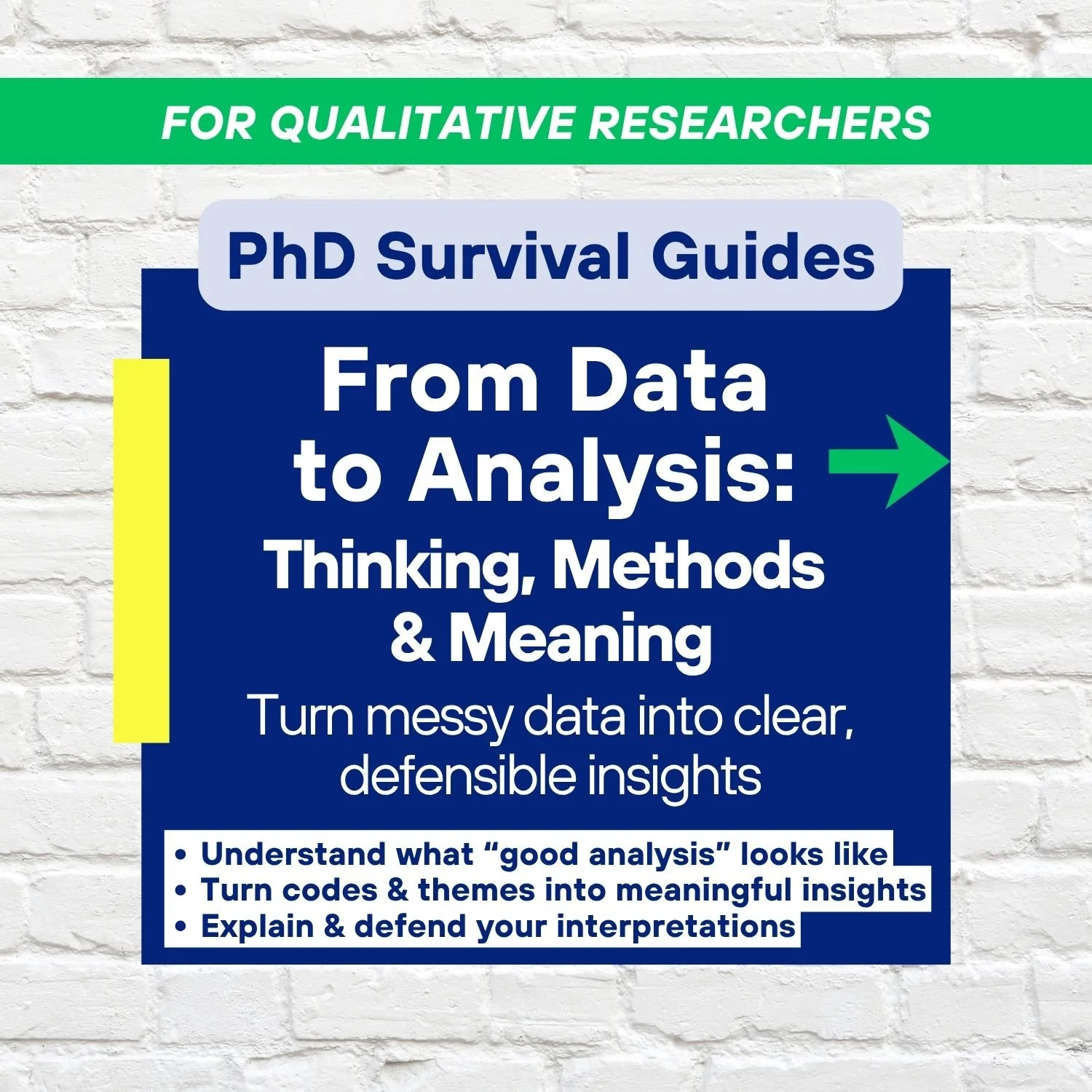
My Methodology, Data Collection & Analysis PhD Survival Guide walks you through this in a structured way:
how qualitative analysis actually works in practice
how to move from data to themes with confidence
where theory fits (and where it doesn’t)
and how to write a findings chapter that aligns with your research questions and paradigm
It’s there to help you turn that sense of “I think I get this” into something you can clearly express on the page.
It’s here when you’re ready for it.
“I can describe what I did. I just don’t know if I trust my own judgement.”
This is the point in the PhD where your research starts demanding something different: interpretation, judgement, coherence, and confidence in your reasoning. This guide was written for that stage.
Swipe through the images above to see what’s inside.
Get the full Survival Guide set here.
If you have any questions, feel free to contact me. I’ll be happy to help.
By purchasing this product, you agree to our Terms & Conditions.