Pragmatism in qualitative research: what it means for your PhD (and how to use it)
Pragmatism in qualitative research is often described as a practical, flexible approach. On the surface, that sounds reassuring - especially if you’ve already found yourself slightly tangled in discussions of paradigms, ontology, and epistemology. But for many PhD researchers, that description doesn’t quite go far enough. It explains the appeal of pragmatism, without really clarifying what you’re supposed to do with it.
If you’ve come across pragmatism and thought, “this sounds like it might fit my project, but I’m not entirely sure how,” you’re in the right place.
I’m Dr Elizabeth Yardley, and I work with qualitative PhD researchers who are trying to make sense of exactly these kinds of decisions. What I want to do here is slow this down a little and look more carefully at what pragmatism is doing, and where it can leave you needing something more.
Why pragmatism often feels like a relief
By the time paradigms enter the conversation, most PhD researchers already have a developing sense of their project. You’re not starting from nothing. You’ve usually spent time thinking about your topic, perhaps doing some early reading, maybe even sketching out research questions. There’s already a direction, even if it still feels provisional.
And then paradigms arrive, often framed as something you’re expected to “choose” or “position yourself within.”
For many qualitative researchers, this is the point where things start to feel unnecessarily rigid. The language can feel abstract, and the idea that you need to commit to a clearly defined philosophical position can sit uneasily alongside the way your project is actually developing.
This is where pragmatism tends to stand out.
It appears to offer a way of working that is less about committing to a fixed position and more about staying focused on the research problem itself. It suggests that your choices should be guided by what helps you understand the issue you’re studying, rather than by strict adherence to a particular philosophical framework.
It’s not surprising that many qualitative PhD students find that appealing. It seems to remove some of the pressure. It creates space to think.
But that sense of relief is only part of the picture.
What pragmatism is actually doing
At its core, pragmatism shifts the emphasis of research away from abstract questions about the nature of reality and towards more practical questions about understanding and usefulness. It asks what kind of knowledge would be meaningful in relation to your research problem, and what kinds of approaches might help you develop that understanding.
In qualitative research, this can feel like a natural fit. Many qualitative projects are already concerned with meaning, experience, and interpretation. They often evolve as the researcher becomes more familiar with the field, the participants, or the data. A pragmatic stance seems to accommodate that movement.
But there is a subtle shift that happens here, and it’s easy to miss.
Pragmatism does not remove the need for coherence in your research. It changes how that coherence is built.
Rather than deriving your decisions from a fixed philosophical position, you are working in the other direction. Your research questions, your developing understanding of the topic, and your emerging data begin to shape your approach. The coherence of the project comes from how well these elements fit together, not from how neatly they align with a predefined paradigm.
That sounds straightforward in principle. In practice, it’s where many researchers begin to feel less certain.
Where things can start to feel less clear
One of the reasons pragmatism is often summarised as “doing what works” is because of this flexibility. But in the context of a PhD, that phrase can quickly become unhelpful.
What does “working” actually mean here? Working for what purpose? And how do you demonstrate that your decisions are not simply convenient, but appropriate?
These questions don’t always appear immediately. They tend to surface later, often when you are asked to explain your methodological choices more explicitly. You might find yourself trying to articulate why you chose a particular approach, or how your decisions connect to your research questions, and realising that “it made sense at the time” doesn’t quite feel like a sufficient answer.
This is the point where pragmatism can begin to feel less like a solution and more like an open space that still needs structure.
It’s not that anything has gone wrong. It’s that flexibility on its own doesn’t provide a clear account of your reasoning.
A brief note on the “paradigm or not” question
There is an ongoing discussion in research methods literature about whether pragmatism should be considered a full paradigm. Some argue that it lacks the clearly defined ontological and epistemological commitments that characterise other paradigms. Others suggest that its strength lies precisely in that openness.
For your PhD, this debate is not the most important issue.
What matters more is understanding what adopting a pragmatic stance allows you to do, and what it still requires you to think through carefully. Whether you call it a paradigm, an approach, or a stance, the practical question is the same: how does this shape the way you design and explain your research?
What this looks like in a qualitative study
If you bring this back to your own project, pragmatism often shows up as a willingness to let the research problem lead. You might begin with an interest in people’s experiences of a particular process or situation, and choose methods that allow you to explore those experiences in depth.
As your understanding develops, you might notice new directions or questions emerging. A pragmatic approach allows you to follow those, rather than feeling constrained by earlier decisions. There is space to adapt, to refine, and to respond to what you are learning.
But this does not mean that anything goes.
At doctoral level, what becomes increasingly important is your ability to explain how and why your study has taken the shape it has. The flexibility of your approach needs to be matched by clarity in your reasoning. You need to be able to show how your research questions, your assumptions, and your methodological choices connect in a way that makes sense.
Holding flexibility and coherence together
This is where many qualitative PhD researchers find themselves doing quite a delicate piece of thinking.
On the one hand, you don’t want to force your project into a rigid framework that doesn’t fit. On the other, you need to be able to demonstrate that your study is coherent, that your decisions are not arbitrary, and that your approach is appropriate to the kind of understanding you are trying to develop.
Pragmatism can support that balance, but it doesn’t resolve it for you.
What tends to make the difference here is not the label you use, but how clearly you can articulate the relationships within your project. How your concepts are working. How your research questions are shaping your approach. How your methodological choices follow from the kind of knowledge you are trying to produce.
When those elements begin to align, your project starts to feel more grounded. Not fixed, but stable enough to move forward with confidence.
Where this leaves you
Pragmatism can be a genuinely helpful way of approaching qualitative research. It can ease the pressure to adopt a rigid philosophical position and allow your study to develop in a more responsive way.
At the same time, it places a different kind of responsibility on you as a researcher. Instead of relying on a predefined framework to hold your project together, you are responsible for building that coherence yourself.
That is where many PhD researchers find themselves needing a bit more support.
If this feels like it makes sense - but still slightly unfinished
That sense of “I understand this, but I’m not entirely sure how to apply it to my own project” is very common at this stage.
Understanding ideas like pragmatism is one thing. Working out how they connect to your topic, your research questions, and your methodological decisions is something else.
My Conceptual & Theoretical Foundations PhD Survival Guide is designed to help you do that work in a more structured way. It focuses on how concepts, paradigms, and early research decisions fit together across a qualitative PhD, so that your project feels coherent rather than pieced together.
It’s not a substitute for your own thinking, but it does give you a way of organising that thinking so you can move forward with more clarity.
It’s there if and when you need it.
If you’d prefer to keep working through these ideas gradually, you can join the email list for regular guidance on qualitative PhD research. It will help you stay oriented as your project develops.
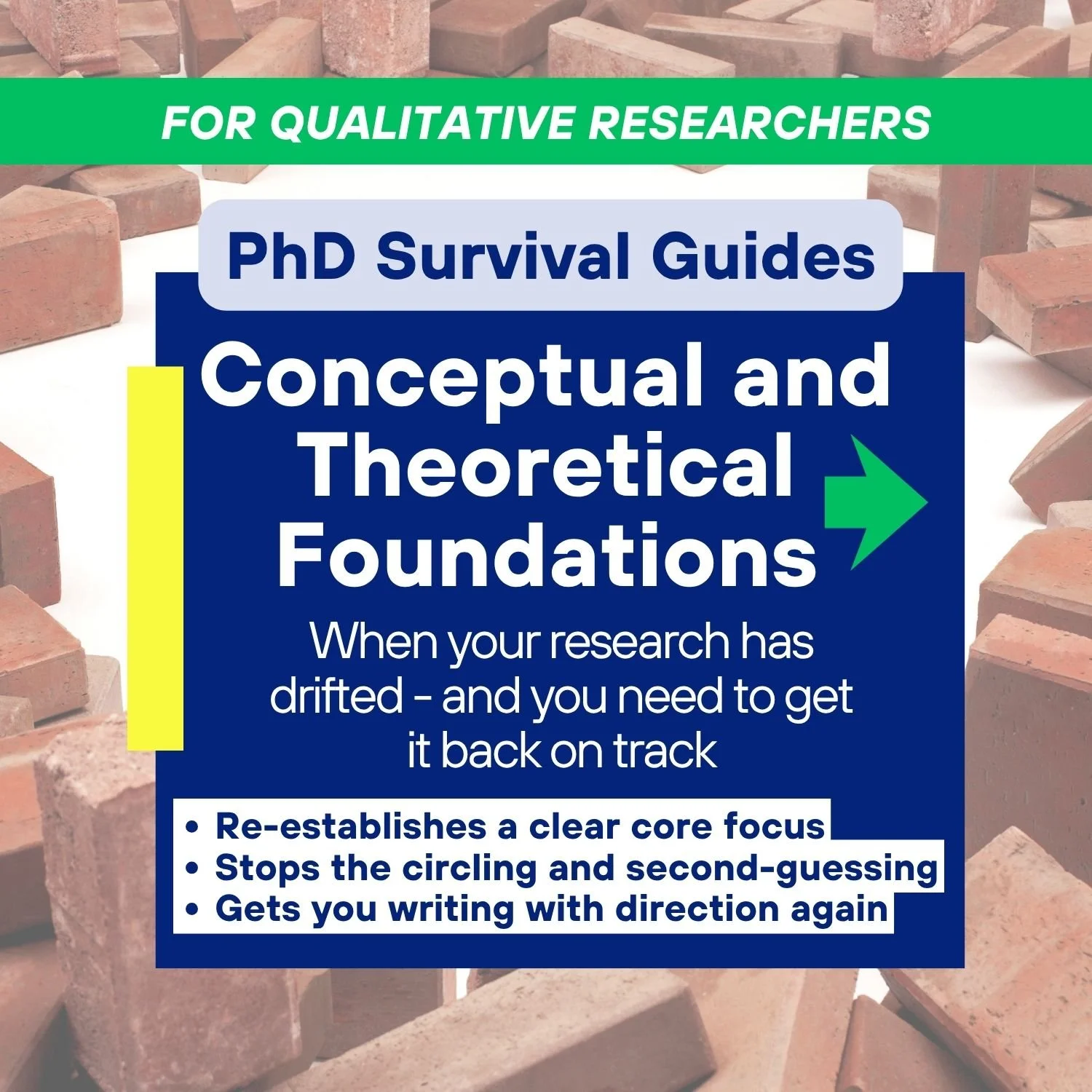
“My research feels slippery, I’m not sure what it is anymore.”
If your research is moving, but something underneath it doesn’t fully make sense yet, this guide will help you get it back on solid ground. If you’ve started to freeze when someone asks what your PhD is about, this guide will help you get clear on it.
Swipe through the images to see exactly what’s inside.
Get the full Survival Guide set here.
Got questions? Contact me using this form, I’ll be happy to help.
By purchasing this product, you agree to our Terms & Conditions.