How to narrow your qualitative PhD topic without getting stuck - a clear approach using the PIC strategy (people, issue / interest, context)
Working out your PhD topic sounds like it should be straightforward. In reality, it’s often one of the most difficult parts of the whole process.
You might already have a general area you care about. You may even have a few ideas that feel promising. But when you try to turn that into a clear, focused title, things can quickly become vague, overly broad, or slightly tangled.
This is especially true in qualitative research, where your project is not just about what you study, but how you are thinking about it.
In this post, I want to show you a way of approaching your topic that brings a bit more clarity without forcing you into something rigid too early. It’s based on a simple framework I use with PhD researchers: People, Issue or Interest, and Context - or PIC.
Why narrowing your topic feels harder than it should
Most qualitative PhD researchers don’t struggle because they lack ideas. If anything, the opposite is true.
There are too many possible directions. Too many ways of framing the problem. Too many things that feel interesting, relevant, or important.
At this stage, it’s very easy to drift into topics that sound plausible but don’t quite hold together. Titles become broad, slightly abstract, or filled with terms that don’t yet have a clear role in the project.
This isn’t a failure of ability. It’s usually a sign that your thinking hasn’t yet been given enough structure to work with.
That’s where a framework like PIC becomes useful. Not as a formula to “get the right answer”, but as a way of making your thinking more visible.
What PIC is really doing
PIC stands for People, Issue (or Interest), and Context.
On the surface, it looks simple. But its value isn’t in the labels themselves. It’s in the way it helps you move from a loose idea to something that has enough shape to work with.
Rather than trying to come up with a perfect title straight away, PIC gives you three points to anchor your thinking.
Who or what is this study about?
What is it that you are actually interested in?
And where, or in what setting, does this take place?
When those three elements begin to come into focus, your topic starts to feel more manageable. Not finished, but workable.
Starting with people (and why specificity matters)
In qualitative research, “people” is rarely just a background detail. It shapes what your study can meaningfully explore.
Early topic ideas often leave this quite vague. You might find yourself thinking about “students”, “professionals”, or “users” in very general terms.
The difficulty is that broad categories don’t give your thinking much to hold onto.
As soon as you begin to specify who you are interested in, your project starts to take on a different level of clarity. That might mean focusing on a particular group, a shared experience, or a specific position within a wider context.
For example, there is a noticeable shift between thinking about “students” and thinking about “first-generation university students studying mathematics”. The latter immediately suggests different experiences, challenges, and questions worth exploring.
This isn’t about getting it perfectly defined from the start. It’s about giving your project something more concrete to work with.
Clarifying your issue or interest
The second part of PIC is often where things feel slightly less stable.
Your issue or interest is not your research question, and it’s not your findings. It’s the thing you are trying to understand.
In qualitative research, this is often something like:
an experience
a process
a form of meaning-making
a tension or challenge
a particular practice
At this stage, it’s very common for this to feel a bit fuzzy. That’s not a problem - it’s useful information. It tells you where your thinking is still developing.
What matters is beginning to articulate it in a way that you can work with. Instead of “education”, you might be interested in how students experience online learning. Instead of “work”, you might be interested in how people navigate work–life boundaries.
As this becomes clearer, your topic starts to move from a general area into something more focused and purposeful.
Bringing in context (and why it matters more than it seems)
Context is what prevents your topic from floating.
Without it, your study risks becoming too broad or disconnected from the setting in which your research actually makes sense.
Context might be a physical location, an institutional setting, a particular sector, or even an online space. It doesn’t have to be overly detailed at this stage, but it does need to do some work.
It helps you define the boundaries of your study. It signals where your research is situated. And it allows you to think more carefully about how your issue or interest plays out in a specific environment.
Once context is introduced, your topic begins to feel less like an abstract idea and more like a study that could realistically be carried out.
From PIC to a working title
When you bring these elements together, you don’t get a “final” title. What you get is something much more useful: a working version of your project that you can begin to develop.
At this point, your title is doing one main job. It is helping you think.
It is not a contract. It is not a fixed declaration of what your PhD will become. It is a way of holding your ideas together while you read, explore, and refine your thinking.
This is an important shift, because many PhD researchers feel pressure to get their title exactly right, too early. In reality, a good working title is one that gives you enough focus to move forward, while still leaving room for change.
Allowing your topic to evolve (without losing direction)
As you move into your literature review and begin engaging more deeply with your topic, your thinking will almost certainly shift.
You might refine who your study focuses on, narrow or reshape your central interest, or adjust the context as your understanding develops. This is not something to avoid. It is part of the process.
What PIC gives you is a stable starting point. It allows your project to evolve without becoming directionless.
Instead of starting again each time something changes, you are adjusting and refining something that already has structure.
Where many PhD researchers get stuck
The difficulty is not usually in understanding PIC as a framework. It’s in knowing how to use it alongside everything else your PhD is asking of you.
How does your topic connect to your conceptual framework?
How do your early ideas link to your research questions?
How does this all sit alongside paradigms and methodological decisions?
Without a way of bringing those elements together, it can feel like you are working on separate pieces that don’t quite align.
If your topic feels clearer, but not fully settled
That sense of partial clarity is completely normal.
Getting to a focused topic is not about having everything figured out. It’s about having enough structure to think productively, while allowing your ideas to develop.
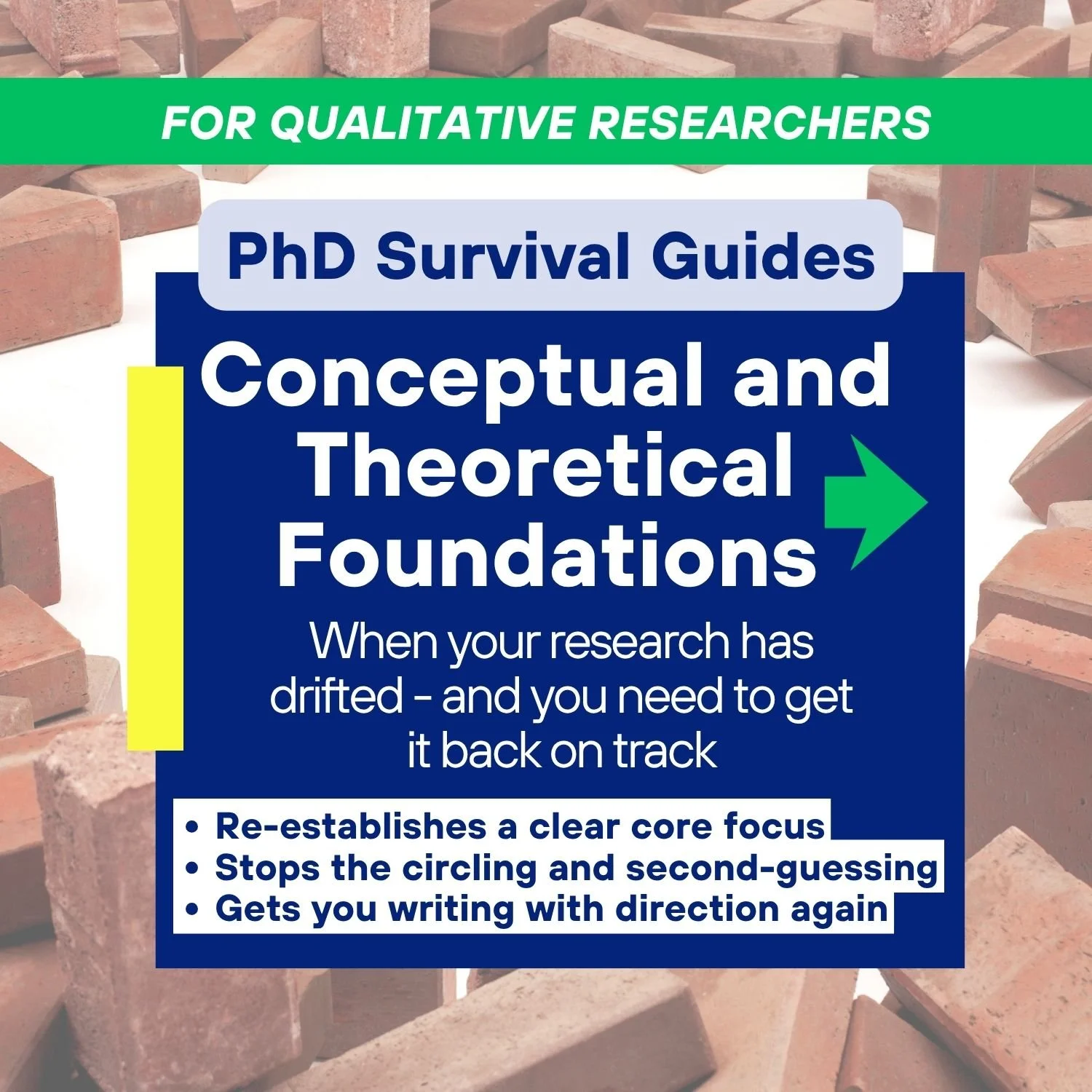
My Conceptual & Theoretical Foundations PhD Survival Guide is designed to support exactly this stage. It shows how your topic, concepts, paradigms, and early research decisions fit together, so that your project feels coherent rather than pieced together.
It’s a way of building structure around your thinking, without closing things down too early.
It’s here when you need it.
If you’d prefer to keep working through these ideas gradually or you feel confident in your topic, you can join my email community for regular guidance on qualitative PhD research. It will help you stay oriented as your project develops.
“My research feels slippery, I’m not sure what it is anymore.”
If your research is moving, but something underneath it doesn’t fully make sense yet, this guide will help you get it back on solid ground. If you’ve started to freeze when someone asks what your PhD is about, this guide will help you get clear on it.
Swipe through the images to see exactly what’s inside.
Get the full Survival Guide set here.
Got questions? Contact me using this form, I’ll be happy to help.
By purchasing this product, you agree to our Terms & Conditions.