Why the PhD is one of the first times many intelligent people cannot clearly tell how well they are doing
One of the hardest parts of doing a PhD, particularly a qualitative PhD, is that many researchers struggle to tell whether they are actually progressing, doing good work, or meeting doctoral expectations.
Even highly capable PhD students often spend years feeling uncertain about whether their writing is “PhD level”, or if they’re getting the entire thing wrong.
Last year, while I was on holiday in Spain, I started drawing again for the first time in around thirty years. The last time I had drawn properly was at school, around the age of fifteen or sixteen.
Back then, progress felt relatively straightforward.
We were all working on similar projects - I remember one was to draw a scene happening inside your pencil case, that was… interesting. Anyway - there were assessment criteria, a teacher explained what stronger work looked like, you could compare your work with classmates and get some sense of where you stood.
Even when something was difficult, there was structure around the difficulty.
Then, fast forward, and there I was in Spain all these years later, sitting with a small pile of expensive art supplies I had enthusiastically bought online beforehand. Hardback sketchbooks. Good pencils. Professional-looking felt-tip pens. The sort of materials that make you briefly believe you are now the kind of person who casually sketches in cafés while drinking something elegant.
The problem was that I had absolutely no idea what I was doing. Not a Scooby Doo. No teacher, no curriculum, no sequence of exercises, no assessment criteria, no clear sense of what counted as “improving”.
I would finish a drawing and stare at it thinking:
“Is this terrible?”
“Is this normal beginner-level terrible?”
“Am I progressing?”
“Would someone who actually knows how to draw think this is reasonable?”
There were moments I genuinely could not tell.
Although, to be fair, the cats I attempted to draw often resembled deeply troubled dogs, which did provide at least some evaluative clarity.
Somewhere in the middle of all this, I realised I’d felt this way before - when I was doing my PhD. One of the strangest things about doctoral research is that, for many intelligent and previously high-achieving people, it is the first prolonged period of their education where they cannot clearly tell how well they are doing. That can affect people far more deeply than they expect.
Earlier education usually provides visible standards
Most forms of education come with relatively visible structures.
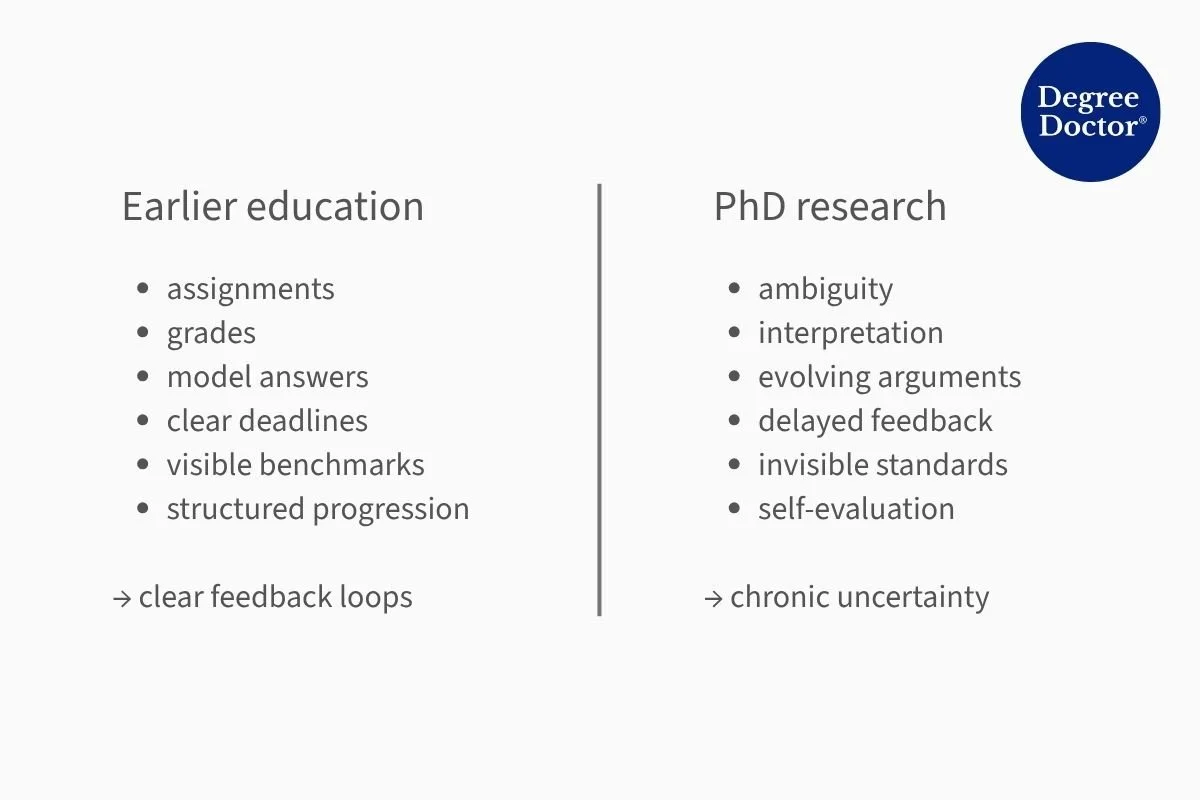
There are assignments, mark schemes, grades, clear deadlines, examples of strong work, other people doing similar tasks at roughly the same time. Even if students feel stressed or uncertain, there is often still some framework helping them estimate where they stand.
You get to find out whether you passed, whether your work improved, whether you were near the top or middle of the class, whether your teacher thought you were on the right track. That does not remove anxiety, but it does provide orientation.
The PhD removes much of that structure - particularly in qualitative research.
The doctorate replaces certainty with judgement
By the time researchers reach doctoral study, the nature of the work changes significantly.
You’re no longer mainly being asked to demonstrate that you understand existing knowledge, you’re being asked to contribute towards the creation of it.
That means feeling wobbly whilst you’re doing things like defining problems, evaluating literature, shaping arguments, interpreting data, defending conceptual choices, deciding what matters, and developing original thinking.
This happens without clear external markers constantly telling you whether you are succeeding - that can feel deeply destabilising.
Especially for people who are used to being competent.
I have seen many highly capable researchers really struggle with this transition because they are operating in an environment where the usual systems for measuring progress and competence become much less visible.
Why qualitative research intensifies this feeling
Qualitative research adds another layer to all of this because so much of the work is interpretive.
You’re making judgement calls around coding, themes, interpretation, theoretical framing, reflexivity, structure, meaning, and conceptual alignment. This can feel like trying to plait fog.
While supervisors can guide and support, they often cannot provide the kind of certainty students secretly wish for.
There is no answer sheet hidden in the back somewhere.
This creates a difficult psychological environment because some researchers misinterpret feelings of uncertainty as evidence they are failing.
The internal logic becomes: “If I were doing this properly, surely I would feel more certain than this.”
The comparison problem
When people cannot clearly evaluate their own progress, they often start looking sideways, using other people as substitute benchmarks.
Other students seem more confident - someone else has published, another researcher sounds articulate in research seminars, a peer appears to have a cleaner methodology chapter.
The difficulty is that PhDs are rarely directly comparable. A lot of things differ: projects; methods; supervisors; timelines; life circumstances.
One student may be panicking while sounding polished in meetings. Another may appear slower and less sure of themselves while actually doing extremely thoughtful work.
Over the years, I have met many qualitative doctoral researchers who privately assumed everyone else understood the process better than they did. Usually, that assumption was wildly inaccurate because uncertainty is often built into the work itself - particularly once you move beyond procedural tasks and into interpretation, argument, and meaning.
Returning to the drawing
Eventually, while sitting in the Spanish sun with another slightly questionable cat sketch in front of me*, I realised something important:
The PhD often asks you to start developing a whole different learning structure internally - one that enables you to adapt to periods where the work still feels messy, the answers are incomplete, the standards feel blurry, and your thinking is still developing.
*I should add that my ability to draw cats remains highly debatable - but it’s a lot better than it was.
What PhD progress looks like in qualitative research
Doctoral research develops in a lumpy, messy, uneven way. That means that the markers of progress are different from those you might have experienced in earlier education. These indicators can help:
• understanding something more deeply
• recognising a flaw in your own argument
• refining a research question
• noticing a pattern in the data
• realising a conceptual framework no longer fits
• becoming more precise in your thinking
One of the most psychologically helpful shifts in a PhD is learning to stop interpreting every difficult moment as evidence of inadequacy. Instead, these are signs that your thinking is evolving.
That is particularly true in qualitative research, where understanding usually develops iteratively rather than appearing all at once.
When researchers are deep inside the process, the work often feels fragmented. However, later on, patterns emerge, arguments sharpen, connections become clearer, and the thesis gradually starts holding together more coherently - because your ability to work within uncertainty has gotten stronger.
If your PhD currently feels unclear
If you are in a stage where you constantly feel unsure whether you are progressing properly, I would be cautious about interpreting that too personally. Focus more on structures and systems that enable you to see the progress you are making.
This is exactly what’s inside my PhD Survival Guides and the Complete PhD System. They’re here when you need them.