Writing a Qualitative PhD Discussion Chapter: A clear structure that actually works
The discussion chapter is where many qualitative PhD researchers start to feel exposed.
You’ve done the analysis. You’ve written up your findings. You can see what your data is showing you.
And then you’re asked to do something harder than reporting: you’re asked to explain what it means.
That’s why the discussion chapter often feels more difficult than the findings chapter. It’s not just another chapter. It’s the point where your whole thesis has to come back together - findings, literature, concepts, theory, and contribution - without you repeating yourself or overstating your claims.
This post gives you a structure that works, and the thinking that sits underneath it.
What the discussion chapter is really for
A useful way to think about the discussion chapter is this:
The findings chapter answers: What did I find?
The discussion chapter answers: So what does this mean, in relation to what we already know?
Your job is to interpret your findings in conversation with the literature. That doesn’t mean redoing your literature review. It means selecting what’s relevant now, and using it to make your reasoning visible.
In a qualitative PhD, that reasoning is your credibility. This is where your work becomes more than a set of themes. It becomes an argument.
A structure that keeps you out of trouble
Most strong discussion chapters follow a simple shape, even when the headings differ by discipline.
1) Start with a short orientation
Begin by restating your research aim and question(s) briefly, then summarise your key findings at a high level.
This is not the place for quotes or detail. It’s the reader’s “zoom out” moment.
Then, give a short map of how the chapter is organised. A practical tip: write the map last, once the chapter is drafted.
2) Build the main body around 3–5 meaning-based headings
For qualitative research, discussion headings work best when they reflect meaning rather than simply repeating your findings themes or your literature review headings.
Aim for three to five main sections. That’s usually enough to keep your argument clear without diluting it.
If you have too many sections, your contribution gets lost in the noise. If you have too few, you risk collapsing complexity into one dense block.
3) For each section, run a discussion “loop”
A good discussion section usually runs through a loop like this:
Finding → interpretation → literature/theory → contribution
In other words:
Start with what you found (briefly).
Explain what it suggests.
Bring in the most relevant literature or concepts to interpret it.
Show what your finding adds, changes, or complicates.
That loop prevents the two most common problems:
Repeating your findings with a few extra citations
Repeating your literature review without using it
If you want a set of prompts that keep you on track, try these:
What does this finding suggest, in plain language?
How does it align with existing research - and where does it diverge?
Which concepts or theories actually help explain it (and which don’t)?
What does my study add here that wasn’t visible before?
What does this mean for how the topic is currently understood?
4) Make your contribution visible (without overclaiming)
Qualitative PhD students often worry that “contribution” has to be enormous.
In reality, strong doctoral contribution is often small, precise, and well evidenced.
Your contribution might be:
offering insight into an underexplored context or group
refining how a concept is understood
complicating an existing explanation
showing how a process works in practice
highlighting tensions that the literature glosses over
A good contribution statement stays aligned with your data and design. You are not claiming the final word. You are making a defensible addition to the conversation.
5) Write limitations as boundaries, not apologies
A limitations section is not a confession.
It’s where you show judgement about what your study can and cannot speak to.
For qualitative research, this often involves:
what your sample and context make possible
what transferability might look like (and where it would be careless)
what alternative data sources might have added
what your design choice foregrounded - and what it left in the background
The tone you want is: thoughtful boundaries, not self-criticism.
6) Future research as a continuation of your findings
Future research should not be filler.
The strongest future research sections are specific and arise naturally from what you found.
What questions did your study make newly visible?
What gaps became more important because of your findings
What contexts or populations would extend this work?
Would a different approach or design shed light on what you couldn’t access?
This is also where you can show that your study moves the field forward - not by “changing everything”, but by sharpening what matters next.
A quick note about the literature review
Many qualitative PhD researchers feel slightly guilty at this point because they haven’t looked at their literature review in a while.
That’s normal.
But the solution is not to re-read thousands of words and try to stitch them in. The solution is selective return.
Go back to the parts of your literature review that relate to each discussion section and ask:
What helps me interpret this finding now?
What needs updating in light of what I found?
What debate is my finding actually speaking to?
The discussion chapter is where literature becomes active. You’re not summarising it. You’re using it.
Remember the loops
The discussion chapter becomes manageable when you stop treating it as a “big final performance” and start treating it as a set of discussion loops.
Finding. Meaning. Literature. Contribution.
If you can keep making those links visible, your discussion chapter will feel coherent, doctoral, and grounded.
And if you want calm, structured support for this stage - including how to connect findings back to literature without repeating yourself, and how to articulate contribution without overclaiming - my Discussion & Writing Up Guide can help . It’s designed for qualitative PhD researchers who want structure without rigidity.
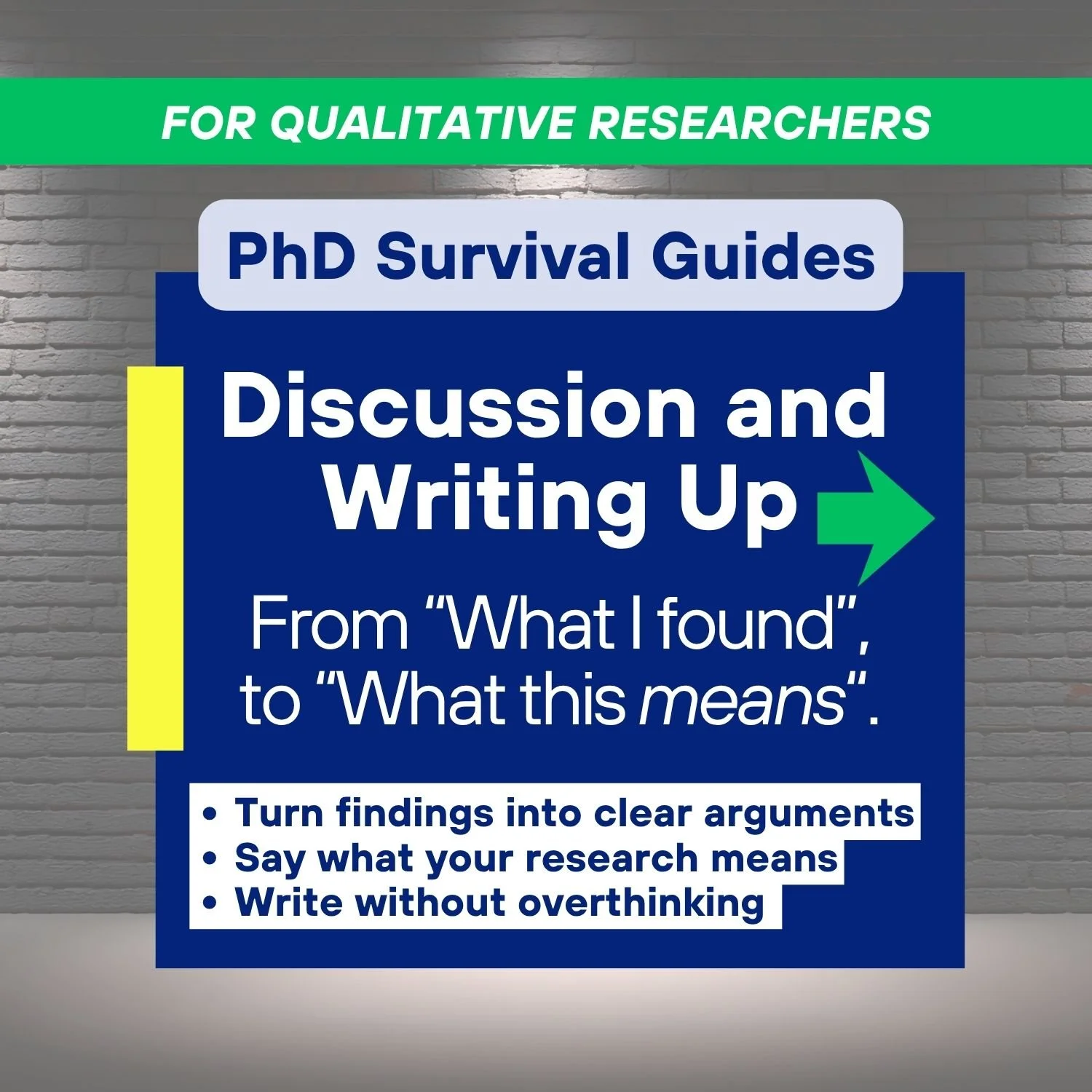
Move from “What I found” to “What this means” - clearly and confidently.
This guide is for qualitative PhD researchers who need to turn their findings into a clear, defensible argument.
If your discussion or conclusion feels uncertain, fragile, or harder than it should be, this guide shows you how to move from uncertainty to a clear, defensible discussion.
If you’ve ever thought:
“What if this isn’t enough for a PhD?”
“Should I go back and change my literature review?”
“I’ve done the work, but I can’t explain what it adds up to.”
This is the stage where qualitative research becomes interpretive - and many researchers struggle to explain what their findings mean.
This guide helps you:
Connect your analysis to literature, concepts, and theory
Turn your findings into a clear, defensible argument
Articulate your contribution without overclaiming or underselling
Write a discussion and conclusion chapter you feel confident to submit
This is a digital download. You’ll get immediate access to the full guide and worksheets as soon as you purchase, so you can get unstuck and start making progress straight away.
Swipe through the images to see exactly what’s inside.
For a more streamlined and coherent approach, you can access all four PhD Survival Guides in the full series here.
Got questions? Contact me using this form, I’ll be happy to help.
By purchasing this product, you agree to our Terms and Conditions.