Conceptual vs theoretical frameworks in a qualitative PhD: what’s the difference? And why students get stuck
If you’ve started a qualitative PhD, you’ve almost certainly heard the terms conceptual framework and theoretical framework repeatedly.
Supervisors mention them.
Examiners expect them.
Methods textbooks assume you already understand them.
And yet, for many capable PhD researchers, these two terms remain stubbornly unclear.
They’re often used interchangeably. They’re introduced without explanation. Or they appear in feedback with no guidance about what is actually missing.
The result?
PhD researchers begin to wonder:
Have I misunderstood something fundamental?
Is there a whole section of my thesis missing?
Do I need to redesign my study?
Usually, the answer is no.
The confusion happens because frameworks are not just definitions. They are ways of structuring and interpreting your thinking.
Let’s separate them carefully.
Why frameworks feel so confusing in a PhD
Frameworks sit at the intersection of ideas, data, and theory. They are not simply things you “add in” to make your thesis look more academic.
They shape:
what you pay attention to
how you organise your analysis
how you interpret what you find
Early in a doctorate, when your project is still evolving, that level of abstraction can feel slippery.
It’s common for frameworks to make only partial sense at first.
That’s not incompetence. That’s development.
What is a conceptual framework?
A conceptual framework is about your specific study.
At its simplest, it answers this question:
What are the key ideas in my research, and how do they relate to one another?
These ideas - your concepts - might include:
experiences
processes
interactions
behaviours
social conditions
organisational dynamics
A conceptual framework does not just list them. It shows how they connect.
For qualitative researchers, this is especially important. Without conceptual clarity, qualitative work can become diffuse or overly descriptive.
An example
Imagine a qualitative study exploring workplace performance reviews.
Your key concepts might include:
preparation
stress or anxiety
behaviour during the meeting
power relationships
communication patterns
A conceptual framework helps you ask:
How does preparation shape behaviour?
How does stress influence communication?
How do power dynamics constrain what employees feel able to say?
It clarifies what matters in the situation you are studying and how those elements fit together.
Below is an example of what an early-stage conceptual framework might look like. Notice: this does not need to be perfect. It is a thinking tool.
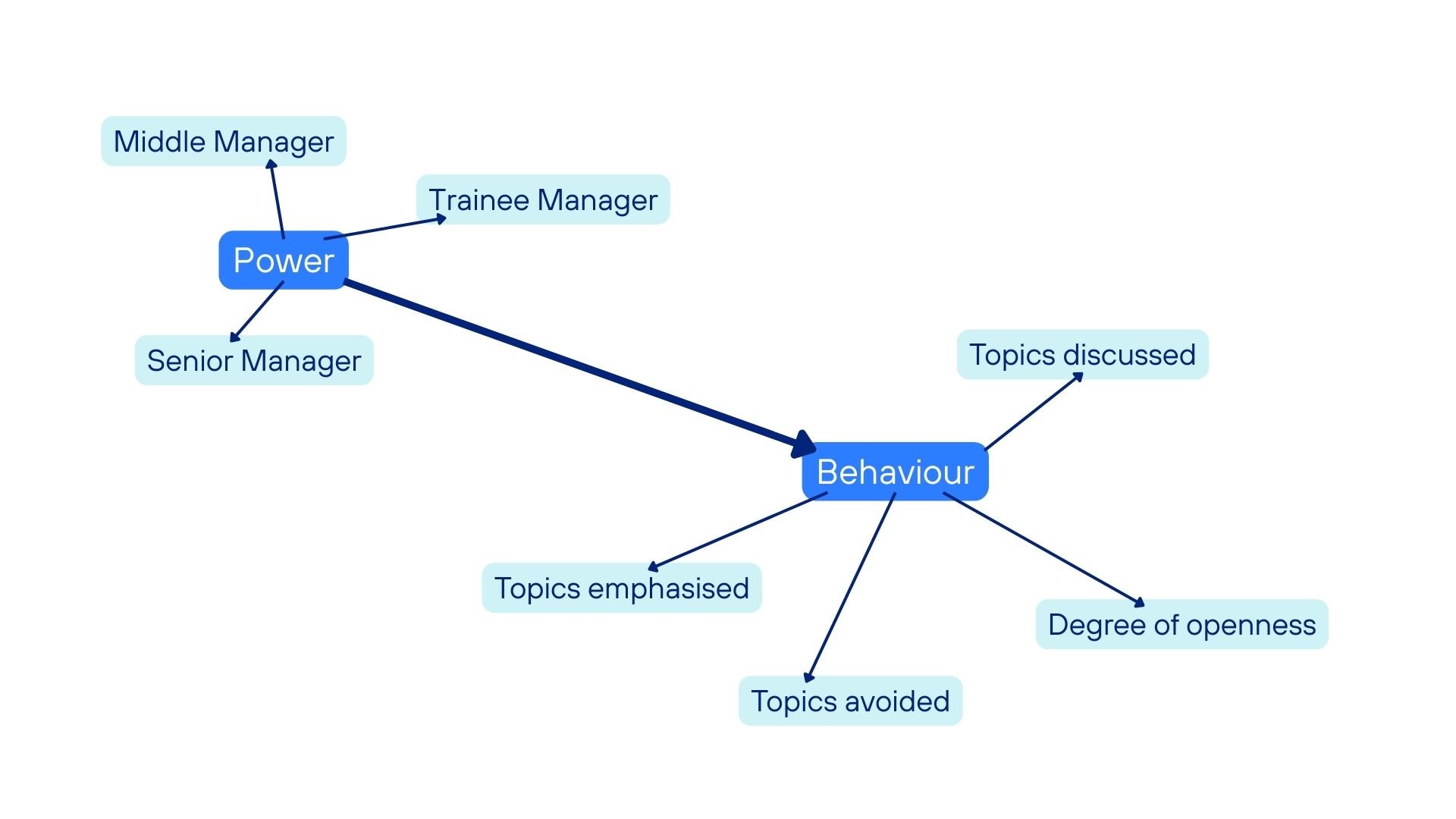
Example - early draft conceptual framework
What a conceptual framework is not
Many students overcomplicate this stage because they assume it must be:
a comprehensive summary of the literature
a polished, finalised model
a beautifully designed diagram
It is none of those things.
Conceptual frameworks evolve.
As you collect and analyse data, certain concepts become more central. Others recede. Relationships become clearer or more complex.
That evolution is part of the doctoral process.
What is theory?
Before discussing theoretical frameworks, we need a grounded understanding of theory.
A theory is simply an explanation of how something works.
It is an attempt - developed over time - to account for patterns in behaviour, interaction, experience, or social life.
When you begin your PhD, you enter an existing intellectual conversation. Other researchers have already proposed explanations related to your topic.
You do not start from scratch.
What is a theoretical framework?
A theoretical framework is what happens when you explicitly draw on those existing explanations to interpret your study.
It answers a different question:
Which established explanations am I using to understand what I am seeing?
Returning to the workplace performance review example:
You might draw on one theory to explain impression management in hierarchical settings.
Another might help explain psychological safety in professional relationships.
By positioning your study within those theoretical conversations, you show:
how your work connects to existing knowledge
how you are interpreting your findings
where your contribution sits
You are not claiming theory explains everything.
You are showing the intellectual lenses shaping your interpretation.
How conceptual and theoretical frameworks work together
Many PhD researchers assume they must choose one or the other.
That is rarely the case.
They do different jobs.
Your conceptual framework organises what you are studying.
Your theoretical framework helps you interpret what you find.
As your data develops, you begin asking:
Do existing theories explain this pattern well?
Where do they fit neatly?
Where do they fall short?
Often, the most interesting contribution emerges precisely where theory does not fully account for what your data reveals.
That is not a problem. That is doctoral work.
Bringing it together
By the end of a qualitative PhD, many researchers develop a framework that integrates both conceptual clarity and theoretical positioning.
This might:
refine an existing theory
extend it into a new context
combine insights from multiple traditions
offer a reworked interpretation grounded in your findings
Below is an example of how conceptual and theoretical elements might be presented together.
In this illustration, blue boxes represent core concepts emerging from the study, and yellow annotations show where theory provides explanatory depth.
Notice that theory is not used everywhere. It appears where it helps interpret what is happening. That selectivity signals intellectual maturity.
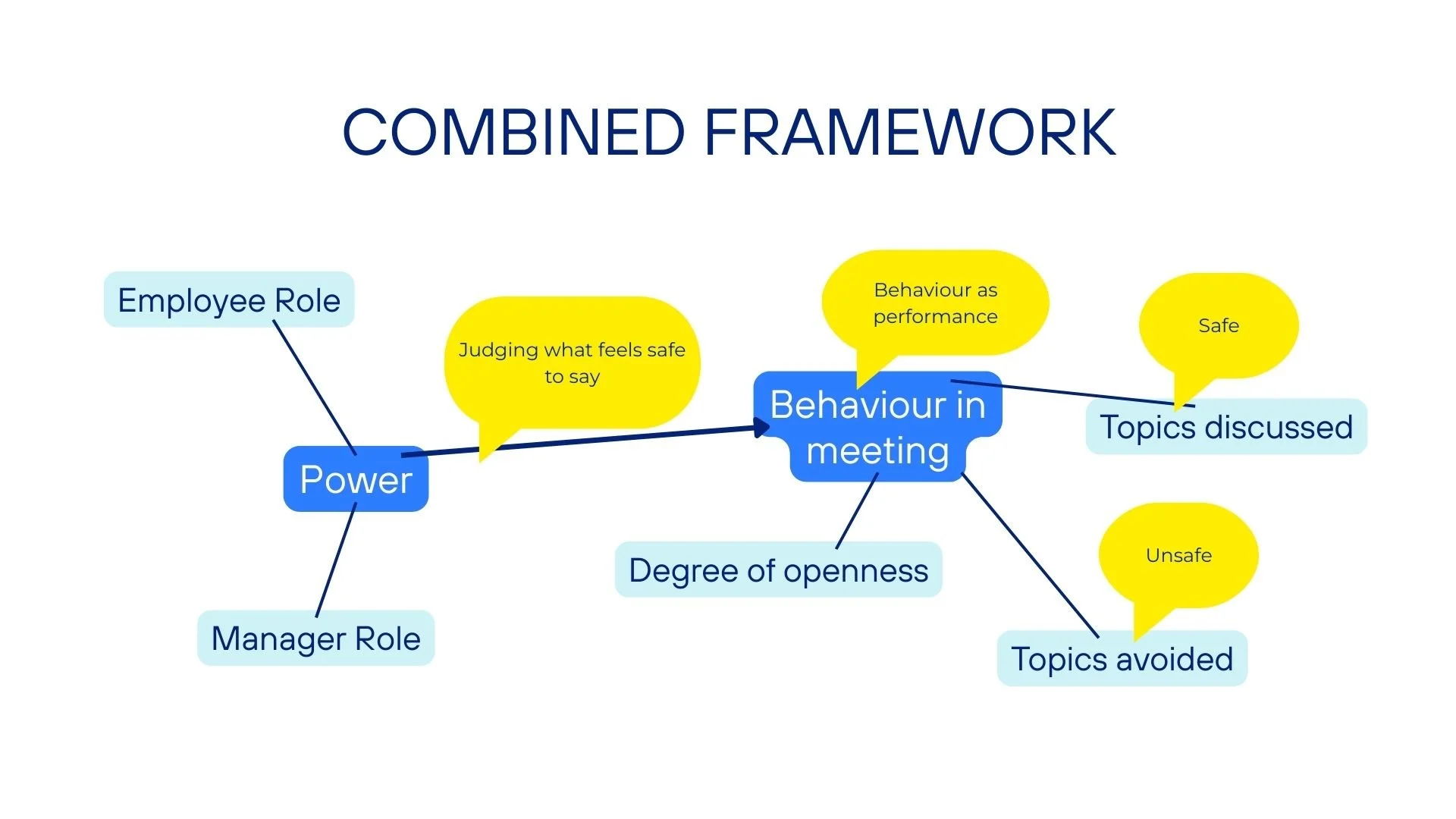
Example - draft combined conceptual and theoretical framework
Why frameworks often only click later
Many students worry because frameworks feel vague in the early stages.
This is normal.
Frameworks are not static requirements to “get right” at the beginning.
They are tools for clarifying your thinking as your understanding deepens.
It is extremely common for frameworks to become clearer:
after data collection
during analysis
when drafting the discussion
If things are only starting to click now, that usually means you are engaging at the right level.
Making reasoning visible`
Frameworks are not traps designed to catch you out.
They are ways of making your reasoning visible.
Used well, they reduce confusion rather than create it.
If you are ready to move from “I think this sounds about right” to a framework that is clear, defensible, and confidently positioned, my Clarifying Your Research Guide walks you step-by-step through paradigms, conceptual structuring, theoretical positioning, and contribution.
It offers structured support without rigidity - particularly for qualitative researchers who want depth without unnecessary abstraction.
And if you’re still building your understanding, that’s fine too.
Frameworks develop alongside you.