Reflexive Thematic Analysis: A practical step-by-step guide for qualitative PhD researchers
If you’re sitting with pages of interview transcripts wondering how they are ever going to become a coherent findings chapter, you are in exactly the place most qualitative PhD researchers find themselves at some point.
You might be thinking, “I can see interesting things here, but how do I turn this into something structured and defensible?”. This is where Reflexive Thematic Analysis, as developed by Braun and Clarke, becomes incredibly powerful.
It is by far - by far - the most popular qualitative data analysis technique I have seen people use in the twenty years I have been supporting qualitative researchers through masters degrees and PhDs. Part of the appeal is in the “six-stage” process. Six steps. Sounds simple, right? Not really. This can make it appear simpler than it actually is in practice.
Now, let me be clear here, I am not trying to put you off Braun and Clarke’s Reflexive Thematic Analysis before you’ve even started - but I do want to make you aware of the messy middle of this process - which makes a lot of researchers want to give up on it halfway through. It’s very important that you don’t give up once you get into it because when you use this process, mess and confusion are an important part of the analysis, you have to go through them to get to findings that are confident and defensible. So, just be prepared - that’s all I’m saying. Expect mess and embrace it when it arrives.
What makes thematic analysis “reflexive”?
Reflexive Thematic Analysis is about recognising that you are actively involved in identifying patterns in your data. There is not a hidden set of themes that you have to unearth like buried treasure. You produce these themes and as such, your themes might look different from someone else’s - even from a similar set of data. Main thing is - that’s okay - it doesn’t mean you’ve got anything “wrong”.
Your theoretical positioning, your assumptions, your experiences, and your research questions all shape what you notice and how you interpret it. All good.
That can feel uncomfortable - a lot of the PhD researchers I’ve supervised over the years have shared that they worry about their themes being “right”, fret about getting things wrong, feel guilty about not representing their participants accurately, and often ask themselves if they’re just guessing or “making stuff up”.
In interpretivist qualitative research, you should always come back to this:
You are not aiming for perfection or being “right”. You are trying to be thoughtful and transparent about your analysis and your role within it.
Reflexivity means asking questions like:
Why did this excerpt stand out to me?
What assumptions am I bringing to this interpretation?
How does my theoretical stance shape the themes I am developing?
For many qualitative PhD students, this is both liberating and unsettling. You are developing judgement, and that involves learning to trust yourself and your decisions - not an easy thing to do when you’re doing a form of research that brings all your insecurities to the surface.
The six phases of Reflexive Thematic Analysis
Braun and Clarke outline six phases. They are often presented as steps, but it is more accurate to think of them as movements. This is what I was referring to earlier when I said “expect mess”. You will move back and forth between them as your understanding deepens. You’ll circle back, go in loops, and experience periods where you want to throw it all in the bin and start over.
Let’s walk through the steps one at a time.
1. Familiarise yourself with the data
Before coding, you immerse yourself.
Read and reread your transcripts. Make margin notes. Write brief summaries. Notice tone, contradictions, emotional shifts.
At this stage, resist the urge to organise everything. Your task is to understand the texture of the data.
Many qualitative researchers feel impatient here. They want to “start analysing properly”. But familiarisation is analysis. You are beginning to see patterns before you formally name them. So, learn to just sit with the data, resist the urge to start twiddling.
2. Generate initial codes
Coding is simply labelling segments of data that feel meaningful in relation to your research question.
Some codes will be descriptive. They capture what is explicitly said. Others will be more interpretive. They capture implied meaning, tension, or underlying processes.
For example, a participant might say, “I did not want to ask for help because everyone else seemed confident.” A descriptive code might be reluctance to ask for help. An interpretive code might be fear of exposure.
At this stage, breadth matters more than perfection. You are opening the data up.
3. Construct initial themes
Themes are not topics. They are patterns of shared meaning underpinned by a central organising concept.
When you move from codes to themes, you begin asking: What is the bigger story here? What is this an example of?
Codes such as ‘hidden expectations’, 'unclear rules’, and ‘confusion about processes’ might cluster into a theme such as ‘navigating invisible systems’.
This is the point where many qualitative PhD students feel unsure. As I said earlier - they worry they are “making it up.”
You are not making it up. You are interpreting systematically.
The key question is whether your theme captures something important about the dataset in relation to your research question.
“You are not ‘making it up’. You are interpreting systematically.”
4. Review and refine themes
Now you test your themes.
Do the coded extracts within each theme cohere meaningfully?
Is each theme distinct from the others?
Does the overall set of themes tell a convincing analytic story?
This phase often involves merging themes, splitting them, or discarding ones that felt promising but do not hold up.
5. Define and name your themes
Strong themes have clear definitions.
You should be able to articulate what the theme captures, what it includes, and what it excludes. A good theme name is concise but evocative.
For example, Feeling like an outsider might be defined as - participants’ sense of not fully belonging within an institutional environment, shaping their behaviour, confidence, and help-seeking patterns.
Once you get this far in, analysis begins to feel more confident and less provisional.
6. Write up your analysis
Writing is not a final add-on. It is part of the analytic process.
I have said this thousands of times throughout my academic career and I’ll say it again here: analysis doesn’t happen before the writing, it happens through the writing. Getting the words on the page is the most helpful way to figure out where you’re making sense, where you’re not making sense and how to move forward.
In your findings chapter, you introduce each theme, explain its central organising concept, and illustrate it with carefully chosen extracts. You interpret those extracts, connect them back to your research question and, later, to relevant literature.
This is where reflexivity remains important. Be transparent about how you moved from data to theme - show your reasoning, or - as my old mathematics teacher used to say, “Show me your workings out”.
Speaking as someone who has examined many qualitative PhDs, what we as examiners are not looking for in your writing is objectivity. We are not going to sit in your viva and tell you your themes are wrong (and any examiner that does, well, they have no business being an examiner - just saying). What we are going to ask you about is how you arrived at these themes - can you walk me through how you got to that from your data? How did you put that picture together? In your answer, I want to see coherence, depth, and thoughtful interpretation.
Know exactly what to do next
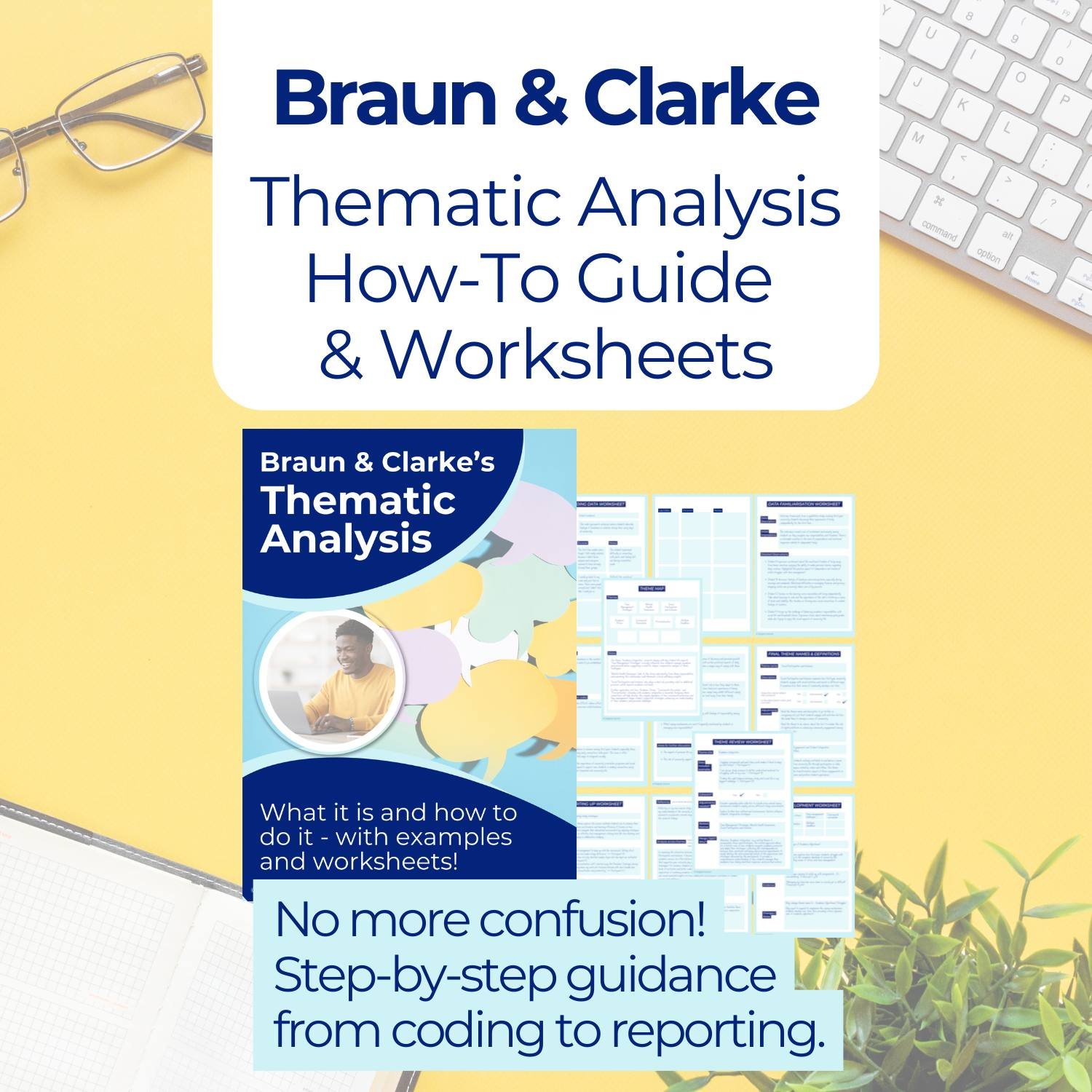
If you’re wondering whether your themes are “right”, worrying you’re just guessing at them or anxious you’re “making things up”, my Braun and Clarke Reflexive Thematic Analysis Guide can help you get words on the page and develop an analysis you feel happy to send to your supervisor.
Learn more about it here.
Feel like you want to throw your analysis away and start again “properly”?
This is exactly where most people get stuck with Braun & Clarke’s thematic analysis.
Not sure if you’ve coded things “right”?
Worried your themes don’t quite make sense (or feel forced)?
Reading papers over and over and still thinking, “I don’t get it…”
That doesn’t mean you’ve done it wrong - it usually means you’ve hit the messy middle
This guide shows you how to make sense of what you’ve already done and move forward with confidence, without starting from scratch.
Inside, you’ll find a clear, step-by-step breakdown of Braun & Clarke’s six-stage process, with practical examples and worksheets to help you actually do your analysis, not just read about it.
Swipe through the images to see exactly what’s included.
Got questions? Contact me using this form, I’ll be happy to help.
By purchasing this product, you agree to our Terms & Conditions.