How to restart your qualitative PhD after a break (without spiralling)
PhD study is rarely linear.
There are pauses. Illness. Funding gaps. Caring responsibilities. Burnout. Or simply the moment when your brain says, “enough”.
Then one day you sit down again, open your laptop, and feel a strange combination of distance and dread.
You cannot quite remember what you were doing. The analysis feels rusty. The literature feels unfamiliar. You wonder whether you have undone all your previous progress.
That disorientation is normal. Restarting is not about discipline. It is about re-entry.
The quiet panic of restarting
For qualitative PhD researchers especially, breaks can feel destabilising because so much of the work lives in your head. Interpretations. Theoretical positioning. Subtle analytic decisions.
After time away, you might notice:
You reread your own writing and feel disconnected from it.
Your confidence in your interpretations has dipped.
You feel pressure to “catch up” immediately.
You are tempted to avoid reopening the project altogether.
The problem is not laziness. It is cognitive distance.
Restarting works best when you shrink the project back down to human size.
Remove the guilt first
Before doing anything practical, deal with the emotional layer.
Taking a break does not erase your intelligence or your capability. Many qualitative PhDs include pauses. Research exists within real lives, not idealised timelines.
If you start from shame, you will approach the work with urgency and self-criticism. That rarely produces clarity.
Restarting is not punishment. It is reconnection.
Create a one-page snapshot
One of the most effective ways to reorient yourself is to write a one-page project summary for yourself only.
Not a polished abstract. Not a proposal. Just clarity.
What is my core research question?
What are my main aims?
What stage was I at when I paused?
What still feels unresolved?
This single page acts as a cognitive bookmark. It reminds you that your project has shape. It is not a fog.
Qualitative projects especially benefit from this because they evolve. Writing a snapshot often reveals that your thinking is more intact than you assumed.
Start smaller than you think you should
After a break, many researchers set unrealistic restart goals. They promise themselves a full chapter draft in a week.
That pressure often recreates avoidance.
Instead, begin with something deliberately modest. Re-read one transcript and write analytic notes. Update a handful of references. Sketch the outline of your next section.
The goal is not intensity. It is movement.
Small, completed actions rebuild trust in yourself. And trust is what makes sustained momentum possible.
Focus on clarity before productivity
When restarting, ask a single question: what is the very next concrete step?
Not the next chapter. Not the next milestone. The next step.
Perhaps it is refining your theme definitions. Perhaps it is clarifying your conceptual framework. Perhaps it is writing a paragraph that explains your methodological positioning more clearly.
Ambiguity fuels overwhelm. Specificity reduces it.
Rebuild rhythm, not heroics
A PhD is not restarted through a dramatic burst of productivity. It is restarted through rhythm.
Decide what is realistic given your current life context. Two focused sessions a week. Thirty minutes each weekday morning. One protected weekend block.
Consistency matters more than volume.
Qualitative research especially benefits from steady engagement. Regular contact with your data and writing helps your analytic thinking stay warm.
You are not back at the beginning
This is important.
Even if it feels like you are starting from scratch, you are not the same researcher you were before the break. You have lived more. Thought more. Experienced more.
Restarting often brings a subtle shift in perspective. Many researchers return with clearer boundaries, sharper questions, or a stronger sense of what actually matters in their project.
Breaks do not automatically weaken a PhD. Sometimes they strengthen it.
If you need structure to restart
If what you are missing is not motivation but structure, that is where guided frameworks help.
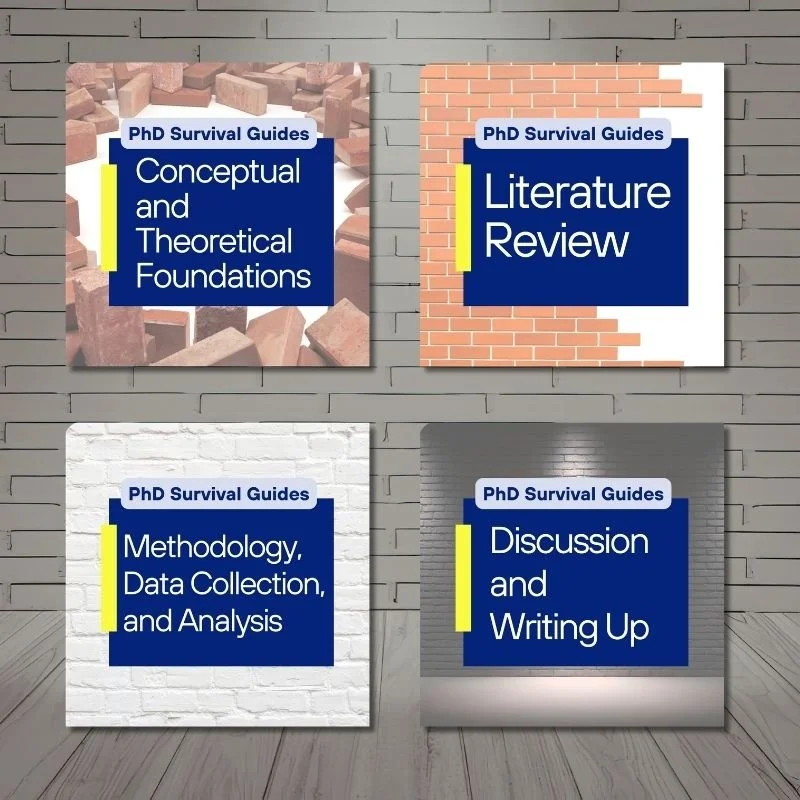
My PhD Survival Guides are designed precisely for moments like this. They provide step-by-step clarity so you are not guessing what to tackle next. They shrink the doctorate into manageable stages and help you rebuild momentum without panic.
You do not need to restart perfectly.
You just need to restart.
Learn more here: PhD Survival Guides.