Why your aims, objectives, and research questions never seem to click in your qualitative PhD
If you are working on a qualitative PhD and struggling with your research aims, research objectives, and research questions, this might sound familiar:
“My supervisor keeps asking me to clarify my aims and objectives.”
“I feel like I’m just repeating the same sentence three times.”
“Aren’t aims, objectives, and research questions basically the same thing?”
Often the need to refine these elements appears during proposal development or upgrade preparation. You draft a set of aims and objectives, perhaps add a few research questions, send them to your supervisor and receive feedback along the lines of:
These need tightening.
The aims and questions are not quite aligned.
This still feels a bit vague.
At that point it can feel as though you are simply being asked to rewrite the same idea in slightly different words.
But the difficulty here is rarely just a writing problem.
More often, it is a structural thinking problem.
Once you understand how research aims, research objectives, and research questions operate at different levels of a qualitative research project, the process becomes much calmer and more coherent.
This blogpost will walk through those levels and show how they work together.
Why aims, objectives, and research questions often feel repetitive
Many PhD students approach these three elements as separate tasks.
First you write some research aims.
Then you try to generate research objectives.
Then you invent research questions.
Seen this way, the process feels oddly mechanical.
You are trying to produce three different things that all describe the same project. So it is not surprising that the sentences begin to sound repetitive or slightly forced.
A more helpful way to think about these elements is as different layers of articulation within a single research design.
Your title describes what the study is about.
Your aims clarify what the study seeks to achieve.
Your objectives describe what you will do to achieve those aims.
Your research questions specify what the study needs to find out.
When these layers are aligned, they feel like natural extensions of one another rather than separate administrative hurdles.
Research aims in qualitative research: the level of purpose
Research aims operate at the level of purpose.
They answer a simple but demanding question:
What intellectual work is this study trying to accomplish?
Notice what this question is not asking.
It is not asking what methods you will use.
It is not asking what steps you will take during the project.
Instead, it asks what kind of understanding your study is attempting to develop.
In qualitative research, this often involves clarifying whether the study is oriented towards experience and meaning or towards patterns and explanatory factors.
Consider a study exploring first-generation law students in elite universities.
An experience-oriented set of research aims might look like this:
To explore how first-generation law students experience academic belonging within elite institutions.
To understand how institutional cultures shape students’ sense of legitimacy and confidence over time.
The verbs here matter - Explore, understand.
They signal a focus on lived experience and meaning making.
Now compare that to a different orientation:
To investigate the factors associated with persistence and attrition among first-generation law students.
To examine the relationship between institutional support structures and student retention.
The verbs have shifted - investigate, examine.
Now the emphasis is on identifying factors and relationships.
Both orientations are entirely legitimate forms of qualitative research. But they represent different intellectual projects.
Strong research aims reflect the kind of knowledge the study is trying to generate.
At this stage they do not need to be perfectly worded. What matters most is that they are directionally aligned with the overall orientation of the research.
Research objectives: structuring the research process
If aims operate at the level of purpose, research objectives operate at the level of process.
They answer the question:
What will the study actually do in order to achieve its aims?
This is where many students begin to rush. Objectives can feel like something you simply need to “get written down” for a proposal or ethics form.
But when research objectives are vague or randomly ordered, the entire project starts to look unfocused.
A useful way to think about research objectives is as a deliberate progression.
Most qualitative PhD projects have three to five objectives that move through three broad stages.
First comes the stage of establishing foundations.
Then the analytical work of the study.
Finally the stage where insights are brought together.
Returning to our example study, the first objective might establish conceptual or contextual groundwork: To identify how first-generation status is defined and experienced within elite law school contexts.
Middle objectives then focus on interpretation and analysis: To interpret how institutional narratives of meritocracy shape students’ experiences of belonging. To analyse how students make sense of confidence and legitimacy across their degree programme.
Finally, a concluding objective might synthesise the insights: To highlight how institutional practices shape the academic trajectories of first-generation law students.
When research objectives follow a logical progression like this, the study begins to look coherent and manageable.
The project moves from groundwork to analysis to contribution.
Research questions: focusing the inquiry
Research questions translate your aims and objectives into questions that your study can realistically answer.
They guide your literature review, your data collection, and your analysis.
Most qualitative PhD projects include between two and four research questions.
One of the most common mistakes students make is trying to invent research questions from scratch. A more productive approach is to work backwards from your objectives. Ask yourself:
What would I need to know in order to achieve this objective?
If your objective is:
To interpret how students make sense of belonging within elite law schools.
Your research question might be:
How do first-generation law students describe and interpret their experiences of belonging within elite institutions?
If another objective is:
To analyse how institutional contexts shape confidence and persistence.
A research question might be:
What institutional practices do students identify as influencing their sense of academic confidence and progression?
Notice how the language echoes the aims and objectives.
This is not redundancy or repetition - it is alignment.
When these elements align, your research becomes clearer
Once the relationship between aims, objectives, and research questions is clear, a PhD project often begins to feel much more stable.
Aims clarify the purpose of the research.
Objectives structure the process of the study.
Research questions focus the inquiry.
Together they transform a broad intellectual interest into something far more precise.
A research project that is coherent, defensible, and realistically achievable within the scope of a doctoral study.
This is why supervisors often pay close attention to these sections in a proposal and at review stage. They are not simply administrative requirements. They reveal whether the project has a clear conceptual foundation.
If you want to develop this properly
If you are currently shaping your research topic or preparing a PhD proposal or annual review report, this is exactly the stage where strong conceptual foundations matter most.
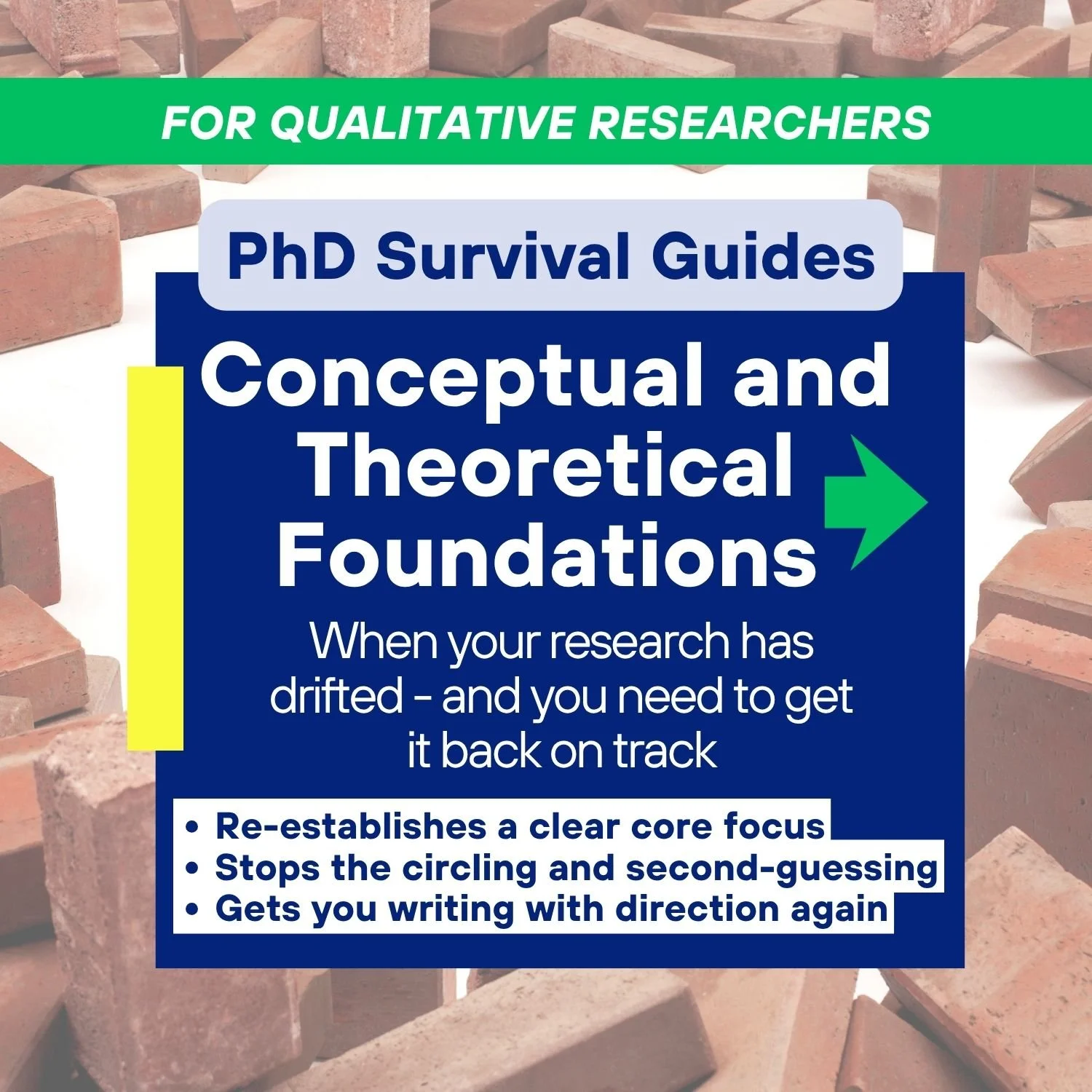
Inside my Conceptual & Theoretical Foundations PhD Survival Guide, I walk through the process step by step. From clarifying your topic and key concepts through to developing aligned research aims, objectives, and research questions.
The focus is not on templates or shortcuts.
It is on helping you make deliberate, defensible decisions about how your study is framed.
When you are ready to go deeper into this properly, you can explore the guide here.
And if you value thoughtful, structured guidance like this, you can also join my email community where I share reflections on doctoral research and qualitative thinking each week.
“My research feels slippery, I’m not sure what it is anymore.”
If your research is moving, but something underneath it doesn’t fully make sense yet, this guide will help you get it back on solid ground. If you’ve started to freeze when someone asks what your PhD is about, this guide will help you get clear on it.
Swipe through the images to see exactly what’s inside.
Get the full Survival Guide set here.
Got questions? Contact me using this form, I’ll be happy to help.
By purchasing this product, you agree to our Terms & Conditions.