Research ethics in qualitative research: beyond the approval form
“Why is my ethics form so hard to complete?”
“What do they actually want in a PhD ethics application?”
“Am I doing this wrong?”
If you are a qualitative PhD student preparing a research ethics application, those are the kinds of questions that often send you to Google or AI chatbots late at night.
On the surface, the struggle looks administrative. You are being asked about informed consent, anonymity, confidentiality, data protection, the right to withdraw, dissemination plans. You are expected to explain how you will store recordings, protect participants’ identities, and manage potential risk.
And yet the difficulty rarely lies in the form itself.
The deeper issue is usually conceptual.
You have not yet fully worked through what your research is asking of participants, and what it is asking of you.
Research ethics in qualitative research is not simply a bureaucratic requirement. It is a reflection of your methodological clarity, your interpretive authority, and your intellectual judgement as a doctoral researcher.
When that clarity is in place, the form becomes translation. When it is not, the form feels overwhelming.
Let’s slow this down properly.
Why qualitative research ethics feels harder than it should
Qualitative research ethics can feel uniquely demanding because qualitative work is relational. You are not simply collecting data. You are inviting people to share experiences, interpretations, and sometimes deeply personal accounts.
An ethics form will ask you to outline:
How informed consent will be obtained
How ongoing consent will be managed
How participants can exercise their right to withdraw
How data will be stored and protected
How anonymity and confidentiality will be maintained
How findings will be disseminated or published
These are not technical add-ons. They are extensions of your research design.
If you are unsure how your methodology works, or how your paradigm shapes your approach to knowledge, then questions about ethics will feel exposed. They require you to articulate assumptions that may still be forming.
That is why many capable PhD students experience ethics applications as destabilising. Not because they lack intelligence or commitment, but because ethics demands coherence.
The difference between anonymity and confidentiality
One common area of confusion in qualitative research ethics is the distinction between anonymity and confidentiality.
Confidentiality means that identifiable information is protected and not disclosed beyond agreed research contexts. It relates to how you store, handle, and control access to data. It includes secure storage, encryption, access limits, and clarity about who can see raw materials.
Anonymity means that participants’ identities cannot reasonably be inferred from your research outputs. This is not achieved simply by assigning pseudonyms. In small organisations or tight-knit communities, combinations of contextual details may make someone identifiable even without their name.
An ethics form might ask how anonymity will be preserved. A thoughtful response considers speech patterns, specific job roles, unusual experiences, or unique demographic details that could reveal identity.
In some cases, true anonymity may not be fully achievable. Ethical maturity lies in recognising that and being transparent about limits rather than over-promising protection.
Risk is rarely dramatic
When students are asked to describe “potential risks to participants”, they often assume risk must involve physical harm.
In qualitative PhD research, risk is usually more subtle.
It may involve emotional discomfort when discussing academic failure. It may involve social risk if critical comments about institutional culture become identifiable. It may involve reputational risk in tightly networked professional fields.
Risk operates on a spectrum. Ethical reasoning requires you to anticipate where discomfort may arise and to consider how it will be minimised.
This is where informed consent becomes meaningful. Not as a signed form, but as a clear explanation of what participation involves, what topics may arise, and what participants can expect during dissemination and publication.
Ongoing consent and the right to withdraw
In many qualitative projects, consent is not a single moment.
An interview may move into unexpected territory. A participant may disclose something they did not initially anticipate discussing. Ongoing consent means being attentive to that shift. It means checking whether they remain comfortable continuing.
The right to withdraw also requires clarity. If someone withdraws after an interview, what happens to the recording? Is it deleted? Are transcripts destroyed? Is there a deadline after which data cannot be removed because it has been anonymised and integrated into analysis?
Ethics committees are not looking for perfection. They are looking for thoughtfulness and coherence. Can you explain how consent operates in practice, not just in principle?
Power and interpretive authority
Power is rarely labelled explicitly on ethics forms, yet it shapes everything in qualitative research.
You decide the research questions. You determine which extracts appear in your thesis. You interpret what participants’ experiences mean. You frame findings in dissemination and publication.
This is narrative power.
Ethical research does not require you to relinquish authority. It requires you to recognise it. Reflexivity is not about self-criticism. It is about understanding how your position, assumptions, and theoretical leanings shape representation.
If you are asking participants to share their experiences of belonging, exclusion, migration, or professional identity, you are also shaping how those experiences enter academic discourse. That is a serious responsibility.
Responsibility includes the researcher
Another dimension of qualitative research ethics that is rarely emphasised in formal training is the wellbeing of the researcher.
Repeatedly engaging with detailed personal accounts can involve emotional labour. Listening to experiences of inequality, pressure, or loss can accumulate.
Ethical research design includes pacing interviews, building supervisory support, and recognising personal limits. Burnout in qualitative research is rarely dramatic. It is often gradual and cumulative.
Responsibility extends to yourself because depleted researchers make poorer judgements. Ethical reasoning requires sustainability.
From compliance to coherence
Most universities require formal research ethics approval. That is appropriate and necessary.
But the deeper question is not “How do I get this approved?”
It is “Can I justify my decisions as a serious researcher?”
Ethics committees and examiners are listening for coherence. They want to see that your decisions about informed consent, data storage, anonymity, confidentiality, and dissemination align with your research questions and methodological approach.
Defensible does not mean flawless. It means reasoned.
When you approach qualitative research ethics as part of your intellectual foundation rather than as a procedural hurdle, something shifts. The process becomes calmer. More deliberate. Less reactive.
You are no longer trying to satisfy a committee. You are articulating the ethical logic of your study.
That is doctoral-level work.
Moving forward with structure
If you are currently wrestling with your research ethics application, pause before you revise the form again.
Ask yourself:
What exactly am I asking participants to give me?
What might that cost them?
What might it cost me?
Then revisit your methodology. How does your paradigm shape what feels like an ethical decision? How do your data collection methods influence anonymity, confidentiality, and consent in practice?
Ethical reasoning develops alongside research design. It is not an afterthought.
If you are ready to go deeper into this properly, structured support exists. My Methodology, Data Collection and Analysis PhD Survival Guide walks through ethics, paradigm alignment, data collection, analysis, and writing in a coherent framework designed for serious qualitative researchers. It is not a shortcut. It is a structured foundation for defensible decisions.
If you want thoughtful, structured guidance like this in your inbox, you can also join my email community. It is a space for careful doctoral thinking rather than noise.
Qualitative research is rigorous. It is relational. It requires judgement.
You are capable of that judgement.
The work now is to make it visible.
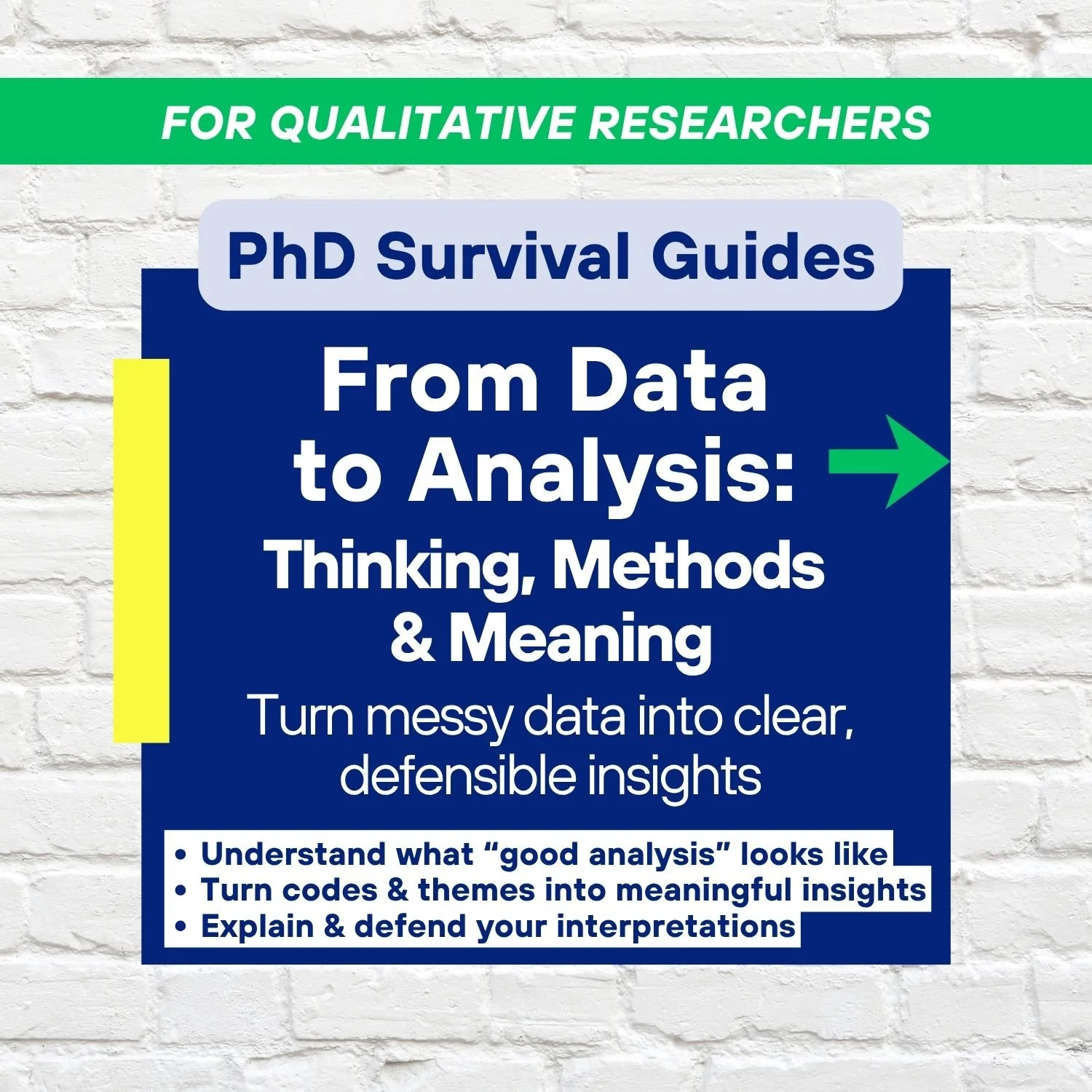
“I can describe what I did. I just don’t know if I trust my own judgement.”
This is the point in the PhD where your research starts demanding something different: interpretation, judgement, coherence, and confidence in your reasoning. This guide was written for that stage.
Swipe through the images above to see what’s inside.
Get the full Survival Guide set here.
If you have any questions, feel free to contact me. I’ll be happy to help.
By purchasing this product, you agree to our Terms & Conditions.