If you are knee-deep in Braun and Clarke’s reflexive thematic analysis and staring at a long list of codes wondering what on earth comes next, you are not alone.
You might have:
200+ codes
Highlighted transcripts in five colours
A sense that something should be “clicking” by now
And yet you are thinking:
“Wait… what actually is a theme?”
This is one of the most common sticking points in reflexive thematic analysis. Not because you are doing it wrong, but because theme development is conceptually demanding. It requires a shift from organising data to interpreting meaning.
Let’s slow it down and make that shift clearer.
Why theme development feels so hard
Many PhD researchers secretly believe that themes are hidden in the data, waiting to be discovered. As if careful coding will eventually reveal the “correct” set.
But Braun and Clarke are very clear about this: themes do not emerge fully formed. They are actively constructed.
In reflexive thematic analysis, you build themes through interpretation. They are shaped by:
Your research question
Your theoretical positioning
Your reflexive engagement with the data
There is no single “right” answer.
What matters is that your themes are coherent, meaningful, and analytically useful.
If you are waiting for certainty before naming a theme, that is usually a sign you are expecting objectivity from an interpretive method.
What a theme actually is
A theme is not just a cluster of similar codes.
It is a pattern of shared meaning organised around a central concept that helps answer your research question.
The key phrase here is shared meaning.
For example:
If participants frequently mention “team meetings,” that is a topic.
If those accounts reveal patterns of exclusion, silencing, or power imbalance within those meetings, that might form a theme such as: Speaking but not being heard - power and voice in organisational spaces.
A theme does conceptual work. It tells the reader something about how the world operates within your dataset.
Your codes are pieces. A theme is the analytic argument those pieces allow you to make.
Moving from codes to themes
This stage is iterative and often uncomfortable. That discomfort is normal. You are moving from description to interpretation.
Start by laying out your codes in whatever format works for you: software, spreadsheets, printed excerpts, or physically arranging them on a wall.
Then ask deeper questions.
Are these codes connected by meaning, or just by wording?
What is the underlying idea running through them?
How does this cluster help answer my research question?
Keep your research aims visible while you do this. Themes are not just interesting observations. They must relate directly to what your study set out to explore.
If you find yourself creating themes that are fascinating but disconnected from your research question, pause and realign.
Let your themes evolve
Your first set of themes will not be your final set.
It is common to:
Merge themes
Split one theme into several
Rename themes as your interpretation sharpens
Discard themes that no longer hold analytically
For example, you might initially label a theme “Work-life balance.” As you revisit the data, you realise participants are not describing balance at all. They are describing constant availability and blurred boundaries.
The theme might evolve into something more precise, such as: Precarious boundaries and the myth of balance.
Notice the difference. The second version carries interpretation. It signals a stance.
That movement from summary to conceptual framing is where doctoral-level analysis begins.
Common traps in theme development
There are three patterns that often derail this stage.
The first is vague themes. Titles such as “Communication issues” or “Challenges” are too broad. They describe a topic but do not convey meaning. Push yourself to specify what kind of communication and what kind of challenge, and why it matters.
The second is mistaking prevalence for importance. Just because something was mentioned frequently does not automatically make it a theme. A powerful but less common pattern may be more analytically significant.
The third is overlapping themes. If two themes are making the same argument, they likely need combining. Each theme should feel distinct and necessary.
How many themes should a PhD have?
There is no universal rule. However, most PhD projects using reflexive thematic analysis present three to five well-developed themes, sometimes with sub-themes.
Quality matters more than quantity.
Each theme should:
Have a clear central organising concept
Be supported by rich data extracts
Be distinct from other themes
Directly relate to your research question
If you find yourself with eight or nine themes, ask whether some are better framed as sub-themes or absorbed into broader analytic patterns.
If it feels messy, you are probably doing it properly
Theme development often feels chaotic because you are wrestling with meaning. That is intellectual work.
If you are asking:
What does this pattern actually say?
Why does this matter?
What is the broader implication here?
Then you are doing analysis, not just sorting. The discomfort does not signal incompetence. It signals depth.
Feel like you’re making it all up?
Many qualitative researchers experience a moment during theme development where they think:
“I feel like I am making this up.”
You are not making it up.
You are interpreting, and interpretation requires judgement. What examiners look for is not perfection, but coherence, reflexivity, and clarity in how you moved from data to themes.
If you can explain why your themes make sense, how they connect to your research question, and how you constructed them, you are on solid ground.
If you want structured support through this process
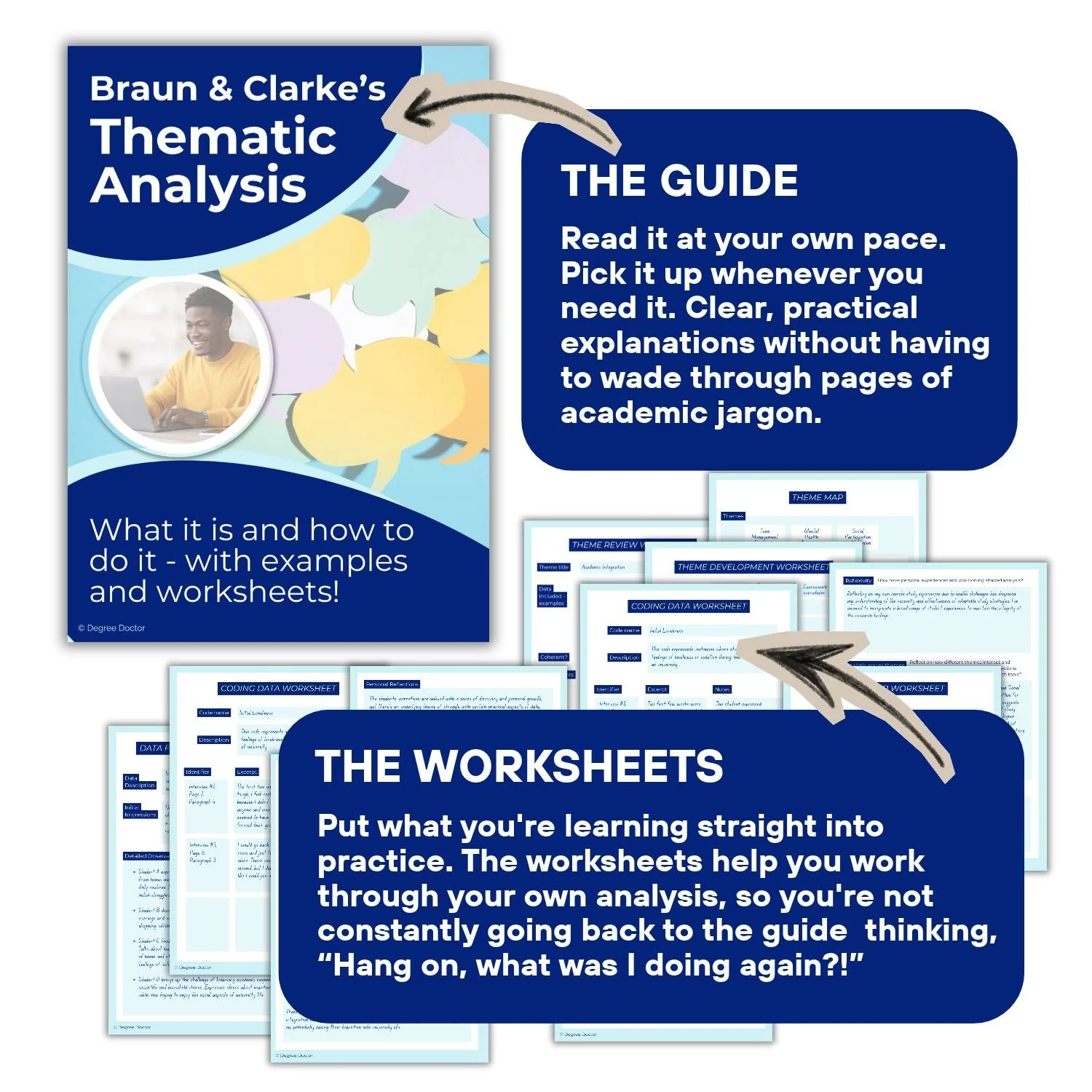
If you are at the stage where you do not just want reassurance but a defendable, step-by-step framework, my Braun and Clarke Reflexive Thematic Analysis Guide walks you through:
Each of the six phases
How to construct and refine themes
How to write them up clearly
How to articulate your reflexive stance
It is designed for serious PhD researchers who want clarity rather than vibes.
If you are ready to go deeper into this properly, it is here for you.
And if you want thoughtful, structured guidance on qualitative research in general, you can join my email community where I share deeper reflections and practical direction for finishing well.