Writing a PhD research proposal can feel intimidating, especially if you’re applying for the first time.
Questions quickly start piling up:
What should a research proposal include?
How detailed should it be?
How much of the project needs to be decided in advance?
If your research is likely to involve exploring people’s experiences, perspectives, or interpretations, you are probably moving toward a qualitative research proposal - even if you haven’t labelled it that way yet.
Many social science PhD projects begin with questions like:
How do people experience…
How do individuals interpret…
What meanings do people attach to…
How do organisations understand…
These kinds of questions typically lead to qualitative methods, such as interviews, focus groups, or qualitative analysis.
In this blogpost, we’ll look at how to structure a strong qualitative PhD research proposal, including the key sections most universities expect.
One important note before we begin: always check the specific guidance provided by the university you are applying to. Every institution has its own requirements for proposal length and structure.
What follows is a structure that works for most qualitative PhD applications.
1. Introduction: What is your research about?
The introduction explains what your research will explore and why it matters.
Start with a working title. At this stage, it doesn’t need to be perfect. Research topics often evolve once the project begins.
For qualitative research, titles often highlight:
the group being studied
the experience or phenomenon
the context
For example:
Exploring international students’ experiences of mental health challenges within UK higher education
Understanding middle-aged men’s experiences of job insecurity in the tech industry
Caregivers’ experiences of managing work-life balance in rural communities
After introducing the topic, explain where the research idea comes from.
This might be a gap in the literature, a real-world issue or policy concern, or debates within your field. Your reader should quickly understand why this research is worth doing.
2. Aims, objectives and research questions
Next, clarify the focus of the study.
Your proposal should usually include:
Aims
The overall purpose of the research.
Objectives
The steps you will take to achieve that aim.
Research questions
The questions guiding the investigation.
Qualitative research questions often focus on experiences, meanings and interpretations.
Example research questions include:
How do international students experience mental health challenges while studying in the UK?
How do middle-aged professionals interpret job insecurity in rapidly changing industries?
How do caregivers in rural communities navigate work-life balance?
These types of questions signal that the research is focused on understanding lived experience, which is a hallmark of qualitative research.
3. Academic foundations: Literature and research positioning
Your research proposal must also show that your project sits within an existing academic conversation. This section typically includes two elements:
Research positioning or paradigm
In qualitative research, this often involves identifying the philosophical perspective guiding the study.
For example:
interpretivism
critical realism
feminist research approaches
constructivism
This helps clarify how you understand knowledge and social reality.
Literature overview
Depending on the requirements of your university, you may include either:
a brief overview of key literature, or
a more developed literature review
The goal here is to demonstrate that you are familiar with the major research in your field and can position your project within it.
Rather than simply summarising studies, you should begin identifying patterns, debates and limitations in the literature.
Your proposal should ultimately answer this question:
What does existing research tell us, and what still needs exploring?
4. Methodology: How will you conduct the research?
The methodology section explains how you will actually carry out the research.
For qualitative proposals, this often includes:
Sample
Who will participate in the study?
Be as specific as possible - number of participants, location, and relevant characteristics.
Example: “This research will involve semi-structured interviews with approximately 20 caregivers living in rural communities across the UK.”
Data collection
Explain how you will gather your data. Common qualitative methods include semi-structured interviews, focus groups, participant observation, or document analysis.
Just as importantly, explain why these methods are appropriate for your research question.
For example: “Interviews allow participants to describe their experiences in depth, making them well suited to exploring how caregivers interpret the challenges of balancing work and family responsibilities.”
Data analysis
You should also outline how the data will be analysed.
In qualitative research this might include Braun and Clarke’s reflexive thematic analysis, Interpretative Phenomenological Analysis (IPA), or narrative analysis.
The goal is to show that you have a clear plan for making sense of the data you collect.
Ethics
Finally, address ethical considerations. For example protecting participant confidentiality, obtaining informed consent, managing sensitive topics.
Potential supervisors want to see that participant welfare has been carefully considered and you’re thinking about this from the outset.
5. Project management: Is the research realistic?
A strong proposal also demonstrates that the project is feasible within the timeframe of a PhD.
Most proposals therefore include a timeline for different stages of the research, and a brief discussion of potential risks. For example, recruitment may take longer than expected.
Acknowledging these possibilities shows that you have thought carefully about managing the project.
A simple Gantt chart can be useful here to illustrate the overall research timeline.
They are not looking for perfection
A PhD research proposal does not need to be perfect.
What universities are usually looking for is evidence that you can:
identify an interesting research problem
position your work within existing literature
design a clear and feasible research project
If your proposal demonstrates those elements, you are already in a strong position.
Want step-by-step help writing your proposal?
If you’d like structured guidance for writing your proposal, my PhD Research Proposal Guide walks you through the entire process step by step.
It includes:
proposal templates
example structures
guidance on research questions and methodology
practical advice for strengthening your application
You can explore the Research Proposal Guide here.
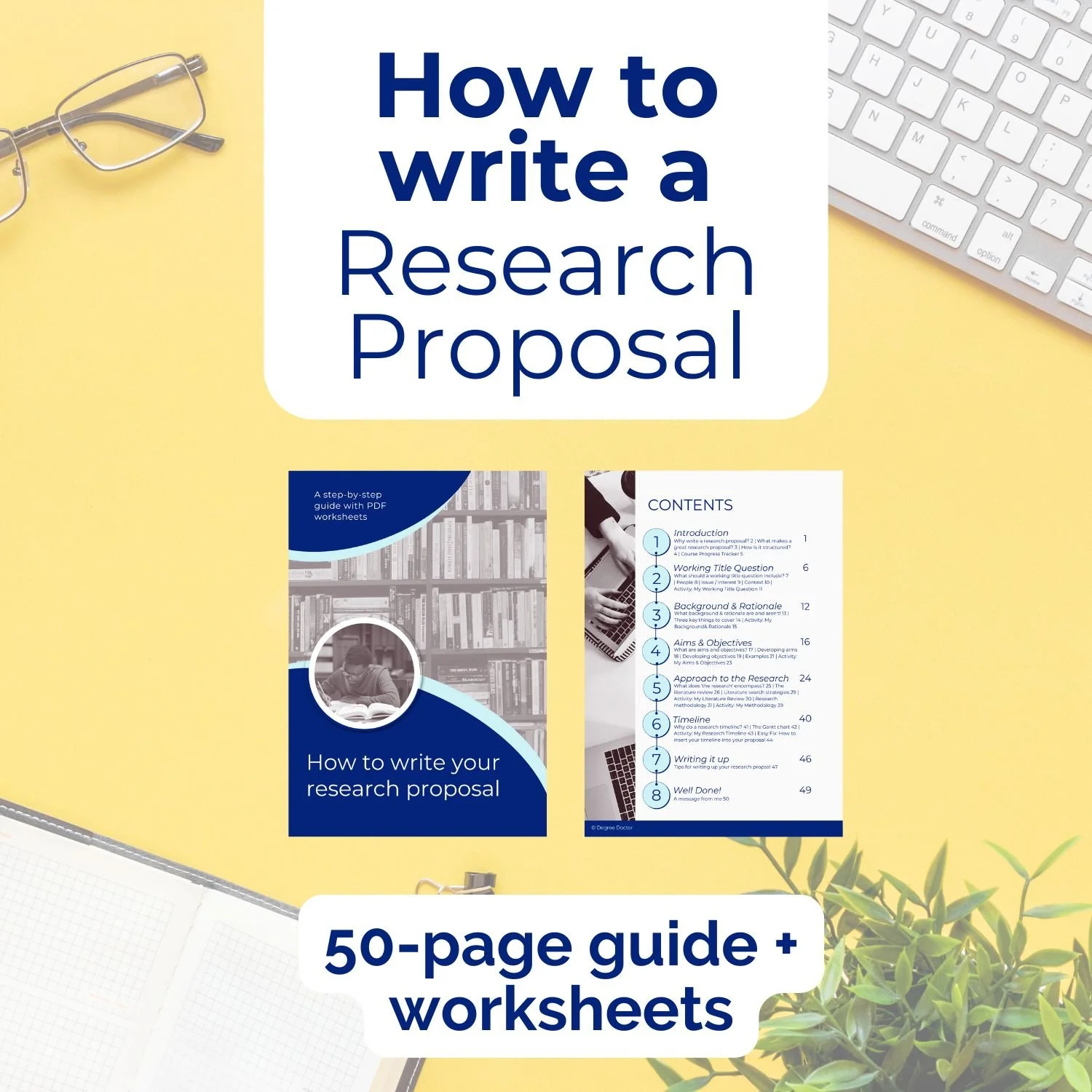
Turn your research idea into a clear, compelling PhD proposal without an anxiety spiral!
Blank page. Blinking cursor. Chaos in your brain.
And a deadline you really don’t want to miss.
Writing a PhD proposal can feel like a high-stakes mystery exam, especially when no one tells you what the “right” structure looks like, how much detail to include, or how to make your ideas sound credible (without waffling for 12 pages).
But this doesn’t have to be stressful.
There is a process. And you don’t have to figure it out on your own.
By purchasing this product, you agree to our Terms & Conditions.