As you’re writing your discussion chapter, maybe you’re wondering why your study appears to have become more complicated rather than less as you’ve got further into it. Perhaps you’re thinking, “What if I’ve done all these years of work and I still can’t put my finger on exactly what my argument is?”
At the beginning of the doctorate, the PhD seems manageable. You identify the problem, review the literature, collect the data, analyse it, and eventually write it up. At least in theory - if you’re reading this, you know that’s not the reality!
Then somewhere around the dissertation discussion chapter, you feel as though the whole thing has become harder to explain rather than easier. Like you’ve found yourself wading through really thick mud all of a sudden and you’re like, “Wait, what?!”
Over the last twenty years supporting qualitative PhD researchers, I have seen many people expect that the more they learn, the more certain they’ll become. Sorry - that’s just not our jam in the world of qualitative research!
I was thinking about this recently while my husband and I were in Jersey in the UK Channel Islands.
Jersey looks wonderfully manageable on Google Maps. It is only about nine miles by five. Not that many roads, nothing particularly intimidating.
Then you actually get behind the wheel of the hire car and start following Google Maps instructions. Very quickly, you realise the island is much more intricate than it first appears.
Particularly when Google decides to send you down the Green Lanes.
If you have never encountered a Jersey Green Lane, they are tiny winding roads where you cannot exceed 15mph and pedestrians, cyclists, and horses all have priority. Despite the reassuring name, they are less “lanes” and more: “hedges very politely attempting to hug your car from both sides.”
Now, was this the fastest route to St Catherine’s Bay?
Absolutely not.
But while creeping cautiously along these tiny roads, we saw a beautiful herd of Jersey cows, an extremely self-satisfied cat sitting on a stone wall, and a pheasant who genuinely appeared to be escorting us towards the beach like: “It’s okay guys, this way, keep up!”
When we ended up in Fliquet Bay, having intended to go to St Catherine’s Breakwater - where you can literally see where you need to be but the road to get there is kind of a detour - I remember thinking: This is actually a lot like writing a discussion chapter.
At the beginning of a doctorate, you are mostly looking at the project from the outside. You can still hold the overall idea fairly neatly in your head.
Then gradually you start noticing far more complexity than you could initially see - nuance, contradictions, context, exceptions, alternative interpretations, theories that partly fit - but not entirely, findings that become more interesting the longer you sit with them.
This is often the point where researchers become anxious because they mistake complexity for confusion. They think: “Surely I should understand this more clearly by now?”
In qualitative research, deeper understanding tends to make the phenomenon look less tidy rather than more. You are no longer standing outside the project looking at a simplified map. You are inside it now, navigating it, seeing details you could not previously see.
That is one of the reasons the qualitative research discussion chapter often feels so difficult.
It asks you to do something fundamentally different from earlier chapters. You are no longer simply presenting findings or summarising literature - you are expected to interpret, synthesise, evaluate, and explain what the research collectively means.
For many researchers, the dissertation discussion chapter becomes the point where confidence dips most sharply because the intellectual task suddenly changes.
Earlier stages of the PhD often feel more procedural. You can identify clearer tasks and clearer outputs - read this paper, conduct that interview, code this transcript.
The discussion chapter is different. Now you are trying to decide what matters most, which patterns are genuinely significant, how theory helps explain the findings, where tensions and contradictions remain, and what contribution emerges from bringing all these pieces together.
That level of interpretation can feel really jarring because there is no formula that tells you precisely how to think your way through it.
Many qualitative researchers think strong analysis should feel certain. In practice, it often involves learning to tolerate complexity long enough to interpret it carefully.
This is one of the biggest things that change between early-stage and later-stage doctoral thinking.
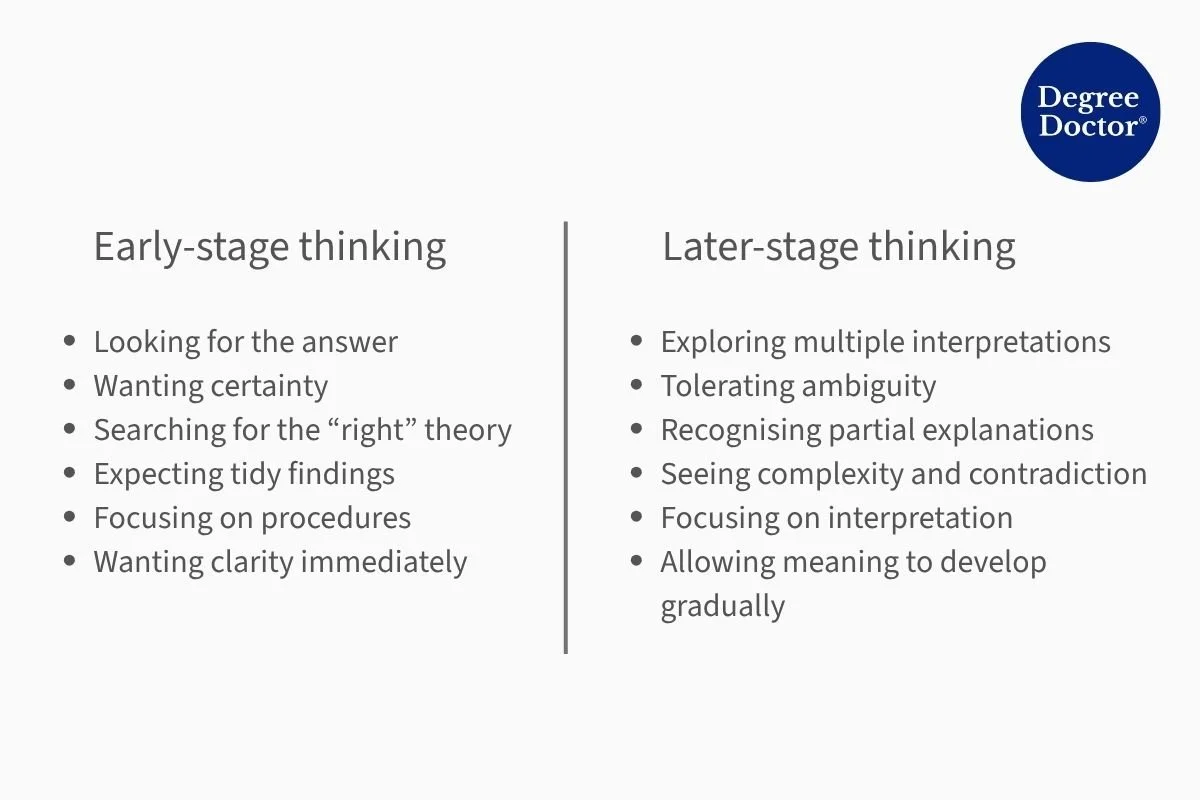
Early in the PhD, many researchers search for the answer, the correct method, or the cleanest explanation. Later on, researchers often begin recognising that good qualitative research usually involves tension, ambiguity, context, and partial explanations rather than neat certainty.
At some point you realise there may not be one perfectly tidy way to explain everything your data is doing - this is usually a sign you are engaging with the material properly.
Over time, experienced qualitative researchers become more comfortable sitting with ambiguity for longer. They stop trying to eliminate complexity immediately and start asking more useful questions instead:
What seems important here?
What keeps recurring?
What tensions remain unresolved?
What does this suggest about the phenomenon I’m studying?
That does not mean “anything goes.” Rigorous qualitative research still requires coherence, careful reasoning, transparency, and defensible interpretation.
But it does mean recognising that complexity is not automatically evidence something has gone wrong. Sometimes complexity is evidence that you are finally seeing the landscape properly - in all it’s messy, contradictory, foggy glory.
Much like a Jersey roadmap, the closer you get, the more intricate it becomes.
If your discussion chapter currently feels messier than it did six months ago, try not to panic. That is often part of the transition from collecting information to developing interpretation, and those are very different intellectual tasks.
The Green Lanes may take you longer, they may occasionally make you question your life choices, but they also show you things you would otherwise have missed entirely.
Want more help with your discussion chapter?
📥 DOWNLOAD MY FREE MINI GUIDE: “What they don’t tell you about the discussion chapter”
Writing your discussion chapter involves a lot more than getting words on the page. There are a few things going on underneath the writing that aren’t always explained very well - and not knowing about them can make the whole thing much harder than it needs to be. I’ve explained four of them in my free mini guide.
→ Get the free Discussion Chapter Mini Guide
🧑💻 GO DEEPER: Turn your findings into a strong discussion chapter
If you're still wondering, “But how do I know if what I'm saying is actually good enough?”, my Discussion & Writing Up PhD Survival Guide takes you further - helping you turn your findings into clear arguments and explain what your research means.