Writing a PhD research proposal? Use these three sentences to make it clear and persuasive
The research proposals that get accepted onto PhD programmes all share one quality.
Clarity.
From the first page, it is obvious what the applicant wants to do, why it matters, how they will do it, and why that approach makes sense. There is no decoding required. No hunting for the point.
As someone who has read a lot of research proposals, I can tell you this: the strongest ones are not necessarily the most complicated. They are the ones where the logic is clean and easy to follow.
If you are currently drafting yours and it feels vague, sprawling, or slightly “all over the place,” you probably do not need more reading.
You need sharper sentences.
Here are three that will transform your proposal.
1. The gap sentence
Despite existing research on X, there remains…
This belongs in your background or literature review section. It is where you stop hinting at the gap and state it directly.
Reviewers are not just looking for an interesting topic. They are asking:
Is this needed?
Does it extend the field?
Is there a clear space for this project?
Many weak proposals circle around the gap without naming it. Strong proposals make it explicit.
You might write:
“Despite existing research on [topic], there remains a lack of understanding about [specific gap].”
Or:
“While several studies have examined [area], limited attention has been paid to [your specific focus].”
Notice what makes this work. It is specific. It narrows the lens. It makes the absence visible.
If a reviewer has to infer the gap, you have made their job harder. And busy reviewers rarely reward that.
2. The aim sentence
This project aims to…
This sentence usually belongs in your introduction, and it should not be buried.
It tells the reader exactly what you are doing. Not what you are interested in. Not what you might explore. What you will do.
A strong aim sentence often follows this structure:
“This project aims to [do what] by [how] in order to [why].”
For example:
“This project aims to explore how early-career professionals experience organisational onboarding by conducting in-depth interviews across three UK organisations.”
Clear. Bounded. Defensible.
If a reviewer finishes your introduction and still cannot articulate your research aim in one sentence, your proposal needs tightening.
3. The contribution sentence
This research will contribute to…
This is the moment you answer the question every reviewer is quietly asking:
So what?
Your contribution does not need to be grand or revolutionary. It needs to be plausible and specific.
You might write:
“This research will contribute to [field] by providing new insight into [issue].”
Or:
“The findings are expected to inform [policy, practice, or theory] in [area].”
This sentence shows that your project does not exist in isolation. It joins a conversation. It moves something forward.
Without this, your proposal risks sounding like an interesting exercise rather than a necessary piece of scholarship.
Why these three sentences matter
Most proposal anxiety comes from vagueness.
You know what you are thinking about, but it has not yet crystallised into something defensible. So the writing becomes padded. Over-explained in places. Under-defined in others.
These three sentences force precision.
They make you articulate:
What is missing.
What you will do.
Why it matters.
Once those are clear, the rest of the proposal becomes easier to structure.
Clarity beats cleverness. Every time.
You do not need complicated phrasing. You need clean logic.
If your proposal still feels messy
If you are struggling with how much literature to include, how detailed your methods need to be, or how to demonstrate feasibility without overselling yourself, that is completely normal.
Writing a research proposal is not just about having a good idea. It is about presenting that idea in a way that feels coherent, realistic and academically grounded.
My Research Proposal Guide walks you step by step through:
Structuring each section clearly
Framing your methodology convincingly
Demonstrating feasibility and project management
Avoiding the most common proposal mistakes
If you want your proposal to feel tight, logical and persuasive rather than sprawling and uncertain, you can explore the guide here.
Because when your logic is clear, reviewers relax.
And relaxed reviewers are far more likely to say yes.
Learn more here: Research proposal guide
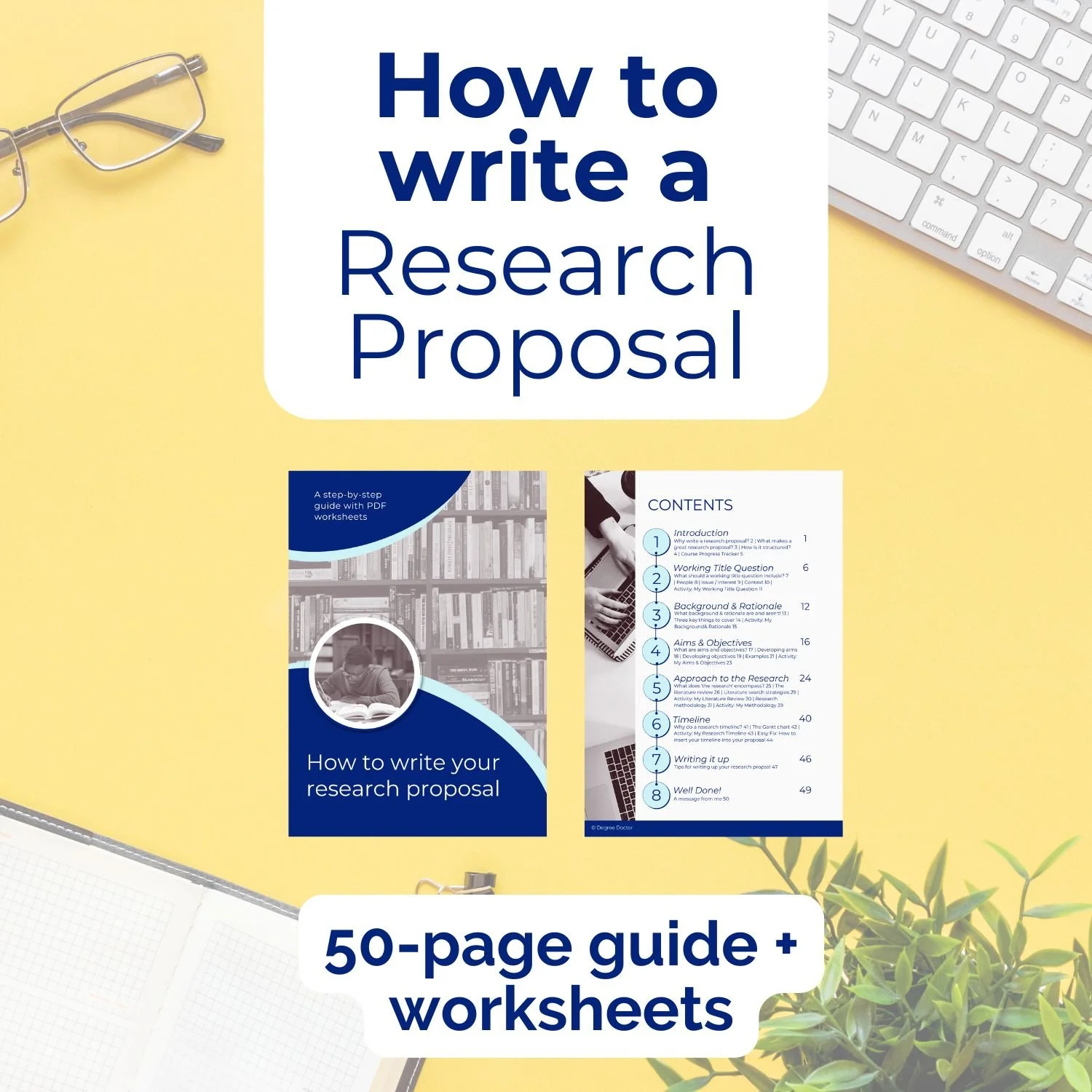
Turn your research idea into a clear, compelling PhD proposal without an anxiety spiral!
Blank page. Blinking cursor. Chaos in your brain.
And a deadline you really don’t want to miss.
Writing a PhD proposal can feel like a high-stakes mystery exam, especially when no one tells you what the “right” structure looks like, how much detail to include, or how to make your ideas sound credible (without waffling for 12 pages).
But this doesn’t have to be stressful.
There is a process. And you don’t have to figure it out on your own.
By purchasing this product, you agree to our Terms & Conditions.