Years ago, during my own PhD, a fellow qualitative doctoral researcher and I were doing what many underfunded PhD students become strangely skilled at: locating leftover lunch buffets after university events.
On this particular day, we had found a tray of untouched sandwiches in a business school meeting room and were congratulating ourselves on having solved lunch, and possibly tomorrow’s lunch too.
She was a little further ahead than me and in the middle of qualitative data collection. Halfway through a sandwich, she said something I have never forgotten.
“We talk about participants so abstractly when we’re learning methods. But I’m out there now, sitting with people, hearing very personal things. They’re people. Real people. I can see the whites of their eyes. It all feels so much more real than I expected.”
Then she added:
“I feel so out of my depth sometimes. I sit down afterwards and I’m supposed to just code it.”
She was describing something many qualitative researchers experience but rarely say aloud: the moment research stops being procedural and starts feeling deeply human.
With that often comes doubt.
Qualitative research is meant to be complex.
That does not stop it triggering waves of self-doubt, imposter feelings, and the heavy responsibility of deciding what to do with other people’s words and stories.
One moment you are reading your transcripts thinking:
“This is rich, layered, interesting.”
The next, your mind is spiralling.
“None of them said the same thing.”
“What if I misinterpret this?”
“This is a mess.”
“I don’t know how to write this up.”
“Now I feel bad for being critical of this.”
If that feels familiar, welcome to the reality of interpretive research.
Let’s look at four common qualitative research struggles and what is usually happening underneath them.
(1) “Everyone said something different. How am I supposed to analyse this?”
This is often the first major panic point.
You expected overlap, repetition, perhaps even tidy agreement.
Instead, you have nuance, contradictions, and complexity.
It can feel as though you have nothing stable to build themes around.
Qualitative research is not about forcing consensus, it is about identifying patterns within variation.
Patterns do not mean everyone agrees. They mean certain ideas, tensions, experiences, or processes recur across cases in meaningful ways.
You may notice similar emotions attached to very different events, shared struggles expressed through different language, common structures beneath diverse stories.
Difference is not noise - it is data.
Your task is not to flatten it, but to interpret it carefully.
(2) “What if I interpret my participants wrongly?”
This fear often appears when you care deeply about the people you interviewed. Most thoughtful researchers do.
As my PhD colleague said all those years ago, we can see the whites of their eyes. These are real people sharing personal details with us. That carries responsibility.
You do not want to distort their words or misrepresent their experiences. That ethical concern is healthy.
What matters here is remembering that qualitative research is interpretive by design.
You are not uncovering a hidden, objective truth buried inside transcripts. You are engaging in a meaning-making process.
Your analysis is a theoretically informed, reflexive interpretation grounded in the data.
Rigour comes from transparency. When you explain your analytical steps, justify theme development, and show clear links between quotations and claims, you are not making things up.
You are doing qualitative analysis properly.
(3) “I feel guilty leaving quotes out.”
There is often a moment during writing up when you realise you cannot include everything.
You have powerful excerpts, thoughtful tangents, and stories that shaped your thinking far more than a chapter can hold.
But space is limited, and chapters need structure.
It can feel as though leaving a quote out means excluding that participant from the study altogether.
It does not.
If someone’s account shaped your interpretation, influenced your coding, or helped refine a theme, they are already present in your analysis.
Quotes are illustrative. They are not the whole contribution.
You are not required to reproduce the dataset. You are required to present a coherent analytical argument.
That involves selection. When done thoughtfully, selection is scholarship, not misrepresentation.
(4) “My data feels like a total mess.”
Qualitative data often feels chaotic.
Participants circle back, contradict themselves, shift tone, move between personal and political, use metaphor, or change direction mid-sentence.
When you first sit with a large qualitative dataset, it can feel like standing at a busy junction with traffic coming at you from five directions at once.
The key shift is recognising that messiness is not the enemy of good analysis. It is often the raw material of it.
Human experience is layered, contradictory, emotionally uneven, and resistant to easy explanation. That is exactly why qualitative research matters.
Your task is not to remove complexity too quickly. It is to stay with it long enough for patterns and meanings to become clearer.
This is where systematic coding, memo-writing, reflexive notes, and iterative theme development become valuable.
They help you trace how your interpretation evolved.
When you document analytical decisions, you begin to transform mess into method.
The deeper pattern behind these struggles
All four of these worries share something in common:
You are looking for certainty inside a methodology built around interpretation.
Qualitative research does not offer the comfort of formulas, thresholds, or neat procedures.
Many researchers have had the fleeting thought that life might have been easier if they had chosen a more straightforward quantitative route.
That thought is more common than people admit. Yes, I had it too, frequently.
Qualitative research asks something different of us.
It demands judgement. It asks us to think carefully, justify decisions, and tolerate ambiguity.
That discomfort is not a sign you are getting it wrong.
It is often a sign you are working at doctoral level.
If you want more structure
If your qualitative project currently feels chaotic rather than interpretive, that is often a sign you are getting closer to something meaningful.
With this kind of research, things often become messier before they become clearer.
Not always comforting when you are the one living it.
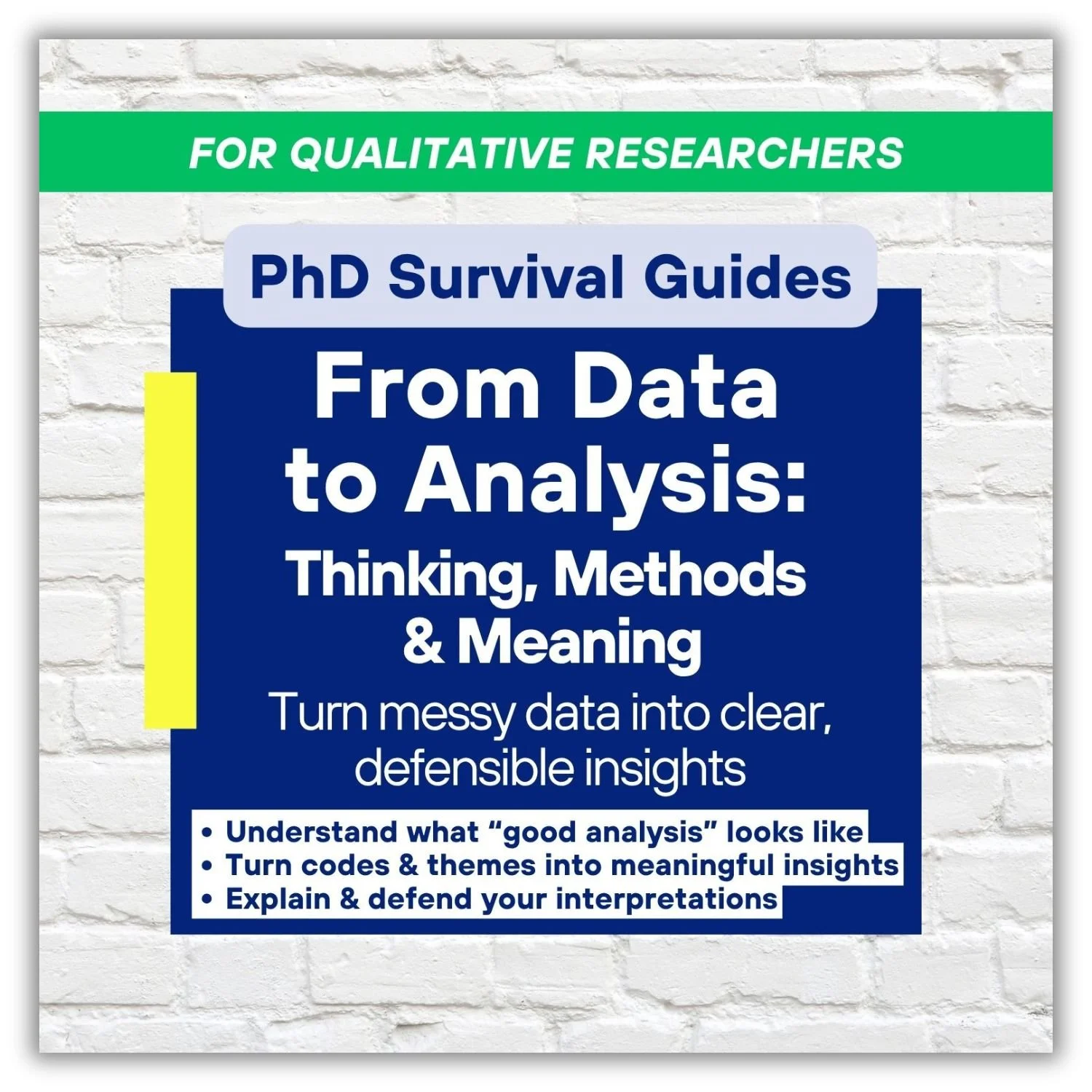
That is exactly why I created the Data to Analysis PhD Survival Guide.
It is built around the tools, explanations, and structures I developed through two decades of supporting doctoral researchers through the awkward middle stages of qualitative work.
I used the standard methodology textbooks too. Many explain research as though clarity comes first and uncertainty comes later. Real doctoral work is usually the other way round.
This guide offers a more grounded way of working while you are still in the middle of the mess.