How to write aims and objectives for a qualitative PhD study
Aims and objectives are often treated as a formality in the early stages of a PhD.
Something to “get down on paper” so you can move on to the more interesting parts of your research.
But in qualitative research, they tend to reveal something much deeper.
They show how clearly you understand what your study is actually about.
If your aims feel vague, or your objectives feel like a list of tasks, it is rarely a writing issue. More often, it reflects something slightly unsettled in the thinking underneath.
This is why many qualitative PhD researchers find this stage unexpectedly difficult.
Aims and objectives: more than a technical distinction
You will often hear that aims are the “big picture” and objectives are the “steps”.
That is true, but it doesn’t quite go far enough.
In a qualitative PhD, your aim is not simply a broad goal. It reflects how you are positioning your research conceptually. It signals what kind of understanding you are trying to develop, and how your work contributes to a wider conversation.
Your objectives, in turn, are not just tasks to complete. They are the way your thinking unfolds across the project. They show how you move from an initial area of interest towards a more developed interpretation.
Seen this way, aims and objectives are not separate from your research.
They are an early expression of it.
Developing a clear aim
A strong qualitative aim tends to feel focused, but not restrictive.
It creates direction without closing things down too early.
Very often, it centres on understanding, exploring, or interpreting a particular phenomenon, rather than measuring or testing it. For example, you might find yourself working towards an aim that seeks to explore how a group experiences a particular situation, or how meanings are constructed within a specific context.
What matters here is not the wording alone, but the clarity behind it.
A useful way of approaching this is to ask yourself:
What is this study really trying to understand?
If that question feels difficult to answer, it is worth pausing here. Because until that becomes clearer, your aim will tend to remain slightly unfocused.
Objectives as a way of structuring your thinking
Once your aim is in place, your objectives begin to take shape.
And this is where many researchers slip into writing what looks like a plan of chapters.
That is not quite what objectives are for.
In qualitative research, objectives are better understood as a sequence of analytical moves. They show how you will build understanding over time, rather than simply what you will “do”.
One way to think about this is in layers.
Early objectives often focus on clarification - working with literature, concepts, or context to establish what the study is engaging with.
As the research develops, objectives move into deeper engagement - analysing data, exploring patterns, or interpreting meaning.
Towards the later stages, objectives often begin to pull things together, asking what all of this adds up to, and what the study contributes more broadly.
This progression is not rigid, but it does create a sense of coherence. It shows that your research is developing, rather than simply accumulating tasks.
Why this stage often feels difficult
If you are finding this harder than expected, it is worth recognising why.
Writing aims and objectives requires you to make decisions about your research before everything feels fully formed. You are trying to articulate clarity while still in the process of developing it.
For qualitative researchers in particular, this can feel slightly uncomfortable.
Understanding tends to develop through cycles of reading, reflection, and interpretation. It is not unusual to revisit your aims and objectives as your thinking deepens.
That is part of the process - not a sign that something has gone wrong.
The importance of specificity
There is, however, one area where clarity really does matter from the outset.
Your objectives need to be specific enough to show what is actually involved in your research.
Vague phrasing tends to obscure your thinking rather than communicate it.
For example, terms like explore, study, or look at are often too broad on their own. They need to be grounded in something more precise - what exactly is being explored, and how?
A helpful way to approach this is to push each objective slightly further than feels comfortable at first. Ask yourself what that objective actually involves in practice, and make that visible in your wording.
When aims and objectives start to work together
When your aims and objectives are aligned, something shifts.
Your research begins to feel more coherent.
You can see how different parts of the project connect. Your literature review starts to feel more purposeful. Your methodology begins to make more sense in relation to what you are trying to achieve.
This is often the point at which the introduction chapter becomes easier to write.
Not because you have found the “right” words, but because the thinking underneath them has become clearer.
Next steps
If you are struggling with aims and objectives, it is very rarely about phrasing alone.
It is usually about the conceptual foundations that sit beneath them—your paradigm, your key ideas, and how you are positioning your research.
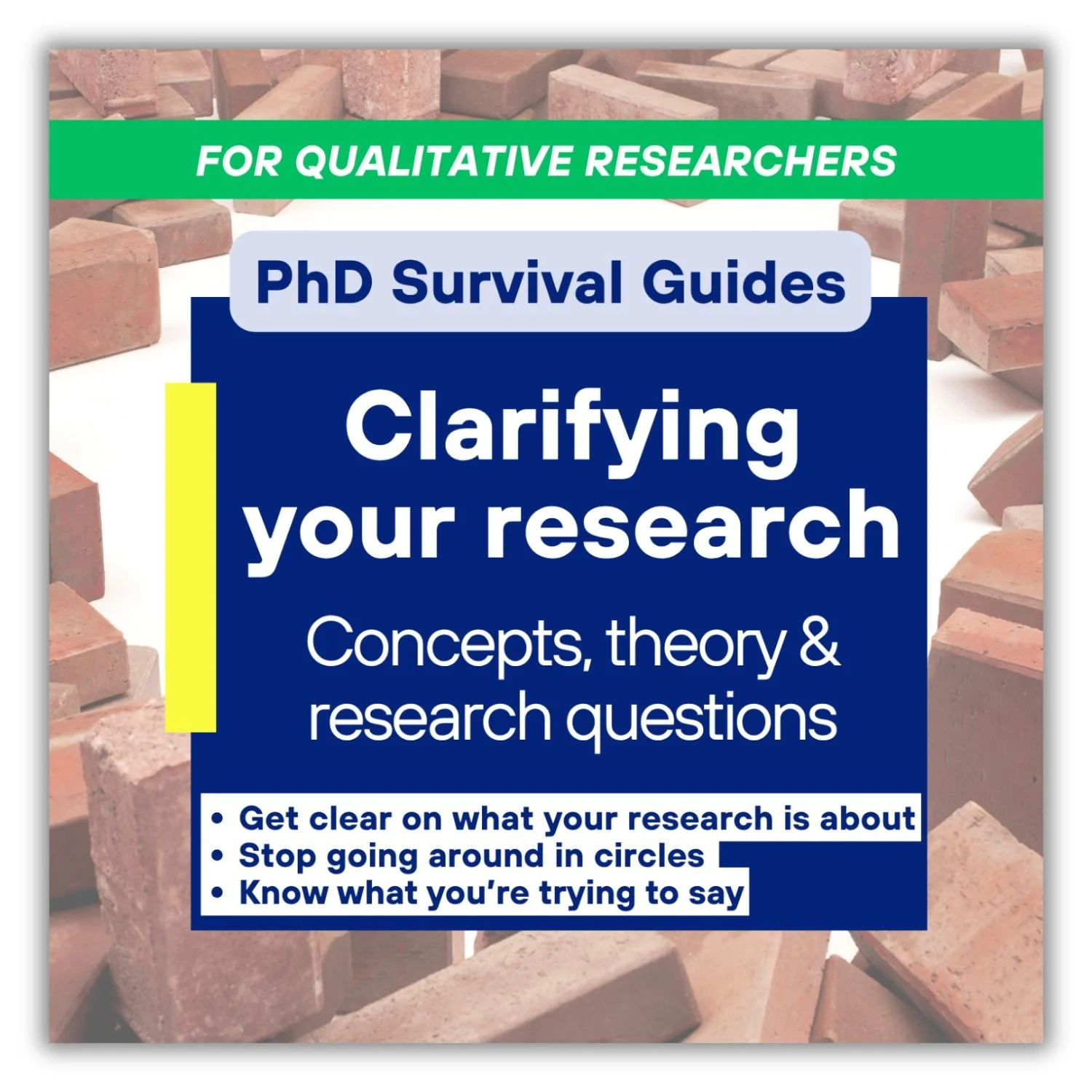
That is exactly what my Clarifying Your Research Guide is designed to help with.
It supports you in:
clarifying what your research is really about
strengthening your conceptual positioning
articulating your paradigm with confidence
developing a coherent introduction chapter
If you are still working things through, that is completely fine. This stage takes time. The clarity does come - but it develops gradually.