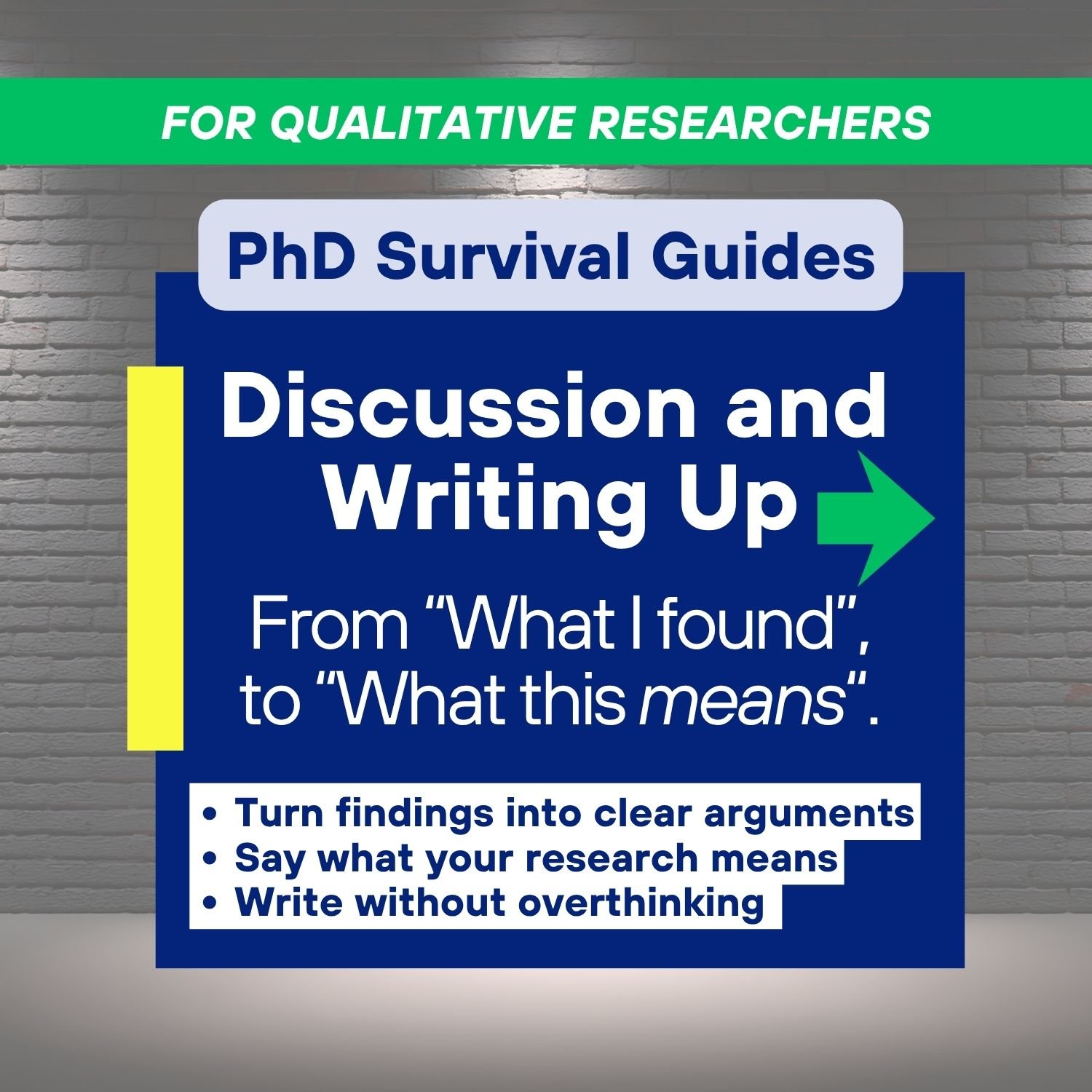
How to structure your qualitative PhD discussion chapter in three clear steps
The discussion chapter is often where confident PhD researchers start second-guessing themselves.
You have analysed your data.
You have written your findings.
And then comes the question:
What does all this actually mean?
The discussion chapter is where your thesis shifts from description to contribution. It is not about repeating findings or restating the literature. It is about positioning your work within the field and making your reasoning visible.
Structure is what makes that possible.
Here are three steps that bring clarity to the process.
Step one: reconnect with your foundations
Before drafting the discussion, return to your research aims and questions.
Not briefly. Properly.
Your discussion chapter should be anchored in the intellectual commitments you made at the start of the thesis. Ask yourself:
How have my findings addressed each research question?
Have any questions evolved in light of what emerged?
What assumptions did I begin with, and do they still hold?
For qualitative PhD researchers, this step is particularly important because research questions often deepen during analysis. Your discussion is where you show that evolution thoughtfully and transparently.
This stage prevents the most common problem in discussion chapters: thematic drift.
Without those anchors, it is easy to wander into interesting but unfocused commentary.
Your research questions are your structural spine.
Step two: build the chapter around key interpretive themes
The main body of a qualitative discussion chapter should be organised around three to five substantial interpretive themes.
These are not simply your findings headings repeated.
They are the higher-level insights that emerge once you step back from the data.
To identify them, ask:
What patterns cut across multiple findings?
Where did the data complicate existing explanations?
What surprised me?
Each theme should follow a clear internal logic:
State the core interpretive claim.
Revisit the relevant findings briefly (not in detail).
Position those findings in relation to existing theory and literature.
Articulate the contribution. What is extended, refined, or challenged?
For example, imagine a study exploring humour in online activism.
A discussion theme might not simply be “Humour in activism,” but something more interpretive, such as:
“Humour as relational resistance.”
You would:
Explain how participants used humour strategically.
Connect this to existing debates on digital activism and resistance.
Show where your findings extend or nuance those debates - perhaps by demonstrating that humour functions less as confrontation and more as community-building.
That final move, articulating how your findings reshape understanding, is the “so what?” of the discussion.
Contribution is rarely dramatic. It is often about refinement.
But it must be visible.
“The discussion is not where you prove you have done the work. It is where you show what the work means.”
Step three: address limitations and future directions with authority
The final section of your discussion chapter is not an apology.
It is an evaluation.
Strong qualitative PhD researchers demonstrate critical awareness of:
the boundaries of their sample
the contextual nature of their findings
methodological constraints
interpretive limits
The key is proportionality.
Avoid generic limitations (“more participants would have been better”). Instead, reflect meaningfully:
How might findings differ in another context?
Which dimensions of the issue remain underexplored?
What would a different methodological lens have illuminated?
Future research should emerge logically from what you discovered - not as a list of unrelated possibilities.
This section demonstrates intellectual maturity. It shows that you understand both the strength and the scope of your contribution.
Mess is a good sign
If your discussion chapter feels messy at first, that is not a problem.
It usually means you are thinking at the right level.
The discussion chapter is demanding because it requires synthesis, evaluation, and positioning simultaneously.
But once you anchor it in your research questions, clear interpretive themes, and an explicit contribution, it becomes far more manageable.
The discussion is not where you prove you have done the work.
It is where you show what the work means.
If you want structured support
If you are writing up your qualitative PhD and want step-by-step guidance on:
structuring the discussion chapter
articulating contribution without overclaiming
integrating theory without repetition
writing with authority rather than hesitation
my Discussion & Writing Up PhD Survival Guide provides calm, structured support designed specifically for this stage of the doctorate.
Because the discussion chapter is not about sounding impressive.
It is about making your reasoning clear.