Is qualitative research less rigorous? Debunking the myth in your PhD
You’re deep into your qualitative PhD and find yourself thinking:
Have I got enough interviews?
Can I really say “most participants felt…”?
Is this biased?
Should I be adding statistics just to make it look more legitimate?
If you’ve had those thoughts, that is not a sign you’re doing anything wrong. You’ve simply absorbed a long-standing (and incredibly annoying) academic narrative that tends to rank methods in a hierarchy. Let’s dismantle that today.
Where the doubt actually comes from
Most qualitative researchers don’t wake up thinking their method is inferior. The doubt creeps in later. Often in supervision meetings, reviewer comments, and conversations where words like robust, objective and measurable get used as if they only belong to one methodological camp.
The underlying message sounds something like this: numbers equal science, and science equals rigour.
However, that only makes sense if we assume all research is trying to do the same thing.
It isn’t.
Different questions demand different kinds of rigour
Quantitative research is built for questions about measurement, prediction and relationships between variables. It asks how many, how much, whether X predicts Y, and whether findings generalise.
Qualitative research asks something else entirely. It asks how people experience something. What it means to them. How social processes unfold. How power operates in everyday interactions. How identities are constructed and negotiated.
Those are not lesser questions. They are different questions.
Different questions require different standards of quality.
If you are studying grief, belonging, inequality, identity or stigma, the goal is not measurement. It is understanding. That requires depth, nuance and contextual sensitivity.
That is not softness, fluffiness or “less than”. It is complexity.
The myth that numbers equal legitimacy
Many qualitative PhD students worry that without statistics their work looks less serious. That if they cannot report percentages or p-values, they are somehow operating at a lower level of scholarship.
Numbers are not inherently more rigorous. They are simply tools suited to certain types of inquiry.
Rigour is not about the presence of statistics. It is about the coherence between your research question, your methodology and your claims.
If you are making sweeping generalisations from thin data, that is weak, whether your study is qualitative or quantitative.
If you are making carefully bounded, well-evidenced claims grounded transparently in rich data, that is rigorous.
Objectivity is not the only route to quality
Another source of anxiety is the idea that qualitative research is “biased” because the researcher is involved.
Quantitative traditions often aim for distance and objectivity. That makes sense when you are measuring variables and testing hypotheses.
Qualitative research, particularly within interpretivist or constructivist paradigms, starts from a different assumption: that the researcher is part of the knowledge-production process.
Your background shapes what you notice. Your theoretical lens shapes what you find meaningful. Your position shapes how participants respond to you.
Acknowledging this does not weaken your research - it strengthens it.
Reflexivity is a form of rigour. It is the discipline of examining how your presence influences the research process and being transparent about that influence.
As a qualitative researcher, pretending you are absent from the process would be less honest.
What rigour actually looks like in qualitative research
If you judge qualitative research by quantitative standards, it will always look deficient. That is a category error.
Qualitative rigour is about:
Depth rather than breadth.
Transparency rather than detachment.
Coherence rather than control.
It involves clearly articulated methodology. Thoughtful sampling decisions. Systematic analysis. Explicit links between data and interpretation. Reflexive engagement with your own assumptions.
It does not require large samples. It does not aim for statistical generalisability. It does not chase significance levels.
Instead, it seeks credibility, trustworthiness and analytical insight.
When you can show how you moved from raw data to interpretation, when your claims are grounded in participant accounts, and when your reasoning is visible to the reader, you are demonstrating rigour.
Why this matters for your PhD
If you are constantly measuring your qualitative study against quantitative benchmarks, you will always feel slightly defensive.
You might over-explain, over-justify, and even be tempted to insert numbers where they do not belong. That defensiveness drains cognitive energy you could be using to deepen your analysis.
Your task is not to make qualitative research look like quantitative research. Your task is to do qualitative research well.
That means being clear about your epistemological position. Being transparent about your methods. Being thoughtful in your interpretation. And being precise in your claims.
When you do that, you are not doing “less rigorous” work.
You are doing rigorous work of a different kind.
Coherence is key
If you sometimes feel like you need to defend your methodology, that does not mean you chose the wrong approach, it simply means you are aware of the politics of knowledge within academia.
That awareness is part of doctoral-level thinking. You do not need to make your research look statistical to make it credible - you need to make it coherent.
If you would like grounded, practical support in strengthening your methodology chapter or clarifying how to articulate qualitative rigour confidently, my PhD Survival Guide on Methodology, Data Collection and Analysis walks you through building qualitative methodological coherence and analytical clarity. It was written specifically for qualitative researchers.
Because qualitative research is not the “softer” option - it is the one that takes human complexity seriously.
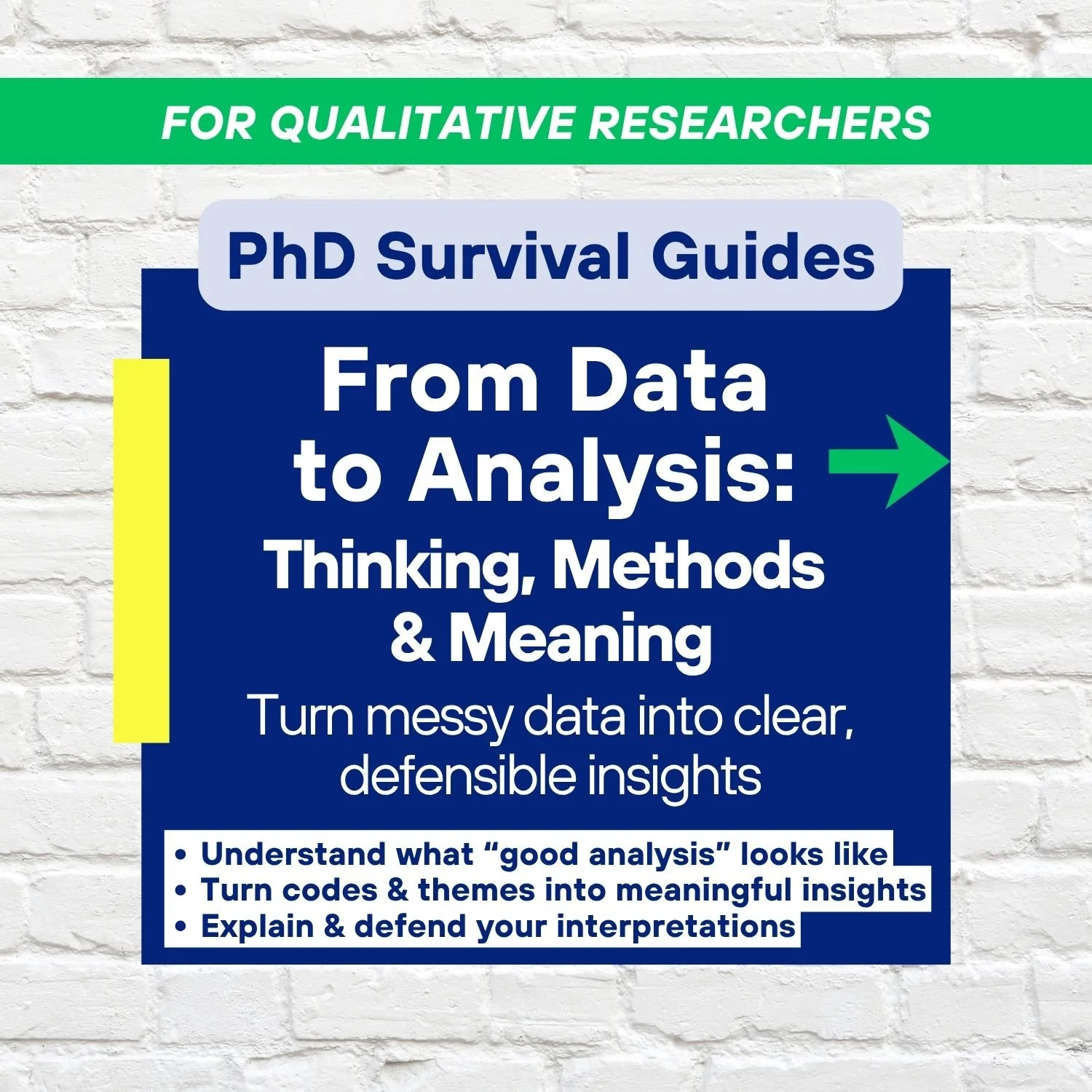
“I can describe what I did. I just don’t know if I trust my own judgement.”
This is the point in the PhD where your research starts demanding something different: interpretation, judgement, coherence, and confidence in your reasoning. This guide was written for that stage.
Swipe through the images above to see what’s inside.
Get the full Survival Guide set here.
If you have any questions, feel free to contact me. I’ll be happy to help.
By purchasing this product, you agree to our Terms & Conditions.