Critical analysis in a qualitative PhD: how to develop doctoral-level critique across your thesis
If you’re doing a PhD, you’ve almost certainly seen some version of this in your feedback:
“This needs to be more critical.”
“This is still quite descriptive.”
It’s often written in tracked changes comments, or said in passing in a supervision meeting, as though it should be immediately obvious what needs to happen next. For many researchers, it isn’t obvious at all.
I remember experiencing this as a PhD researcher myself in the early 2000s. I’d sit with my supervisor, who had read through the draft I had finally sent him after several weeks (sometimes months) of avoiding it, deleting whole sections, and adding them back in again. He would point to a section of my chapter and say, “I think we need a bit more criticality here.”
What do you think happened next? Do you think I said, “Thanks for that. Could we unpack that a little more? What do you mean by more critical? What would that look like on the page?” Of course I didn’t. I nodded and said, “Okay, I’ll go away and work on that.”
By that point in my academic career, as a first-generation student from a working-class background, the imposter feelings were strong enough without asking about something I felt I should already understand.
This is the experience of many PhD researchers. It’s not that supervisors are wrong to ask for more criticality, or even wrong not to expand on it in detail. It’s that “be more critical” compresses a whole set of intellectual skills into a single phrase, and then assumes you already know how to unpack it.
In this post, we’ll start to unpick what that actually means for your thesis.
Criticality is not one thing
Part of the problem is that “critical” is treated as if it describes a single skill. In practice, it refers to a cluster of things that don’t always look the same.
Sometimes it means making a judgement about how useful a piece of research is for your project.
At other times, it involves comparing authors and noticing where they agree, overlap, or diverge.
It can involve explaining why your methodological choices make sense.
It can also mean deciding what matters in your data, and why.
The phrase stays the same. The work underneath it shifts depending on where you are in the thesis.
This is why the feedback can feel frustrating. You are being asked to adjust something, but the instruction does not tell you which part of your thinking needs to move.
What’s actually missing when writing feels “descriptive”
When supervisors describe writing as “too descriptive”, they are usually noticing that your writing is doing one kind of work well - showing what exists - but not yet moving into the next layer of thinking.
“Smith (2020) argues that X.”
There’s nothing wrong with that sentence. It’s accurate.
However, it leaves a question hanging: what does that do for your research?
A more developed version might begin to answer that:
“Smith’s (2020) account of X helps explain A, but struggles to account for B, which becomes particularly relevant in this study.”
That shift changes the role of the literature. You are no longer just reporting what exists. You are starting to work with it.
Why it doesn’t feel straightforward
Many PhD researchers have been rewarded, for years, for careful description. Being accurate, fair, and thorough are all valued skills. At doctoral level, the expectation shifts.
You are still expected to understand the literature.
You are also expected to make decisions about it.
That involves a different kind of confidence. A willingness to say: this is useful here, this is limited in this way, this is how these ideas connect, and this is where my work sits in relation to them.
That shift often isn’t taught explicitly. It’s assumed.
A note on qualitative research (and why this can feel even harder)
If you’re working qualitatively, the “be more critical” feedback often carries an additional layer of uncertainty.
You’re not just working with established findings or clearly bounded variables. You’re working with meaning, interpretation, and accounts that are shaped by context - including your own role in producing them.
That can make criticality feel uncomfortable. There is often a concern about getting it “wrong” in a different way - not just misunderstanding the literature, but over-interpreting data, making claims that feel too subjective, or not sufficiently grounded.
At times, this can leave you feeling as though you are simply making it all up. You’re not.
There is a tension here that is rarely made explicit.
You are asked to be reflexive - to recognise your role in the research, your perspective, your influence.
At the same time, you are expected to make clear, reasoned judgements about what your data shows and how it relates to existing work.
It is not unusual for reflexivity to be interpreted as a reason to hold back. To soften claims, or present interpretations more tentatively than necessary.
Strong qualitative work does something more precise than that. It acknowledges perspective, but it still makes decisions.
Criticality, in this context, is not about claiming certainty. It is about showing how you arrived at your interpretation, why it is reasonable, and what it helps us understand.
That is a different kind of confidence, one that sits alongside reflexivity rather than being undermined by it.
Asking a better question in supervision
One of the most practical things you can do when you receive “be more critical” in feedback is to slow it down. Ask your supervisor:
What feels descriptive here?
Am I summarising without evaluating?
Am I not connecting studies together?
Am I not showing how this relates to my project?
In most cases, your supervisor will have a clear sense of what’s missing, but they may not have articulated it in detail yet.
This is less about intention and more about habit. Much in academia goes unsaid. Supervisors often assume you understand what they mean, while students assume they are expected to already know.
That gap is where frustration builds.
Asking the question you are hesitating over can save a significant amount of time.
It changes across the thesis
Criticality does not look the same in every chapter.
In the literature review, it appears in how you handle other people’s work - whether you compare, evaluate, and draw connections rather than moving through studies one at a time.
In the methodology chapter, it shows up in your reasoning. You are explaining not just what you did, but why those choices make sense for your research questions, and what they allow you to see (and not see).
In your findings, it begins to take the form of interpretation. You are deciding what is significant in the data, what patterns matter, and what feels unexpected.
In the discussion, it becomes more demanding again. You are bringing findings, literature, and theory into conversation, deciding what your study contributes, and where it sits within a wider field.
It is not surprising that this feels difficult when all of that is summarised as “be more critical”.
A more workable way to think about it
It can help to move away from the idea that criticality is something you either have or don’t have.
A more useful way of thinking about it is as a progression in how you handle material.
You begin by describing what is there.
You start to interpret what it means in your context.
You evaluate how useful or limited it is.
You connect it to other work.
You decide where your own research sits.
Most PhD writing contains all of these at different points. The difficulty is rarely the absence of ability, but the balance between them.
When writing feels flat, it is often because it is sitting too heavily in the first stage. Take a look at the Critical Ladder below and notice where your writing tends to settle - and where it might need to move next.
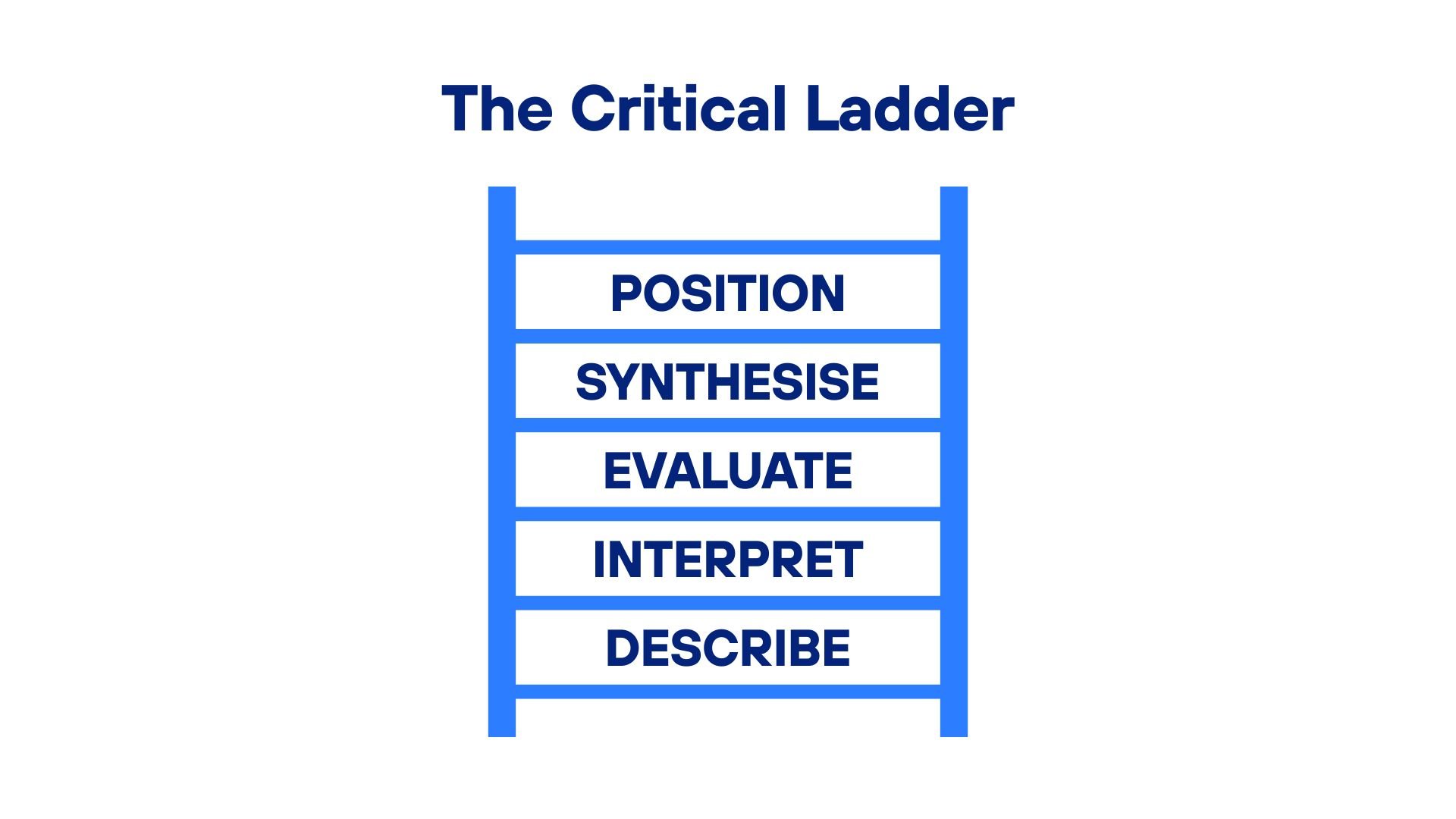
The PhD Criticality Ladder - 5 key rungs
Why the frustration is understandable
The irritation many PhD researchers feel around this feedback makes sense.
You are being asked to do something complex, across multiple chapters, often without a clear explanation of what that looks like in practice. It can feel as though others are working with a shared understanding that you have somehow missed.
In reality, this is a stage of the PhD where expectations become more implicit.
Once you start to see criticality as a set of moves rather than a fixed trait, it becomes something you can work on deliberately. It does not resolve overnight, and it does not need to.
What changes is that the feedback becomes more usable. You can hear it as pointing to a specific gap, rather than as a general judgement.
If you’re working towards writing up
This way of thinking becomes particularly important as you move into the later stages of the PhD, where your writing needs to carry more of your own reasoning.
Turning findings into arguments, connecting back to theory without repeating yourself, and articulating your contribution all depend on these same underlying skills.
If you find yourself recognising the problem but still unsure how to apply this across your own chapters, that is where more structured support can help.
My Discussion & Writing Up PhD Survival Guide is designed for this stage of the process. It focuses on helping you make these higher-level moves visible in your writing, so that your thesis reads as a coherent argument rather than a collection of well-written sections.
Because at this point, the work is about being more precise in how you think on the page — and that becomes easier once you can see what those moves look like in your own writing.
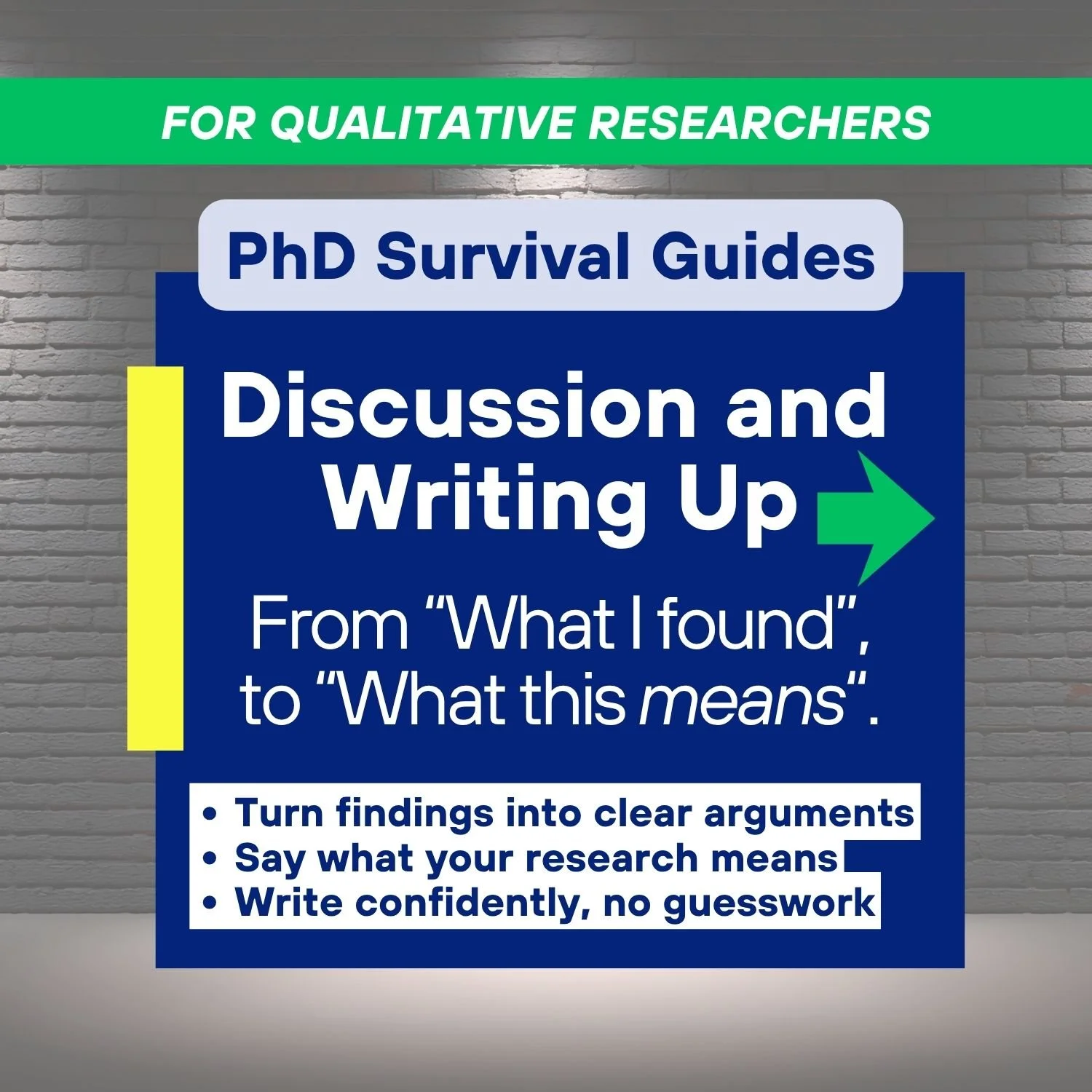
Move from “what I found” to “what this means” - without going round in circles.
This guide is for qualitative PhD researchers who have findings, themes, data, notes, and chapter drafts… but still feel unsure how to turn them into a clear discussion.
This is the stage where your PhD has to become more than a set of chapters, it has to become an argument. That’s exactly what this guide helps you work through.
Swipe through the images to explore the frameworks, worksheets, and guidance included.
Get the full Survival Guide set here.
Got questions? Contact me using this form, I’ll be happy to help.
By purchasing this product, you agree to our Terms and Conditions.