Critical analysis in a PhD - how to do critique properly, throughout your doctoral thesis
If you’re doing a PhD, there’s a good chance you’ve seen this feedback at least once:
“This needs to be more critical.”
Or maybe:
“This is still quite descriptive.”
And if your immediate reaction was What does that actually mean? - you’re not alone.
Critical analysis is one of the most common topics of feedback PhD students receive, and also one of the least clearly explained.
Many students assume being critical means being overly negative or tearing other researchers’ work apart. In reality, that’s not what critical thinking at PhD level is about at all.
Let’s break it down in a way that actually helps.
What does “critical analysis” really mean?
Being critical does not mean:
Being rude about other people’s research
Pointing out flaws for the sake of it
Sounding confident but unclear
Instead, critical analysis in a PhD thesis means making reasoned judgements about ideas, evidence, and choices - and explaining why those judgements make sense.
In practical terms, this means you’re not just showing that you’ve read something. You’re showing how it relates to your research, how useful it is, where its limits are, and how it connects to other work in the field.
Critical thinking is about thinking with the literature, not just reporting it.
Critical analysis is not a switch - it’s a ladder
One of the most helpful ways to understand critical analysis is this:
Criticality is not a switch you flip. It’s a ladder you climb.
Most PhD writing problems happen because people get stuck on the lower rungs - not because they’re incapable of higher-level thinking, but because no one ever explicitly teaches this stuff.
Here’s a simple version of the criticality ladder:
Describe. What does this say?
Interpret. What does it mean for my research?
Evaluate. How strong, useful, or limited is it, and why?
Synthesise. How does it connect with other work?
Position. Where do I stand, and what does my research contribute?
All five matter. Description is necessary, but description on its own is never enough at doctoral level.
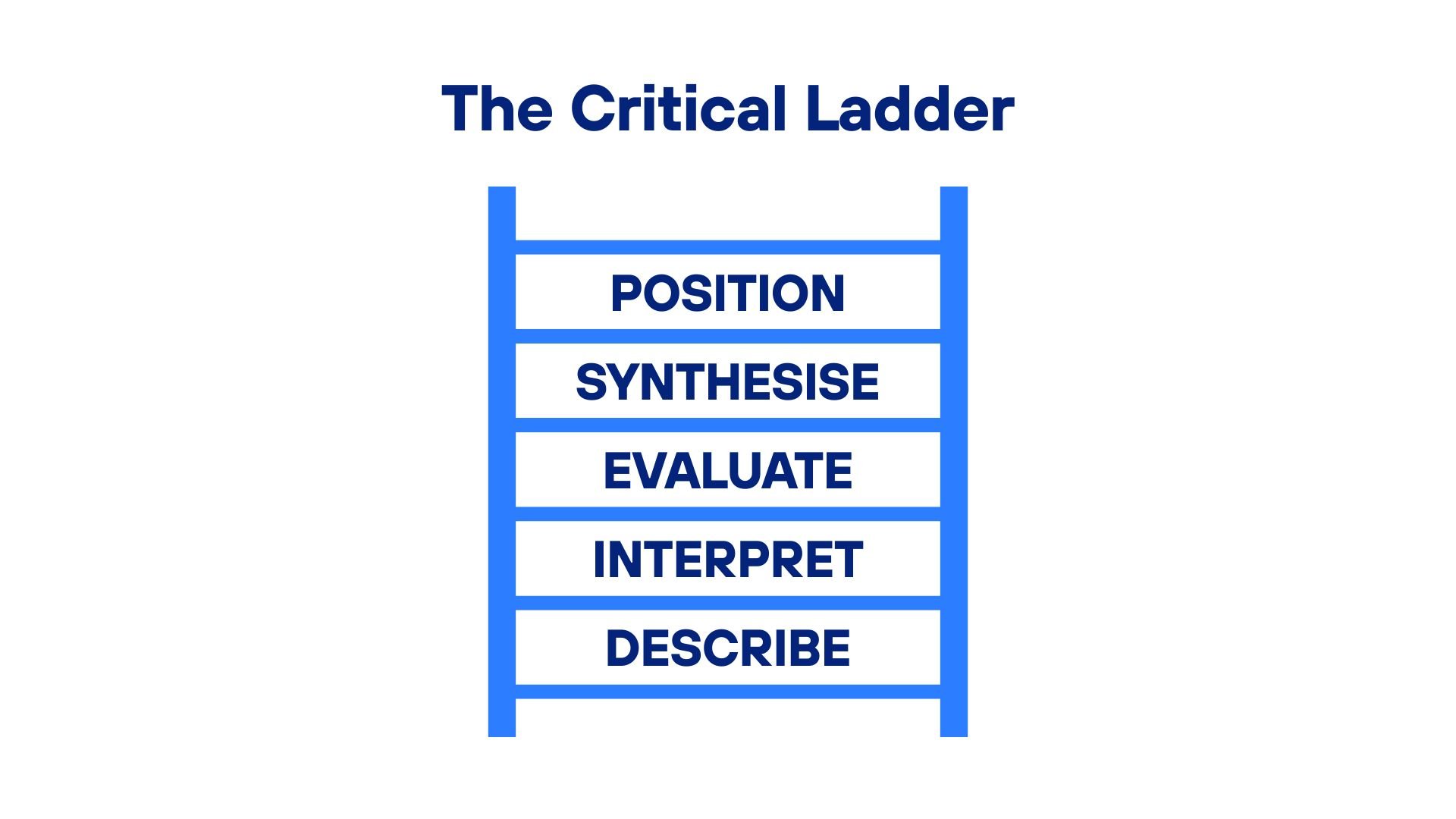
The PhD Criticality Ladder - 5 key rungs
Being critical across your PhD thesis (not just the literature review)
Many PhD students assume critical analysis only belongs in the literature review. In reality, it should run throughout your entire thesis.
Introduction
Critical thinking starts earlier than you might expect. In the introduction, you’re already making judgements about why the topic mattes, what the field currently focuses on, and where attention has been limited.
You’re not dissecting individual studies here - you’re evaluating the shape of the field and broader social context and positioning your research within it.
Literature Review
This is where students most often get stuck in descriptive writing.
Critical analysis here means comparing studies (not listing them), identifying patterns, debates, and gaps, and evaluating usefulness for your research.
If your literature review feels long but flat, it’s usually because it hasn’t climbed high enough up the ladder.
Methodology
Being critical in methodology is not about apologising.
It’s about justifying your choices, acknowledging limitations, explaining why this approach fits your research questions.
You’re showing that your decisions were thoughtful and reasoned, not perfect.
Findings and Discussion
In the findings chapter, criticality is often lighter - but interpretation still matters. You’re flagging what’s interesting, surprising, or important.
The discussion chapter is where everything comes together. This is where you interpret your findings, evaluate them in relation to the literature, synthesise ideas, and position your contribution.
This is why the discussion often feels hardest: you’re working across multiple rungs of the ladder at once.
You are not “bad at being critical”
Struggling with critical analysis does not mean you’re bad at research or not “PhD material”.
It means you’re learning how to write like a researcher.
And that takes time, practice, and clear guidance.
Once you start seeing critical analysis as a process you build, rather than a mysterious quality you either have or don’t, it becomes much more manageable.
Want to go deeper?
If you’ve realised while reading this that critical analysis isn’t about “being negative” but about positioning your work clearly and confidently - that’s exactly the kind of thinking your discussion chapter demands.
This is the stage of the PhD where you’re no longer just reporting what happened.
You’re interpreting. You’re synthesising. You’re deciding what your research contributes.
If you’d like structured guidance through that process, my Discussion and Writing Up PhD Survival Guide walks you step-by-step through:
turning findings into arguments
connecting back to the literature without panic
articulating your contribution clearly
writing with judgement, not apology
It’s there when you’re ready to move beyond description and into confident positioning.
You can explore it here.